

Leh: A widely respected veteran Ladakhi leader and key figure in the region’s identity and empowerment movement since late 1980s, Thupstan Chhewang has cast aspersions on the legitimacy and representative character of the current leadership as he calls for restrain and recalibration before resuming dialogue with New Delhi.
After weeks of uncertainty over his current thought process and future role, Chhewang said that he no longer sees the Apex Body Leh (ABL) functioning in the spirit in which it was originally conceived.
Reminding the Ladakhi people at a press conference here today that the Apex Body was formed after the abrogation of Article 370 as a broad-based, essentially apolitical platform to secure constitutional safeguards for Ladakh. According to him, however, the body gradually became vulnerable to “outside influence” and political agendas, leading to internal distortions in decision-making.
This is politically significant because Chhewang is not merely an ordinary member but one of the principal architects of the post-2019 Ladakhi political consensus. His criticism therefore amounts to a challenge to the legitimacy and credibility of the current leadership structure within the Apex Body. It also signals that the once-unified Ladakhi movement is now fractured not only ideologically, but institutionally.
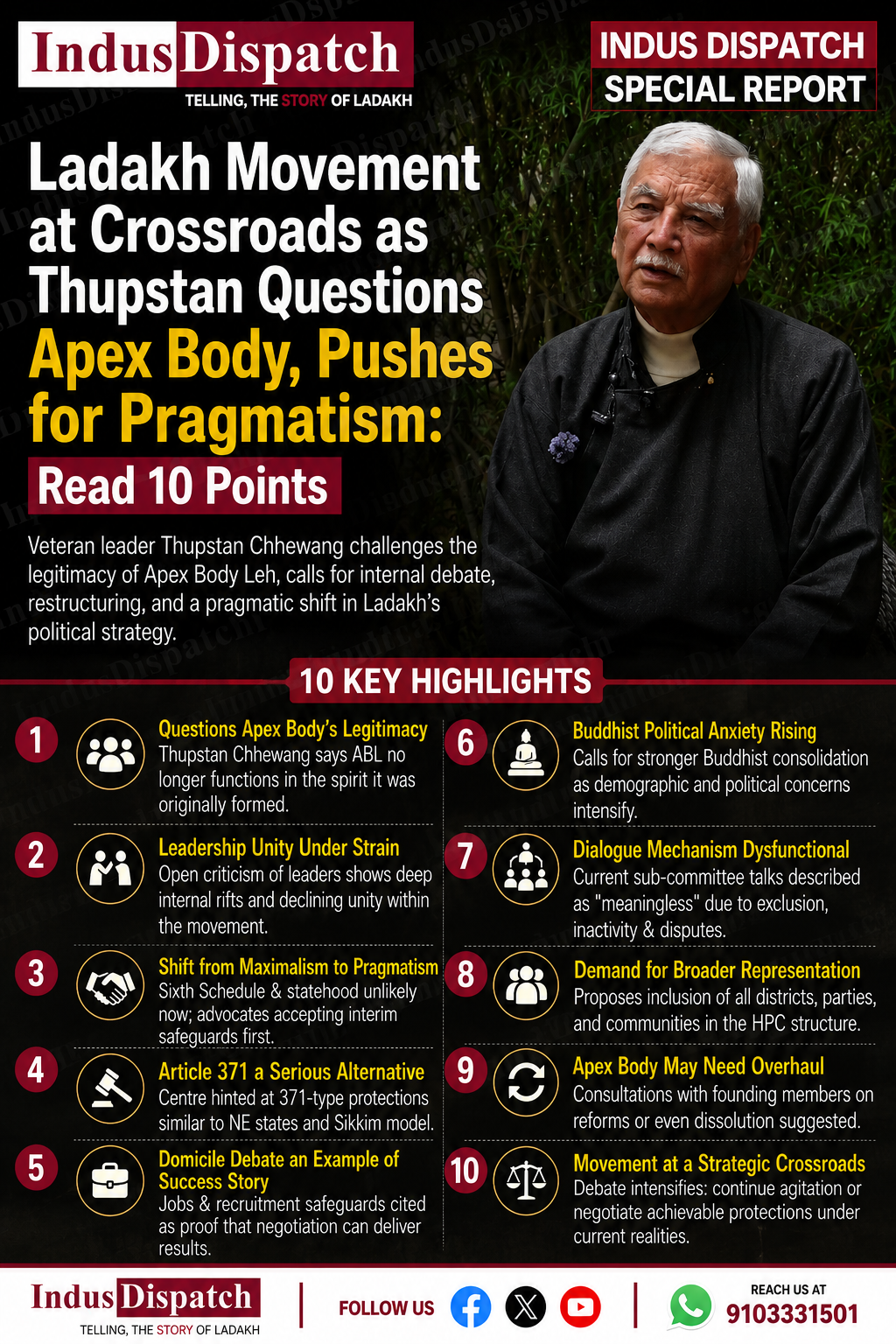
Here are key takeaways from Thupstan Chhewang’s press conference:
The press conference reflected deepening fault lines within Ladakh’s leadership. Chhewang openly questioned the authority of the Apex Body to “expel” him and accused certain actors of hijacking the movement. His sharp remarks directed at Sonam Wangchuk — including allegations regarding foreign funding and outside influence — indicate that personal mistrust has now entered the political discourse in a major way.
This fragmentation matters because the Ladakh movement since 2019 derived much of its strength from the rare unity between Leh and Kargil, Buddhists and Muslims, and political and civil society actors. Chhewang’s remarks suggest that this unity is under strain. The political battle is no longer only between Ladakh and New Delhi, but also among competing visions within Ladakh itself.
Advocating a Shift from Maximalism to Pragmatism
Perhaps the most consequential political takeaway is Chhewang’s open acknowledgement that Sixth Schedule status and statehood are unlikely to be granted under the present BJP-led government. This is a major departure from the dominant public posture maintained by sections of the Ladakhi leadership, which has continued to insist on the full set of demands without compromise.
Chhewang instead advocates a pragmatic, phased approach: accept interim constitutional safeguards now while continuing the long-term struggle for larger demands. This signals the emergence of a “negotiation school” within Ladakh politics, in contrast to the more uncompromising agitation-oriented line represented by others. His remarks indicate that some senior leaders may now be prioritising achievable protections over symbolic political positioning.
Article 371 could be a Serious Alternative Framework
Another important takeaway is the explicit discussion around Article 371-type protections and even a “Sikkim model” for Ladakh. Chhewang revealed that the Centre had hinted at safeguard provisions along lines already operational in several northeastern states.
This is politically important because it suggests that informal exploratory discussions between Ladakhi representatives and the Centre may already be more advanced than publicly acknowledged. Article 371-type arrangements could potentially address concerns related to land, jobs, culture and demographic protections without granting Sixth Schedule status or full statehood. Chhewang appears to be preparing public opinion for a compromise formula that may fall short of the original demands but still provide limited constitutional guarantees.
Domicile Debate, an example of Success Story
Chhewang repeatedly cited the domicile provisions and recruitment process as proof that negotiation and compromise can deliver practical outcomes. He argued that despite criticism from leaders such as Jora Rigzin and sections of the Congress, sustained engagement with the government eventually produced employment safeguards for local youth.
This is an effort to establish a political narrative: incremental gains are better than prolonged deadlock. By highlighting jobs and recruitment, he is appealing particularly to younger Ladakhis who are increasingly concerned about employment insecurity after the Union Territory transition. It also suggests that Chhewang wants future negotiations to be judged not by rhetoric, but by tangible administrative outcomes.
Buddhist Political Anxiety Is Becoming More Explicit
Although Chhewang repeatedly spoke of Ladakhi unity, much of his intervention also reflected growing anxiety within sections of the Buddhist community. He criticised the Ladakh Buddhist Association (LBA) and Ladakh Gonpa Association (LGA) for failing to place Buddhist concerns at the forefront, while praising Kargil-based organisations for defending community interests more assertively.
This indicates that identity-based political undercurrents are intensifying beneath the broader constitutional movement. The concern among sections in Leh appears to be that prolonged political uncertainty and demographic vulnerability could weaken Buddhist socio-political influence. Chhewang’s remarks therefore reveal a dual-track discourse: publicly advocating Ladakhi unity while simultaneously calling for stronger Buddhist political consolidation.
Existing Dialogue Mechanism with Delhi Appears Dysfunctional
Chhewang described the current sub-committee talks as “meaningless” under present conditions. His argument was that several key representatives are either excluded, inactive, or unable to participate because of internal disputes and legal complications. He questioned who would meaningfully represent Ladakh in future rounds of talks.
This reflects a wider crisis of representation. The High Powered Committee (HPC) process was originally projected as a structured institutional dialogue between Ladakh and the Centre. Chhewang’s remarks suggest that confidence in the mechanism is eroding from within. If influential senior leaders openly question the credibility of the process, the Centre may face increasing difficulty in presenting the dialogue as politically legitimate or inclusive.
Need for Reconstituted and More Representative Negotiating Structure
A major structural proposal emerging from the press conference was his demand to expand representation in future negotiations. He argued that all newly created districts, different political parties, and both Buddhist and Muslim communities should receive equitable representation in the High Powered Committee structure.
This is effectively a critique of concentration of influence within a limited leadership circle. Chhewang appears to believe that the current arrangement no longer reflects the political diversity of Ladakh. His proposal could significantly reshape future negotiations by broadening participation and diluting the dominance of any one faction or personality.
Possibility of Reorganising or Even Dissolving the Apex Body Has Been Openly Raised
One of the more dramatic statements was Chhewang’s indication that he may consult the five founding members of the Apex Body on whether reforms are required — or whether the body should be dissolved altogether.
This is a remarkable development because the Apex Body has functioned as the principal political umbrella organisation from Leh since 2019. Even raising the possibility of dissolution reflects the scale of internal distrust and organisational paralysis. If such a debate intensifies, Ladakh’s political landscape could enter a new phase marked by multiple competing platforms rather than a single unified movement.
The Movement Is at a Strategic Crossroads
Underlying the entire press conference was a broader strategic dilemma: whether Ladakh should continue with maximalist agitation politics or move toward negotiated accommodation with the Centre. Chhewang framed the issue bluntly — either intensify the struggle indefinitely or negotiate for whatever is realistically achievable under present political circumstances.
This may become the defining debate in Ladakh politics over the coming months. One camp appears willing to continue mobilisations around Sixth Schedule and statehood as non-negotiable demands. Another, represented increasingly by Chhewang’s line, seems inclined toward securing partial constitutional safeguards first and continuing the broader struggle later. The outcome of this debate could determine not only the future of the dialogue process with Delhi, but also the internal political alignment of Ladakh itself.
