

By Bharat Nanda
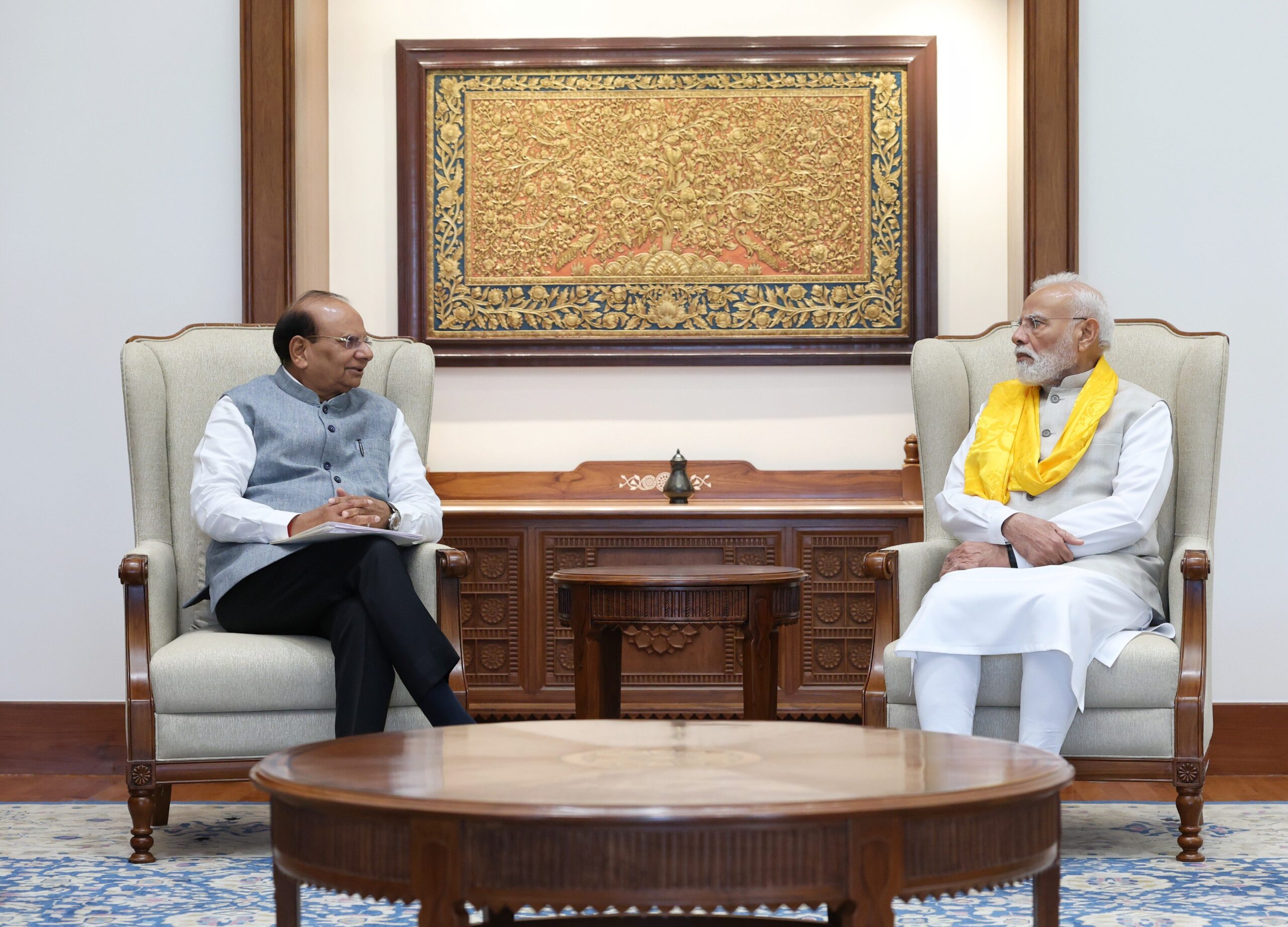
There are days when seemingly separate developments come together to tell a larger story. Thursday was one such day for Ladakh. In New Delhi, Lieutenant Governor Vinai Kumar Saxena met Prime Minister Narendra Modi and briefed him on the progress of key developmental initiatives, infrastructure projects and the implementation of Central welfare schemes in the Union Territory. Back in Ladakh, Chief Secretary Ashish Kundra placed before the people a wide-ranging account of measures concerning recruitment, land reforms, tourism, administrative decentralisation and the region’s evolving democratic architecture.
The timing was significant. At one end was Ladakh’s Lieutenant Governor engaging directly with the Prime Minister on the Union Territory’s developmental priorities. At the other was its Chief Secretary explaining how governance is being translated into institutions, employment opportunities and reforms on the ground. Together, these developments offered a glimpse of a Ladakh that appears to be entering an important new phase in its administrative and political journey.
Employment is understandably at the centre of this transition.
According to figures presented by the Chief Secretary at his press conference, 1,609 posts have been advertised this year and recommendations have been made for 1,340 candidates. He also outlined the next phase of recruitment, including 302 Group B and C posts already advertised and another 1,205 posts expected to be advertised. Recruitment for Sub-Inspectors, teachers and police constables is also part of the process outlined by the administration.
Through the UPSC route too, recruitment is moving forward. Kundra said 224 gazetted posts have been notified, including 125 Medical Officers, besides recruitment relating to Accounts Officers and Lecturers. The University of Ladakh is also processing faculty recruitment.
For Ladakh’s young people, these are not merely numbers.
In a region where private-sector employment opportunities remain relatively limited, government recruitment has consequences extending far beyond the individual receiving an appointment letter. A teacher joining a remote school, a doctor being posted at a health institution or additional personnel strengthening the police and administration ultimately improves the State’s ability to serve its citizens.
The important thing now is continuity.
Recruitment should become a regular and predictable administrative process rather than an occasional exercise. Vacancies must be identified in time, advertisements issued, examinations conducted transparently and selections completed without avoidable delays. For young people preparing for these opportunities, predictability is almost as important as the number of vacancies.
The second major transformation underway is administrative decentralisation.
Ladakh’s expansion from two districts to seven represents a fundamental reorganisation of governance in the Union Territory. District Magistrates and Senior Superintendents of Police have been posted as part of this expanded administrative structure. The Chief Secretary also said that 32 Niabats have been upgraded to Tehsils, while further demands for Tehsils are being examined.
In Ladakh, decentralisation carries a meaning that is difficult to appreciate from the plains.
Distance here is not measured simply in kilometres. Mountains, weather, altitude and seasonal connectivity can turn an ordinary journey to a government office into a significant undertaking. Bringing administrative institutions closer to citizens can therefore make a very real difference to everyday life.
Creating districts, however, is only the beginning.
The success of the seven-district structure will ultimately depend upon whether these districts acquire functioning offices, adequate manpower, infrastructure and genuine decision-making capacity. Administrative boundaries become meaningful only when citizens begin experiencing better access to government.
This is also why the discussion surrounding Ladakh’s future democratic architecture is so important.
The proposal to establish elected Hill Councils across all seven districts, together with discussions surrounding a specially designed Union Territory-level representative body under an Article 371 framework, has the potential to significantly reshape governance in Ladakh.
It is important, however, to distinguish between what has been decided and what remains under discussion.
The proposed UT-level body is still part of an evolving political and constitutional process. Its precise electoral structure, legislative powers and executive responsibilities will have to emerge through further consultations and the appropriate constitutional mechanism.
The Chief Secretary indicated that discussions involving Ladakh’s representatives and the Ministry of Home Affairs are continuing and that another meeting is expected as this process moves forward.
This is an area where patience and momentum must coexist.
Constitutional arrangements cannot be designed overnight, particularly when they involve questions of representation, legislative authority and executive powers. At the same time, dialogue cannot become an endless substitute for decision-making.
Ladakh’s circumstances genuinely justify innovative thinking.
Its enormous geographical area, sparse population, environmentally fragile landscape, strategic importance and distinctive regional identities make it difficult to fit neatly into conventional administrative templates. India’s constitutional system has repeatedly demonstrated an ability to accommodate regional circumstances through specially designed arrangements. There is no reason why Ladakh’s future architecture cannot similarly reflect its particular requirements.
Equally significant is the decision to move ahead with grassroots democratic processes rather than wait for every larger political question to be settled.
The Chief Secretary indicated that the administration has asked for the process connected with Panchayat elections to move forward, beginning with electoral roll revisions. The larger objective is clear: negotiations over Ladakh’s future institutional structure should not result in a democratic vacuum at the grassroots.
This is an important principle.
A Panchayat representative dealing with a village problem, a municipal representative addressing an urban issue and an elected Council dealing with district-level priorities are all essential parts of democracy. The strength of Ladakh’s future governance structure will ultimately depend not merely upon what institution exists at the top, but upon how effectively representation extends down to the village.
Land reform is another area where Thursday’s announcements could have lasting consequences.
The long-standing Nautor land issue has left many occupants facing uncertainty over land that has been used or developed over the years. The legal changes following the reorganisation of the erstwhile State of Jammu and Kashmir further complicated some of these legacy arrangements.
The Chief Secretary said the Lieutenant Governor has approved a one-time regularisation policy and that rules are being prepared to provide a mechanism for resolving these cases.
If implemented carefully, the consequences could extend well beyond correcting revenue records.
Clear land titles create economic confidence. A person with legally recognised ownership is in a better position to approach a bank, raise institutional finance, invest in a business or develop an asset in accordance with law.
The administration’s move towards decentralising permissions for legitimate conversion of agricultural land for non-agricultural purposes follows the same principle. The proposed simplified mechanism could make it easier for residents seeking to establish businesses, hotels and other ventures to obtain approvals and institutional finance.
But Ladakh must exercise particular caution here.
Economic opportunity cannot become a licence for uncontrolled construction.
Ladakh’s environment is not an obstacle to development. It is one of its greatest assets. Its mountains, water systems, landscapes and fragile ecology are precisely what make the region extraordinary. Any land-use liberalisation must therefore operate alongside strong planning regulations.
The decision to develop new district headquarters as regulated Development Areas is consequently important. Ladakh has the opportunity to plan these emerging centres before haphazard construction takes hold. Roads, water supply, sewage, waste management, public spaces and environmental carrying capacity should determine urban growth rather than attempting to correct it decades later.
Tourism presents a similar opportunity and responsibility.
The recognition of tourism as an industry can reduce operating costs for eligible hotels and guest houses and improve the viability of local enterprises. The Chief Secretary explained that registration procedures are also being simplified.
But Ladakh should resist measuring tourism success merely by counting arrivals.
The better measure is how much tourism contributes to local livelihoods while preserving the environment that sustains it. A smaller hotel, homestay, taxi operator, guide, handicraft producer or local entrepreneur should benefit from the tourism economy. At the same time, water consumption, waste generation, traffic and construction must remain within sustainable limits.
The recently announced four per cent reservation for outstanding sportspersons in direct recruitment to eligible Group C government posts is another welcome step.
For young Ladakhis, particularly those competing in difficult climatic and geographical conditions, institutional recognition of sporting achievement can change how families and young athletes view sport. Talent should have a pathway to opportunity.
There was also an important message in the administration’s approach to law and order.
While speaking about cases arising from the September 24 incident, the Chief Secretary said that cases against some individuals are being withdrawn where sufficient evidence was not found, while cases involving those against whom evidence exists will proceed according to law. He also indicated that other cases are being reviewed and that the report of an independent judicial inquiry is awaited.
The principle here should remain simple: accountability where evidence exists and relief where it does not.
That is how confidence in institutions is strengthened.
Taken individually, recruitment, new districts, land reforms, tourism, sports policy, Panchayat elections and constitutional discussions may appear to belong to different compartments of government.
In reality, they are connected by a common thread.
They concern the relationship between the citizen and the State.
Can a young Ladakhi compete fairly for a government job? Can someone living in a distant valley access administration closer to home? Can a landholder obtain legal clarity over an asset? Can a small entrepreneur secure finance? Can tourism generate prosperity without damaging Ladakh’s ecology? Can an athlete see a future in sport? Can citizens elect representatives who possess meaningful authority over local issues?
These are ultimately the questions that will determine whether the current transformation succeeds.
This is also what made Thursday particularly noteworthy.
While Lieutenant Governor Vinai Kumar Saxena was in New Delhi discussing Ladakh’s development and infrastructure with Prime Minister Narendra Modi, Chief Secretary Ashish Kundra was explaining a series of measures whose impact will ultimately be judged in Leh, Kargil, Nubra, Changthang, Zanskar, Drass, Sham and the villages scattered across this extraordinary Himalayan landscape.
There is symbolism in that, but there is also responsibility.
Announcements must now become outcomes.
Recruitment advertisements must become appointment letters. New districts must become functioning centres of administration. Land regularisation must result in clear titles and understandable procedures. Tourism reforms must reach entrepreneurs. Panchayat and other local elections must restore representation. And the continuing political dialogue must eventually produce institutions in which Ladakhis have confidence.
The transformation of Ladakh will therefore not ultimately be measured by the number of government orders issued in Leh or meetings held in New Delhi.
It will be measured by something much simpler: whether government feels closer to the citizen.
If a resident of a remote village finds an official closer to home, if a young graduate receives a fair opportunity to compete for employment, if an entrepreneur can build a business without navigating years of uncertainty, and if communities have elected representatives capable of influencing decisions affecting their lives, then the institutional changes underway will have achieved their real purpose.
Ladakh does not have to choose between development and democracy, between a strong administration and strong local representation, or between economic growth and environmental protection.
The challenge is to make these objectives reinforce one another.
Thursday’s developments suggest that many pieces of that larger architecture are now being placed on the table. The task ahead is to turn them into durable institutions.
For Ladakh, that may well define the next chapter of its journey.
Bharat Nanda
The author is a Jammu-based writer and commentator on strategic affairs, governance and the Himalayan region. Views expressed are personal.
