

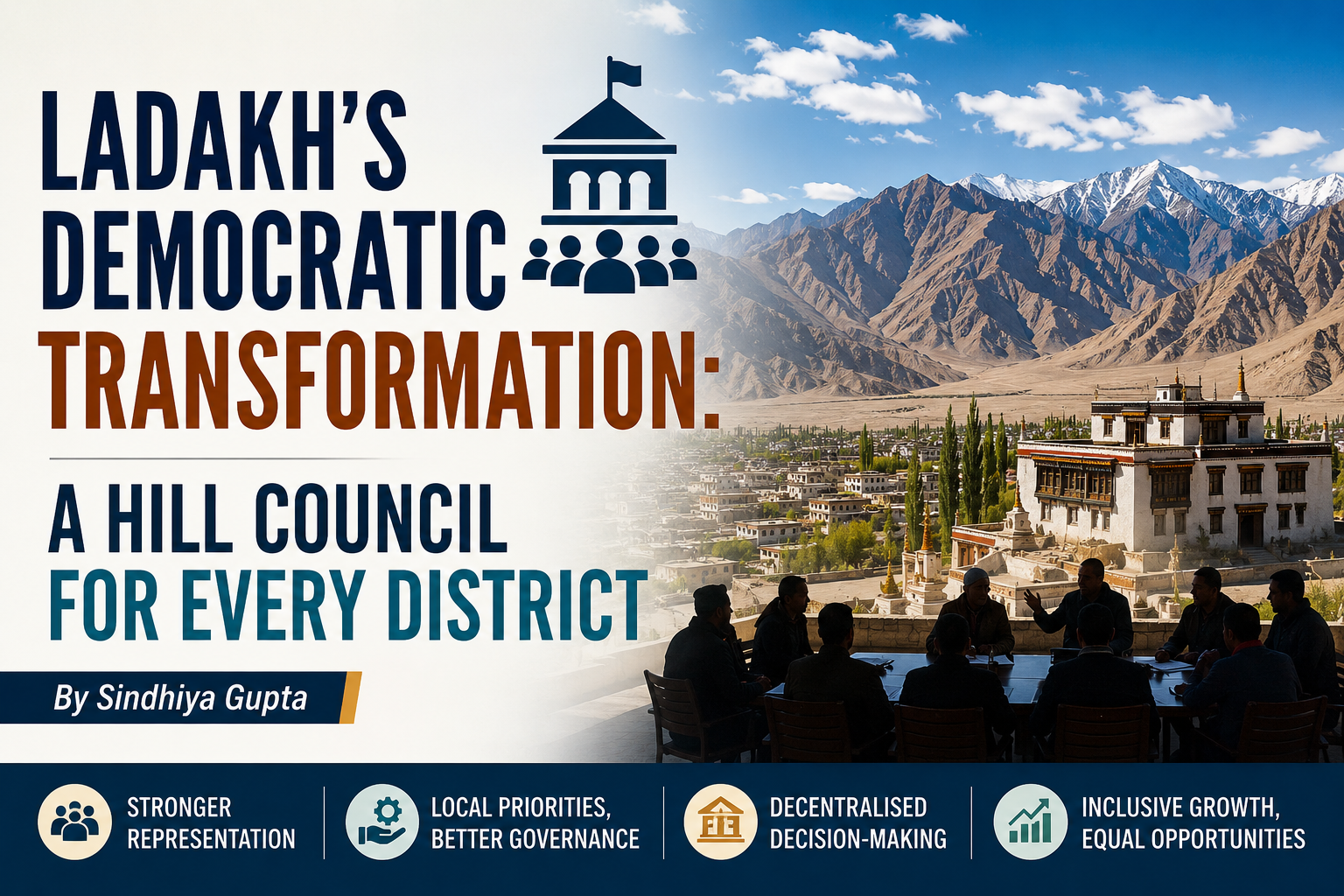
By Sindhiya Gupta
The Union Territory of Ladakh is passing through one of the most significant administrative and political transformations in its modern history.
Since becoming a Union Territory in October 2019, Ladakh has witnessed a series of reforms intended to improve governance, accelerate development and bring public services closer to people living across one of India’s most geographically challenging regions.
The latest proposal to establish Autonomous Hill Development Councils in all seven districts of Ladakh is not merely another administrative measure. It is a landmark step towards institutionalising democratic decentralisation and ensuring that every region receives equal opportunities for representation and development.
The announcement comes at a time when Ladakh’s governance structure is evolving rapidly. Following the creation of five new districts—Sham, Nubra, Changthang, Zanskar and Drass—the Union Territory now has seven districts instead of two.
This historic reorganisation was followed by the creation of 17 new tehsils, rationalisation of the revenue administration and establishment of dedicated engineering divisions in every district. Taken together, these reforms reflect a clear vision: governance must move closer to the people instead of requiring citizens to travel long distances to access government services.
The proposal to constitute Autonomous Hill Development Councils in all seven districts is, therefore, the logical and democratic extension of this vision.
For nearly three decades, the Autonomous Hill Development Council model has remained the cornerstone of local self-governance in Leh and Kargil.
These institutions have enabled locally elected representatives to participate in the planning and implementation of development programmes while safeguarding the region’s distinctive cultural, social and environmental identity.
However, Ladakh’s administrative landscape has fundamentally changed following the creation of five additional districts. Continuing with only two Hill Councils would have created an imbalance in which the newly formed districts possessed an administrative identity but lacked corresponding democratic institutions.
By extending the council system to every district, the government seeks to ensure parity in representation and institutional equality.
Every district—Leh, Kargil, Nubra, Sham, Changthang, Zanskar and Drass—would have an elected platform capable of articulating local priorities, monitoring development projects and strengthening participatory governance.
The importance of this proposal extends beyond politics. It acknowledges the fundamental principle that democracy becomes stronger when decision-making is decentralised.
Local communities are best placed to understand their developmental requirements, whether they concern roads, tourism, education, healthcare, irrigation, environmental conservation or the preservation of cultural heritage.
District Councils provide an institutional mechanism through which these local priorities can be transformed into practical policies and development programmes.
One of Ladakh’s greatest administrative challenges has always been its geography. Spread across nearly 60,000 square kilometres, the Union Territory consists of high-altitude deserts, snow-bound mountain passes and sparsely populated settlements separated by enormous distances.
For people living in remote villages of Changthang, Zanskar or Nubra, reaching government offices has often required journeys of hundreds of kilometres through difficult terrain.
The recent administrative reforms directly address this longstanding problem.
The notification of five new districts brought district administration closer to local communities. The creation of 17 new tehsils further reduced the distance between citizens and revenue services by ensuring that every revenue village falls under one tehsil and every tehsil under one district.
The establishment of new engineering divisions under the Public Works Department, PMGSY, Public Health Engineering and Irrigation and Flood Control departments means that technical expertise and project implementation will now be available within every district.
These changes go far beyond bureaucratic restructuring. They are practical measures intended to improve the everyday functioning of governance.
When a district has its own engineers, revenue officials and elected representatives, development decisions can be taken more quickly, projects can be monitored more effectively and public grievances can be addressed with greater responsiveness.
In this framework, District Councils would become essential democratic partners in an already decentralised administrative system.
Another important feature of the government’s approach is that administrative decentralisation is being accompanied by political decentralisation.
Creating new districts without strengthening democratic institutions could have resulted in an expansion of bureaucracy without a corresponding increase in public participation.
By declaring its intention to establish Autonomous Hill Development Councils in all seven districts, the administration has shown that decentralisation is intended to empower citizens rather than merely reorganise government offices.
Equally significant is the fact that these reforms are taking place alongside discussions between the Government of India and Ladakh’s representatives regarding a customised institutional arrangement under Article 371 of the Constitution.
Although the details remain under discussion, broad agreement has reportedly emerged on the creation of a Union Territory-level body with legislative, executive, financial and administrative features designed according to Ladakh’s distinctive requirements.
Some observers have mistakenly viewed the District Councils and the proposed Union Territory-level body as competing institutions. In reality, the two are complementary.
Modern governance increasingly operates through multiple levels of democratic participation. Panchayats represent village-level interests. District Councils deal with district-level planning and development. A Union Territory-level institution can coordinate broader policy matters affecting Ladakh as a whole.
Such a layered governance structure allows decisions to be taken at the level where they can be implemented most effectively while maintaining coordination across the Union Territory.
Importantly, the proposal also demonstrates the government’s willingness to respond to public aspirations through dialogue rather than confrontation.
Over the past several months, sustained discussions have taken place between Ladakh’s representatives and the Government of India on questions relating to governance, constitutional safeguards and institutional reforms.
The decision to continue these negotiations while simultaneously implementing practical administrative measures reflects a balanced approach that combines consultation with action.
The establishment of District Councils would also have significant developmental implications.
Every newly created district will require administrative offices, supporting infrastructure, trained personnel and institutional capacity. This process is expected to generate employment opportunities for local youth in several sectors.
The construction of public infrastructure, expansion of government services, growth in professional employment and increased administrative activity are all likely to provide a stimulus to local economies.
Decentralised institutions can also improve the utilisation of public resources because development projects can be prioritised according to local needs rather than distant administrative assumptions.
The road requirements of Changthang may be very different from the infrastructure priorities of Sham or the tourism-related needs of Nubra. District-specific planning allows development strategies to reflect local conditions rather than imposing a uniform approach across the region.
The reforms also carry considerable strategic importance.
Ladakh occupies one of India’s most sensitive border regions. Strengthening governance in its remote districts is, therefore, not only a developmental objective but also a strategic necessity.
Border communities that receive efficient public services, improved infrastructure and meaningful democratic participation become stronger stakeholders in national development.
Successive governments have increasingly recognised that national security extends beyond military preparedness. It also depends on good governance, responsive administration, infrastructure development and public confidence in democratic institutions.
Viewed from this perspective, decentralised governance becomes an important instrument of national integration.
Critics may argue that the creation of additional councils could increase administrative expenditure. While such concerns deserve consideration, they often overlook the long-term benefits of institutional investment.
Better governance can reduce delays, improve project implementation, minimise administrative overlap and strengthen accountability. The expenditure involved in establishing new democratic institutions should, therefore, be regarded as an investment in institutional capacity rather than simply as a recurring cost.
Another concern relates to legal and administrative implementation. The existing Ladakh Autonomous Hill Development Council Act will require appropriate amendments to provide for councils in all seven districts.
Constituencies will have to be delimited, powers clearly defined and elections conducted after the completion of the necessary legal processes.
These challenges, however, are procedural rather than conceptual.
Every major democratic reform requires a period of institutional adjustment. What matters is that the policy direction has now been clearly stated. Once the necessary legal amendments are completed, the remaining measures can be implemented in a structured and transparent manner.
The broader course of governance reforms in Ladakh further strengthens confidence in this process.
Since Ladakh became a Union Territory, the administration has considerably accelerated recruitment across departments. Thousands of vacancies have been filled, while hundreds of additional posts remain under recruitment.
Fresh advertisements for teachers, university faculty and police personnel demonstrate that institutional strengthening is continuing alongside administrative restructuring.
Departmental promotions have also gained momentum, while efforts are underway to ensure that the newly created districts receive adequate administrative staff.
Taken together, these developments reveal a governance philosophy centred on decentralisation, institutional expansion and improved public service delivery.
The creation of seven District Councils should, therefore, not be viewed as an isolated announcement. It represents the culmination of a carefully sequenced programme of reforms: first creating new districts, then rationalising tehsils, strengthening engineering infrastructure, expanding administrative capacity and finally extending democratic institutions to correspond with the new administrative structure.
Perhaps the greatest strength of this approach is its inclusiveness.
Every district, regardless of its size or population, is recognised as deserving its own institutional voice. Communities living in remote border regions will no longer have to depend entirely on distant administrative centres for planning and representation.
Instead, they will have locally elected institutions capable of expressing district-specific aspirations within the broader framework of the Union Territory and the Constitution of India.
Ultimately, the success of any governance reform depends not only on legislation but also on effective implementation, public participation and sustained political commitment.
The proposed expansion of Autonomous Hill Development Councils offers Ladakh an opportunity to deepen democracy, preserve its unique cultural identity and promote balanced regional development.
As Ladakh enters this new phase, the emphasis on decentralisation conveys an important message. Development is not achieved merely by drawing new administrative boundaries. It is achieved by empowering institutions that enable citizens to participate meaningfully in shaping their own future.
The proposal to create seven Autonomous Hill Development Councils, one for each district, embodies this principle.
It strengthens democracy, improves administrative efficiency, promotes balanced development and reinforces the Government of India’s long-term vision of a prosperous, inclusive and well-governed Ladakh.
(The author is a media analyst based in Jammu and Kashmir.)
