




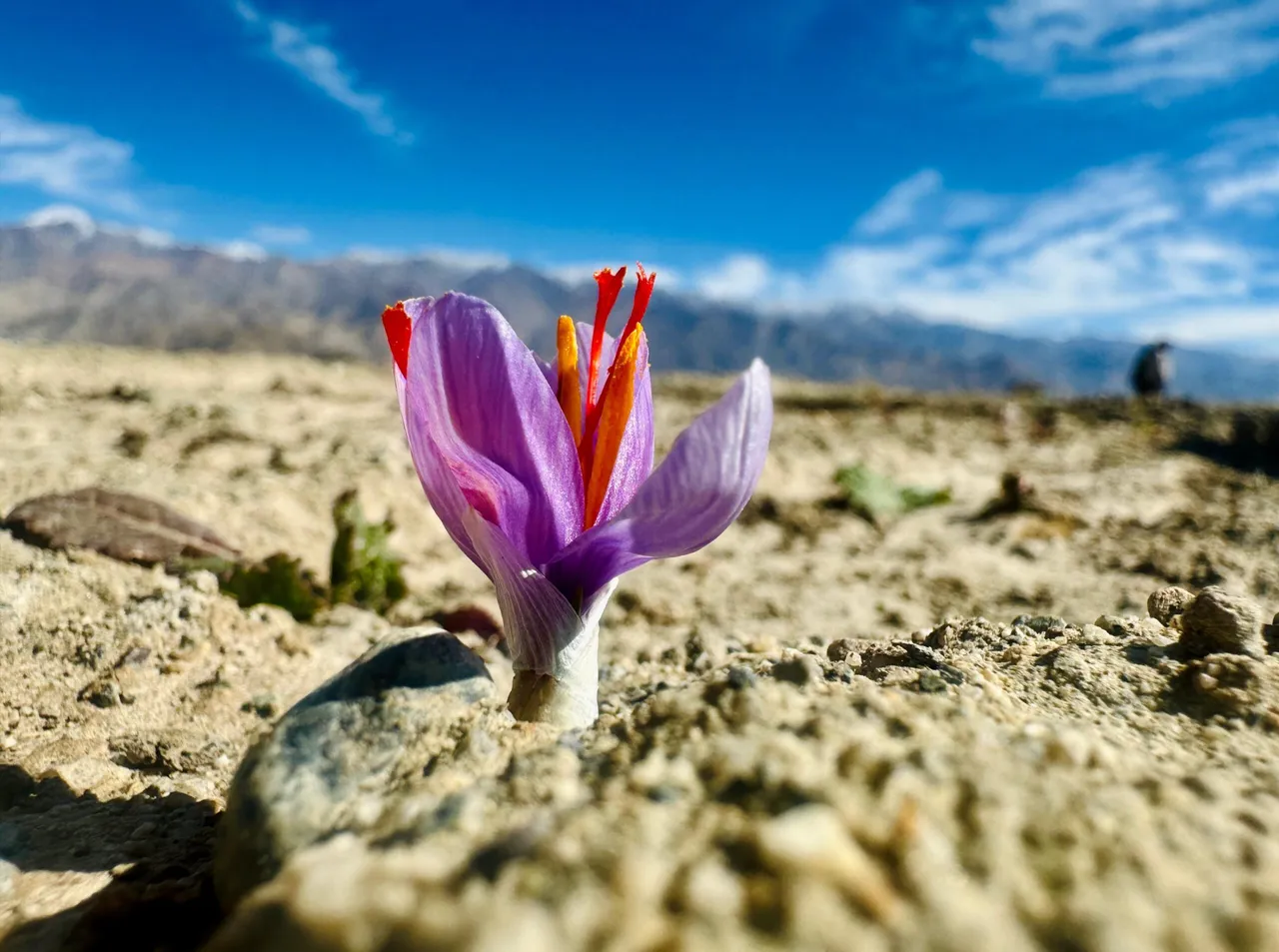
Leh, November 1: In a promising breakthrough for high-altitude agriculture, saffron cultivation in Ladakh has produced its first flowers in just 30 days, nearly half the time typically required for the crop to bloom. The experimental project, conceptualised and initiated by Lieutenant Governor V.K. Saxena, is being seen as a potential new avenue for agricultural diversification and economic opportunity in the Union Territory.
The first bloom appeared at a saffron field developed on recently restored degraded land in Leh under Project Him Sarovar. The plantation, established on October 1, has already yielded nearly 22 grams of pure saffron within four days of the first flowering.
Saxena visited the field on Sunday to witness the development and review the progress of the pilot project. Officials informed him that the plantation was currently averaging 20 to 25 flowers a day, with 72 flowers blooming on Sunday morning alone.
The experiment involves the cultivation of nearly 90,000 corms, weighing around 800 kilograms, of premium Iranian saffron across approximately 4,000 square metres of land that was previously barren.
The early flowering has offered an encouraging indication of the potential of high-altitude farming in Ladakh, where the administration is exploring new crops to supplement traditional agricultural practices and create additional sources of income for farmers and local entrepreneurs.
The initiative builds on the administration’s earlier experiments with high-value floriculture, particularly the cultivation of Lilium and Gladiolus in Leh, which have opened new livelihood opportunities for farmers, Self-Help Groups and local entrepreneurs.
Saxena described the development as a testament to the resilience of Ladakh’s local environment and its untapped agricultural potential. He said the successful pilot could lay the foundation for commercial-scale saffron production, creating new opportunities for crop cultivation and agro-based entrepreneurship.
Saffron, one of the world’s most valuable agricultural commodities, commands premium prices and has strong market demand. Its introduction in Ladakh is being undertaken as an experiment to assess the crop’s suitability to the region’s climatic conditions and determine its economic viability.
Jammu and Kashmir remains India’s principal saffron-producing region, accounting for approximately 90 per cent of the country’s total production, according to the press release.
The Ladakh experiment is part of the broader effort to diversify agricultural activities in the Union Territory in line with Prime Minister Narendra Modi’s vision of promoting financial sustainability and economic empowerment among farmers and young people.
The Lieutenant Governor also appreciated the Agriculture Department and field staff for their contribution to the pilot project.
While the first bloom marks an encouraging beginning, the experiment’s longer-term significance will depend on the crop’s performance across subsequent flowering cycles and its economic viability under Ladakh’s high-altitude conditions. A successful transition to commercial cultivation could open a new chapter in the region’s agricultural economy.