

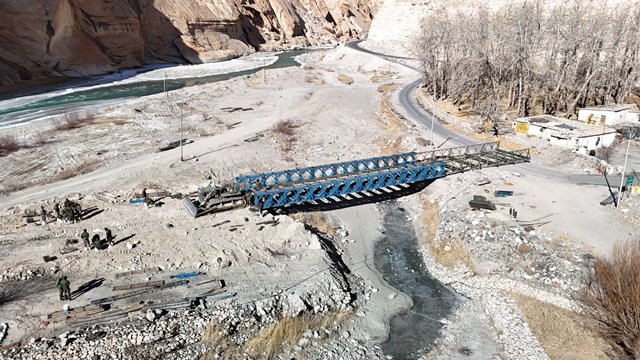
LEH: Fire and Fury Corps, Indian Army yet again demonstrates its operational excellence by conducting high-altitude combat engineering training at over 12,000 feet in union territory of Ladakh.
Under bone chilling temperatures, the Army’s combat engineers, or ‘Sappers’, are undergoing integrated training sessions to enhance their capabilities in executing engineering operations.
The training involves combat engineering skills, and synchronisation with plant operators to ensure seamless collaboration during missions. The rigorous exercise highlights the Army’s readiness to operate in one of the most challenging terrains in the world.
Fire and Fury Corps, Indian Army said in a post on X, “Bridging Training in High Altitude Area
Fire and Fury Sappers at an altitude of over 12,000 feet in Ladakh under chilling temperatures are undergoing integrated training on Combat Engineering operations alongwith plant operators.”
The high altitude training showcases the operational readiness, reliability and confidence, it added.
As per the visuals post on X by the Fire and Fury Corps, the bridging operations showcase the ‘Sappers’ constructing temporary bridges and other vital engineering structures, which are crucial for mobility and logistics in high-altitude zones.
Such exercises are essential to ensure swift operations during both peacetime and conflict scenarios in the strategically important Ladakh region.
Among other diverse initiatives, this added one reflects the Army’s focus on preparedness and transformation, in line with its motto of ‘Transforming India’. The Fire and Fury Corps, tasked with securing the nation’s northern frontiers, is once again proving its reliability and operational confidence, as it continues to adapt to evolving challenges in the region.
Apart from the performing the operational excellence in Ladakh, the Fire and Fury Corps, Indian Army has been relentlessly providing other essential services to the local populace of the UT.
In another message, the Fire and Fury Corps said, “In the freezing winters of Ladakh, healthcare outreach was provided at the doorstep to community members in a remote Village of Leido, Ladakh.”
Army doctors and paramedics provided essential health checkups and treatment in a health care drive. A total of 87 beneficiaries expressed their gratitude to Forever in Operations Division, the message added.
Pertinent to mention here that the Indian Army has been enhancing the combat prowess of its artillery units along the frontier with China by procuring an array of weapons systems, including an additional batch of 100 K9 Vajra howitzers, swarm drones, loitering munitions and surveillance systems.
Lieutenant General Adosh Kumar, the Director General of Artillery in the Army, in September this year said various futuristic platforms and equipment are being procured to bolster the capabilities of the artillery units considering national security challenges.
“Today, we are modernising at a pace like never before and as per defined timelines,” he told reporters ahead of the 198th anniversary of the Artillery Regiment on September 28.
The development work is also in progress by the Defence Research and Development Organisation (DRDO) for hypersonic missiles, he said.
Hypersonic missiles can fly at a speed of five Mach or more than five times the speed of sound.
Lieutenant General Kumar said a number of 155 mm gun systems, including K-9 Vajra, Dhanush and Sharang, have been deployed along the Northern borders to boost the Army’s fire-power.
The Army has already deployed 100 K-9 Vajra gun systems. It is in the process of procuring another batch of 100 K-9s.
“The Acceptance of Necessity (or initial tender) for repeat order of 100 guns was granted. Further process is on,” the senior official said on procurement of an additional batch of K-9 self-propelled howitzers.
The K9 Vajras were originally procured for deployment in deserts, but following the eastern Ladakh standoff, the Army deployed a significant number of the howitzers in that high-altitude region.
“We are also in the process of inducting other 155 mm gun systems to include Advanced Towed Artillery Gun System (ATAGS), Mounted Gun System (MGS) and Towed Gun System (TGS),” he said.
The ATAGS is 100 per cent designed and developed by the DRDO along with two private partners.
Lieutenant General Kumar said the contract is likely to be concluded soon and trials for both MGS and TGS are set to commence in 2025.
“They are lighter in weight and can be carried underslung by helicopters. K-9 Vajra gun system is ideal for mechanised operations,” he said.
Dhanush Guns are an “electronic upgrade” of Bofors guns.
On rockets, he said “Pinaka” systems have been the success story of “Atmanirbharta” (self-reliant) drive and the equipment have added more punch and lethality to artillery’s arsenal.
The focus is now on to enhance the range of Pinaka rockets to 300 kms.
While the Pinaka Mark-I has a maximum range of 40 kilometers, the Pinaka Mark-II is known to have a range of 90 kilometers.
