

Jaishankar recalls how PM tackled Ladakh situation in 2020
LEH: Terming the Eastern Ladakh situation in 2020 a ‘crisis within a crisis’, External Affairs Minister S Jaishankar has said Prime Minister Narendra Modi stood as a resolute, determined and nationalistic leader to ensure that there was no compromise with India’s defence on Line of Actual Control.
The minister recalled how Narendra Modi and his government took a serious, and sober view of the challenge that emerged in eastern Ladakh in the year 2020, even as the country was battling the COVID-19 crisis.
Modi government had to battle a crisis within a crisis, Jaishankar said, recalling the China situation along the Line of Actual Control.
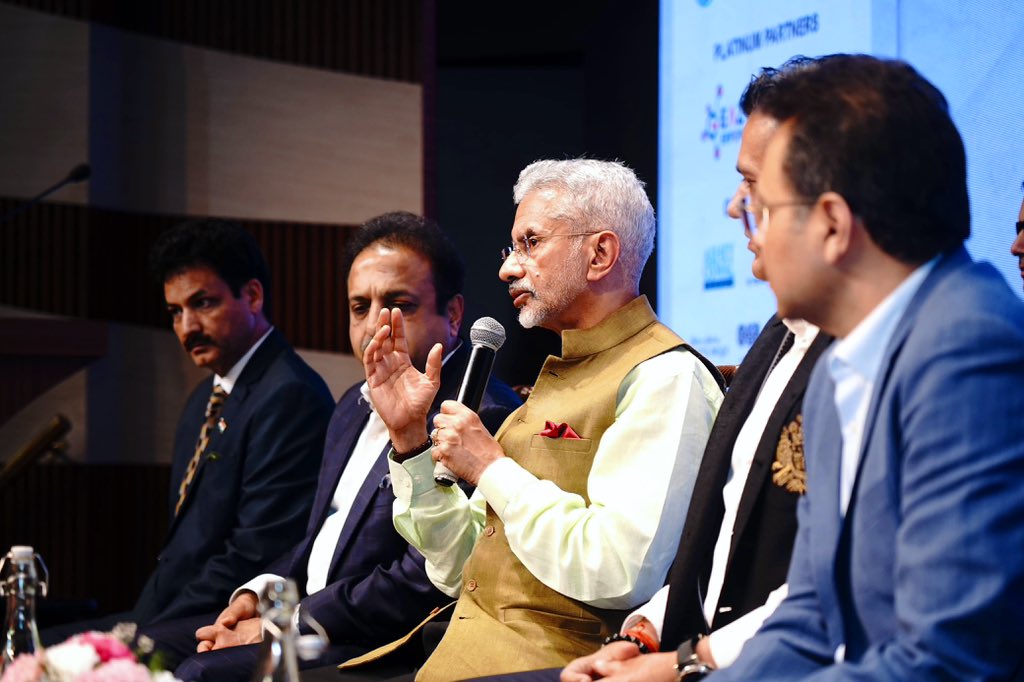
In his opening address at an event hosted by the PHD Chamber of Commerce and Industry (PHDCCI) in Delhi last evening, Jaishankar cited the example of the eastern Ladakh situation that started four years ago and the way India responded to it.
“While Covid was going on, China decided, end of April, early May, to move a very, very large number of forces to our border. This was in violation of multiple agreements that we were not supposed to bring such a large number of forces the border. And, we were not supposed to bring weapons to the border. Now at that time, April-May, do remember, we were all under a lockdown.
“All of you were sitting in your houses. Nothing was moving in the streets, the airlines were shut down, the railways, the roads.
“In this situation, Prime Minister Modi took the decision that we will send our forces, I don’t care what we have to do, they are coming, we will be there, right there…,” he said.
The Union minister, a former foreign secretary who has previously been India’s envoy in Beijing, termed the China situation back in 2020 a “crisis within a crisis”, as it happened when the lockdown was at its peak.
“In this crisis, to have someone determined and resolute saying no, every part of the system has to do, whatever it has to do, but those multiple tens of thousands of troops with their tanks, artilleries, whatever they have to do, will be out there, because there will be no compromise in the defence of India.
That to me was also an experience. And, I asked myself that time, had there been someone less resolute…someone less nationalistic, someone less clear in their definition, in their response to our national security needs, what would have happened,” Jaishankar added.
The Indian and Chinese militaries have been locked in a standoff along the Line of Actual Control in Ladakh since May 2020 and a full resolution of the border row has not yet been achieved though the two sides have disengaged from a number of friction points.
The eastern Ladakh border standoff erupted on May 5, 2020, following a violent clash in the Pangong Lake area. The ties between the two countries nosedived significantly following the fierce clash in the Galwan Valley in June 2020 that marked the most serious military conflict between the two sides in decades. India has been maintaining that its ties with China cannot be normal unless there is peace in the border areas. The two sides have so far held 21 rounds of corps commanders-level talks to resolve the standoff.
Jaishankar said he felt things are moving in a “positive direction” when it comes to India’s bid for a permanent seat in the UN Security Council, and asserted that ‘Viksit Bharat’ will have many faces and expressions and the UNSC will be “one of them”.
He also said the choice for people is “whether the ‘gaadi of Bharat’ should go on fourth gear, fifth gear or whether it should go on reverse gear”.
He said there is one thing which people often say to him, that “governments change but foreign policy doesn’t change”.
“All foreign ministers have to hear this. It’s like we don’t count. We are doing it on auto-pilot. And, I tell people…it’s actually not true. The sharpest example I can give you… It matters when I say, it matters who is in power, it matters what is their gut instinct, what is their belief,” he said, adding, “look at our response to 26/11 (terror attack) in Mumbai and look at out our response to Uri and Balakot”.
He said he thought that nothing could tell one “more clearly, more sharply”, because at the end of the day, the armed forces are the same, the bureaucracy is the same, the intelligence is the same.
Something as big as 26/11 happened “without a strong response” on our side, he said, adding, that in “many ways led to a feeling that this country can be repeatedly punched and pushed, something happens and they will keep absorbing it and they will keep reacting to it, they will protest and the world will say yes, yes, very bad…and life will go on”.
“Now, Uri and Balakot, was meant to demonstrate that no, life will not go on, and that there will be a price,” the minister added.
“Don’t think that because you have done something… and run away to that side, you are safe there, you will not be safe there. You will not be safe across the Line of Control and you will not be safe across the International Border. So, there was a very clear direct message out there, and I think the people to whom that message was intended to be sent, hopefully got it,” he said.
During the interactive session, Jaishankar was also asked about India’s bid for a permanent seat in the UNSC.
“My sense is things are moving in a positive direction. There will be people who will resist it. Because everybody competes, nobody wants anybody else to get ahead. But if you ask me a sense, which way is it moving, I think it is moving favourably, I think more and more countries recognise today what a strong case India has and more and more countries accept the UN itself needs to be reformed, there is no Africa, no Latin America there, very few developing countries out there, I think that also is a fact,” he said.
“So, I feel as part of a Viksit Bharat.. the Viksit Bharat will have many, many faces, and many many expressions, and UN Security Council will be one of them,” he added.
UNSC has 15 members. There are five permanent members — China, France, Russia, the UK, and the US, and 10 non-permanent members elected for two-year terms by the General Assembly (with end of term year).
“…As a nation, we must grow for today and leapfrog for tomorrow to realize our goals and aspirations,” Jaishankar later posted on X.
In his address, he also said, “So, I tell people that and for those of us who live in Delhi, many of whom will be pressing a button in the next few days, and the button is not just for the next five years, that button is for Viksit Bharat. So, please keep that very much in your mind.”
