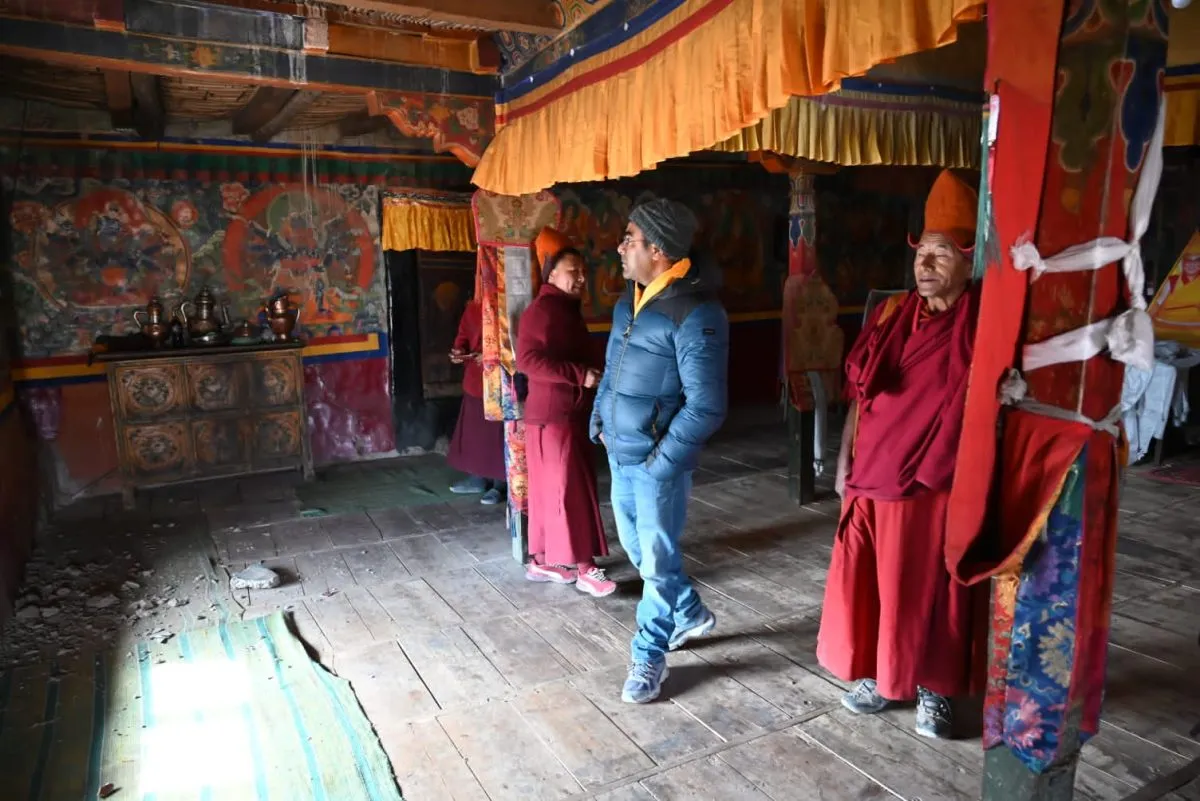
KARGIL: In Ladakh, catastrophe has struck an emblem of history and spirituality as more than 800-year-old main Lakhang of Karsha Monastery in the Zanskar area of the union territory has developed cracks, and has been declared unsafe for performing prayers and gatherings.
The resonating tremors of a recent earthquake have ravaged the centuries old monastery heralding grave concerns for its structural integrity, besides entry in the monastery has been restricted.
The Lakhang of Karsha Monastery, revered for its ancient heritage and spiritual significance, now bears the scars of nature’s relentless force. The multiple seismic events inflicted severe damage, resulting in visible cracks and structural instability along the monastery’s foundation.
The monastery, a sanctuary of spiritual solace for devotees and a pilgrimage site for centuries, stands at the crossroads between history and vulnerability. The fissures etched into its age-old walls speak of a seismic narrative, intertwining past and present in a delicate balance.
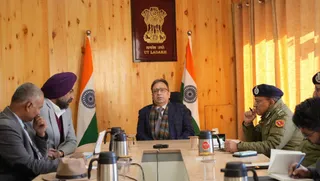
Local authorities swiftly intervened, conducting a comprehensive evaluation of the site. A team of officers and officials of Government Departments headed by Tehsildar Zanskar, Sonam Dorjay on Wednesday inspected the recent earthquake-affected areas in Zanskar subdivision.
“The above 800-year-old main Lakhang of Karsha monastery has developed cracks due to the recent earthquake,” officials said.
Committee head Tehsildar Zanskar Sonam Dorjay decided to declare it unsafe for performing prayer and gathering. They requested the monks of the Monastery to restrict entry in the affected Lakhang (Protectors Room) of the monastery. Government has pledged immediate action to initiate restoration and preservation efforts. The restoration endeavour aims not just to mend the visible cracks but to uphold the spiritual sanctity and historical significance woven into every stone of the Monastery, officials added.
Pertinent to mention here that at least 11 earthquakes and aftershocks have jolted Jammu & Kashmir and Ladakh in 24 hours period while the experts here have stated that low intensity shakes is a good sign as it would dwindle the possibility of a major earthquake.
While five-back-to-back earthquakes jolted J&K and Ladakh within a span of one hours on Monday afternoon, two more aftershocks were witnessed late Monday night, taking the toll of shakes to 7 in a day.
Moreover, four more earthquakes jolted the twin Union Territories in the morning, taking the toll up to 11 within a span of 24 hours.
The origin of all the earthquakes was Zanskar Kargil and Kishtwar in Jammu & Kashmir, the officials said.
Today, the first earthquake measuring 3.0 magnitude jolted J&K and Ladakh parts at 3:57 AM while the second with a magnitude of 3.4 jolted the UTs at 10:30 AM.
The third and fourth earthquakes measuring 2.9 and 2.8 jolted the places at 11:18 Am and 11:28 AM respectively.
The experts have, however, asked the people to take precautionary measures, saying that there was no need to panic.
Senior Assistant Professor at Department of Earth Sciences Kashmir University, Dr Rakesh Chandra said that the tremors felt since yesterday is a normal phenomenon as the earth has to release its energy.
“Zanskar, Kargil and Kishtwar in J&K is in zone five and considered as the most vulnerable areas of the earthquake, thus these earthquakes and aftershocks witnessed since last afternoon are quite normal,” he said.
He added that the earthquakes are unavoidable as the earth has to release its energy and even if the energy is getting released through low intensity shocks, it is a good sign as it will help in avoiding a major earthquake, which would release the accumulated energy in it.
“We need to see the earthquake and aftershocks in a positive aspect and there is no need to panic, but we need to take precautionary measures like constructing our houses on seismically approved design to prevent the losses,” he said.
Moreover, Professor Shakil Romshoo, an earth scientist and Vice Chancellor of Islamic University of Science and Technology (IUST), said that “keeping in view our historical vulnerability to earthquakes, we all need to be conscious about our role and responsibility as far as disaster preparedness is concerned, particularly in case of earthquakes.”
“We must, as individuals, community and society or as a part of the government, work in tandem and join hands for reducing our vulnerability and risk to earthquakes,” he said.