

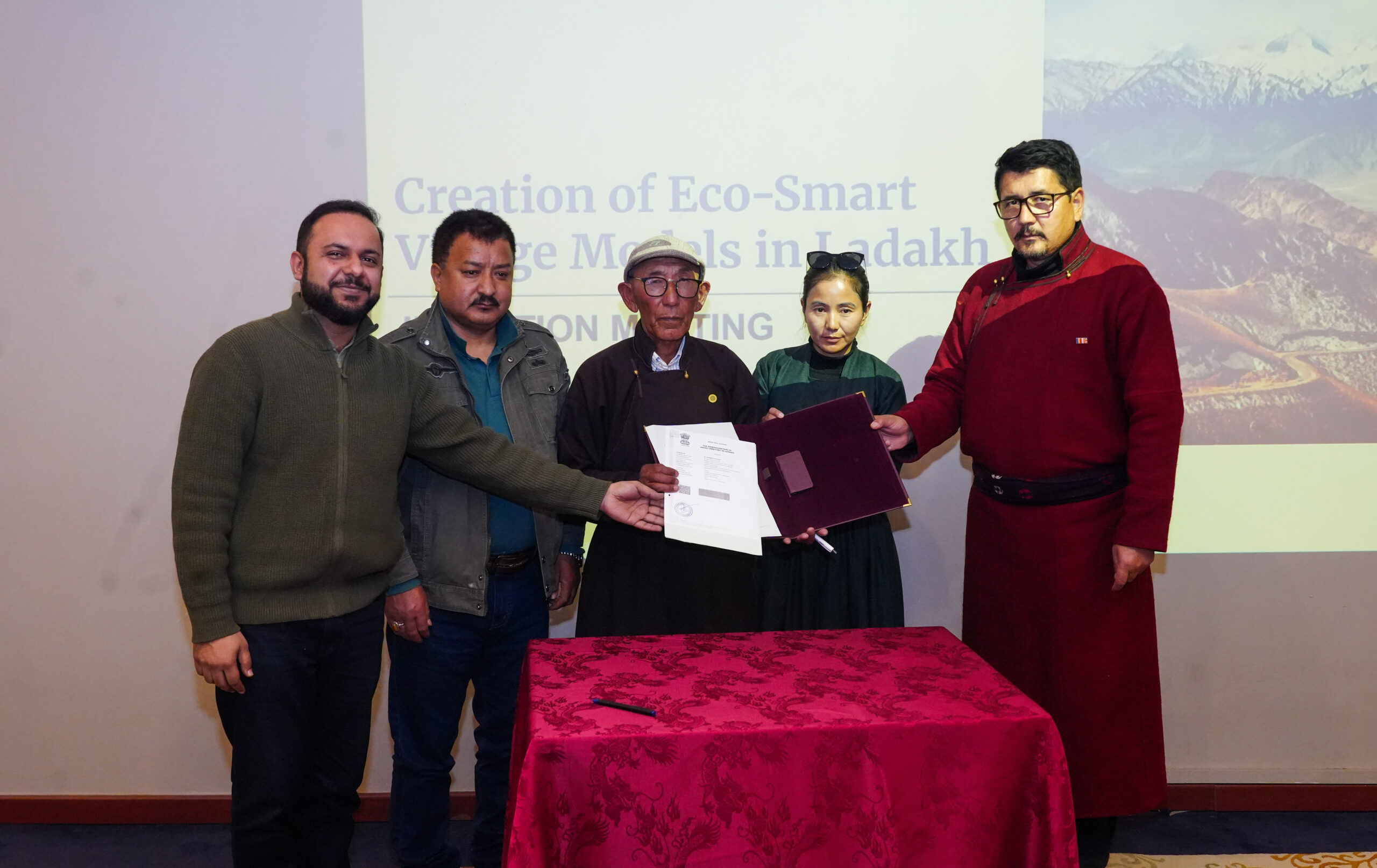
Leh: An inception workshop for the ongoing project on “Creation of Eco-Smart Village Model” was held the other day at Abduz, Leh.
The project is supported by the National Mission on Himalayan Studies (NMHS) and is jointly implemented by Development Alternatives and the Ladakh Ecological Development Group (LEDeG).
The initiative aims to promote sustainable development through integrated efforts in eco-tourism, sustainable infrastructure, and solid waste management in Leh District.
The workshop provided a platform to share the objectives of the project, its approach, baseline insights, and the way ahead.
A key highlight of the event was the signing of a Memorandum of Understanding (MoU) between the Ladakh Autonomous Hill Development Council (LAHDC), LEDeG, and Development Alternatives, marking the formal commitment of all stakeholders to the project.
During the proceedings, Mr. Eshey Tondup welcomed the participants and introduced the purpose of the workshop.
Mohak Gupta from Development Alternatives provided a contextual overview of the project and its relevance for high-altitude Himalayan villages.
Asma Yousuf presented the findings of the baseline assessment, which detailed the current status of infrastructure, tourism activities, and waste management practices in different villages. She also outlined the project deliverables and discussed how the project will proceed in the coming phases.
This was followed by an open consultation session where participants shared suggestions and raised questions.
Former Joint Secreatry Jigmet Takpa offered insights on the concept of ecotourism and emphasised that enjoying natural beauty must go hand in hand with the development of technology and preservation of culture. He cited the example of Markha Valley as a significant destination where the local community works actively to keep the area clean.
However, he stressed that although villagers are proactive, behavioural changes at the community level are still necessary for lasting impact.
AD Tourism also addressed the gathering and spoke about the urgent need to introduce plastic bans in certain villages to reduce waste volume. She pointed out that behavioural change is essential and can only be achieved through continuous awareness.
She further recommended involving the Rural Development Department and the Panchayati Raj Institutions, stating that under the Swachh Bharat Mission Phase 2, every village must be linked with the waste segregation policy.
In his keynote address, CEC Adv. Tashi Gyalson, spoke about the green initiatives undertaken by LAHDC Leh, including subsidies on solar water heaters and electric vehicles to promote sustainable and climate-friendly living.
He highlighted the Council’s efforts in waste management, mentioning that recycled products are now being made from collected waste. He also spoke about the Tsangda project, noting its positive impact in reducing the region’s carbon footprint.
Furthermore, CEC added that the LAHDC is considering the formation of an autonomous body dedicated to waste management to ensure a more focused and efficient system, with further discussions to be held on the proposal.
Appreciating the growing community participation in cleanliness drives, he encouraged continued public involvement to strengthen the region’s environmental efforts. The workshop concluded with a vote of thanks by Development Alternatives, with all stakeholders expressing their commitment to work collectively towards building eco-smart and climate-resilient villages in Ladakh.
The workshop was attended by Adv. Tashi Gyalson, CEC, LAHDC Leh, as the chief guest. He was joined by Councillor Tsering Namgyal, Leader of Opposition; Councillor Upper Leh Phuntsog Stanzin Tsepag; Jigmet Takpa, former Joint Secretary, Ministry of Environment, Forest and Climate Change; ADDC Leh Sonam Nurboo; ADC Leh Ghulam Mohd; Additional Director, Tourism Padma Angmo; Mr. Eshey Tondup, Executive Director, President of ALHGHA and the General Secretary of ALTOA; LEDeG; Mr. Mohak Gupta from Development Alternatives; and Asma Yousuf, Project Manager, LEDeG; Officials from the Tourism Department, Public Health Engineering Department (PHED), Municipal Committee Leh, and other line departments also participated along with Gobas and community members from the Leh, Alchi, Markha and other villages.
