
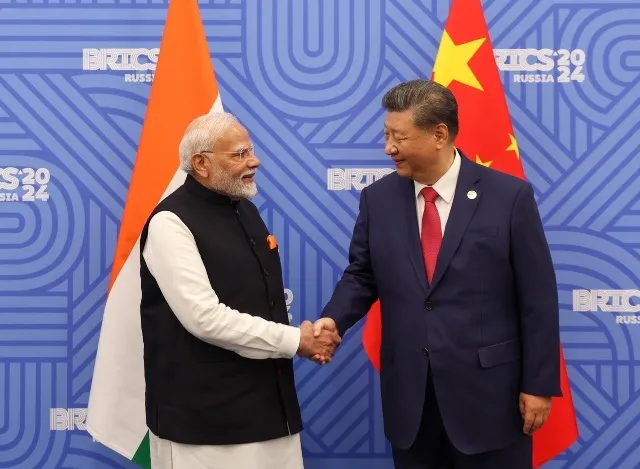
Hold first structured bilateral talks in 5 years
KAZAN: In their first structured bilateral talks in nearly five years, Prime Minister Narendra Modi and Chinese President Xi Jinping on Wednesday agreed that India and China can have a “peaceful and stable” relationship by displaying maturity and mutual respect, and endorsed the pact on the resolution of the dragging eastern Ladakh border row.
In the meeting, Modi underscored the importance of properly handling differences and disputes and not allowing them to disturb peace and tranquility.
In a post on ‘X’, Modi said, “India-China relations are important for the people of our countries, and for regional and global peace and stability.”
“Mutual trust, mutual respect and mutual sensitivity will guide bilateral relations,” he said.
Foreign Secretary Vikram Misri said at a media briefing that the two leaders noted that the special representatives on the India-China boundary question have a critical role to play in the resolution of the issue and for the maintenance of peace and tranquility in border areas.
Modi and Xi instructed the special representatives to meet at an early date and continue their efforts, he said.
“We hope to schedule the next meeting of Special Representatives at an appropriate date,” he said.
The foreign secretary said Modi and Xi reviewed the state of bilateral relations from a strategic and long-term perspective and they were of the view that stable ties between the two countries will have a positive impact on regional and global peace and prosperity.
Both Modi and Xi stressed that with maturity and wisdom, and by showing mutual respect, India and China can have a peaceful and stable relationship, Misri said.
He said restoration of peace and tranquility in border areas will create space for returning towards the path of normalisation of ties.
Officials will now take the next steps to discuss enhancing strategic communication and stabilising bilateral relations by utilising official dialogue mechanisms, he said.
“Welcoming the recent agreement for complete disengagement and resolution of issues that arose in 2020 in the India-China border areas, Prime Minister Modi underscored the importance of properly handling differences and disputes and not allowing them to disturb peace and tranquility,” the Ministry of External Affairs (MEA) said in a statement.
It said the two leaders affirmed that stable, predictable, and amicable bilateral relations between India and China, as two neighbours and the two largest nations on earth, will have a positive impact on regional and global peace and prosperity.
“It will also contribute to a multi-polar Asia and a multi-polar world,” the MEA said.
“The leaders underlined the need to progress bilateral relations from a strategic and long-term perspective, enhance strategic communication and explore cooperation to address developmental challenges,” it said.
In what is easily the biggest breakthrough in the four-and-a-half-year long military standoff between the two countries, India last Monday announced it has reached an agreement with China on patrolling along the Line of Actual Control (LAC) in eastern Ladakh, paving way for the troops from two countries to carry out patrolling the way they used to do before the military standoff between the two sides erupted in May 2020.
The breakthrough, seen as a product of very patient and very persevering diplomacy, has come following 49 months of negotiations between the two countries, which began with a meeting of External Affairs Minister S Jaishankar and his Chinese counterpart Wang Yi, held in Moscow in September 2020, three months after the fierce clash in the Galwan Valley in June 2020 resulted in nosediving of the ties between the two Asian giants.
On Monday, Foreign Secretary Vikram Misri, at a media briefing on Modi’s visit to Russia for the BRICS summit, said the agreement was firmed up following negotiations by the two sides over the last several weeks and that it will lead to a resolution of the issues that had arisen in 2020.
External Affairs Minister S Jaishankar said Indian and Chinese soldiers will be able to resume patrolling in the way they had been doing before the border face-off began and the disengagement process with China has been completed.
It is understood that the agreement will facilitate patrolling in Depsang and Demchok areas as there were major unresolved issues in these two areas.
The ties between the two Asian giants nosedived significantly following the fierce clash in the Galwan Valley in June 2020 that marked the most serious military conflict between the two sides in decades.
The two sides disengaged from a number of friction points following a series of military and diplomatic talks in the last couple of years.
However, the talks hit hurdles in resolving the situation in Depsang and Demchok. “Over the last several weeks, Indian and Chinese diplomatic and military negotiators have been in close contact with each other in a variety of forums,” the foreign secretary said at the media briefing. (PTI)