

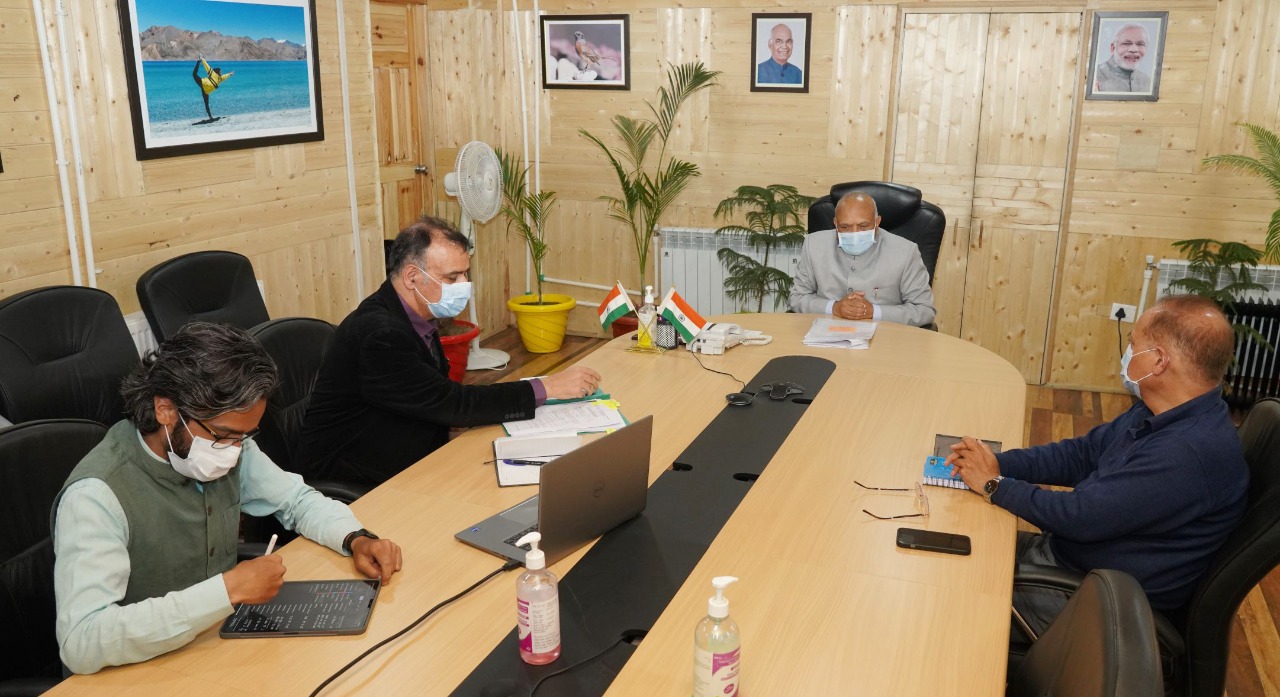
Leh: Emphasising on the need to plant sea buckthorn and Sanjeevani herbs on a large scale, the Lieutenant Governor of Ladakh, RK Mathur said that a Tissue Culture Lab may be set up in Ladakh on the public-private partnership (PPP) model to produce superior quality plants using this technique.
While chairing a meeting to review the progress of the Forest & Wildlife Department, at Raj Niwas today, LG Mathur stressed on the need to target saturation coverage of individual-oriented benefits such as chain-link fencing, Corral pens, solar lights & heaters, etc. He emphasised on 100% upgradation of homestays in Ladakh.
He suggested that the Forest & Wildlife Department may procure organic waste composters in large numbers from the Compensatory Afforestation Fund Management and Planning Authority (CAMPA) fund and Special Development Package (SDP) to address the issue of feral dogs.
LG Mathur suggested that cafeterias with telescopes and waste disposal facilities be developed along with the installation of watch towers in Tsomo Riri and Pangong Lakes.
He stressed on the need to plant sea buckthorn and Sanjeevani herbs on a large scale in Ladakh.
He advised that a Tissue Culture Lab may be set up in Ladakh on the public-private partnership (PPP) model to produce superior quality plants using this technique.
LG Mathur advised the Forest & Wildlife Department to conduct the census of wild animals, birds and water bodies in Ladakh by engaging research scholars to determine their numbers and varieties. He said the data collected from the census would enable them to draft the management plan efficiently. He suggested that the Forest & Wildlife Department may seek assistance from Zoological Survey of India, Botanical Survey of India and Bombay Natural History Society also for the implementation of various projects in Ladakh.
LG Mathur advised the Forest & Wildlife Department to conduct training on wildlife for guides and stakeholders from local tour operators to build their capacities and enhance their knowledge of the wildlife found in Ladakh. He further advised the Department to draft a policy that includes guidelines on livelihood options from Forest/Wildlife activities for the people of Ladakh and the protection/preservation of wildlife and forests. He stressed on the need for the development of new pastures and maintenance of existing pasture land for the benefit of the livestock.
LG Mathur inquired about the CAMPA Fund, the appointment of collectors for the settlement of rights in protected areas, the progress in the implementation of the 5-year Carbon-Neutral Plan, enumeration of water bodies, status of distribution of satellite phones in remote areas for emergencies, Forest/Wildlife Management Plan, setting up of Butterfly Park, the status of the installation of the sequencer, development of flowers on walls around KBR Airport, the upgradation of the Choglamsar Forest Park, etc.
Earlier, Chief Wildlife Warden, Mufti Sajjad Hussai, gave a detailed presentation on the rationalisation of boundaries, feral dogs issue, land diversion cases, the appointment of collectors for settlement of rights, status of rescue centres and watch towers, revised homestay policy, updates on CAMPA fund, plantation of juniper saplings as a part of sacred grove plan in monasteries in Leh and Kargil along with plantation of medicinal and aromatic plant nurseries, Saw Mill and Timber Sale Depot Rules, steps taken by Ladakh Pollution Control Committee, viz. grant of consent given to hotels, the release of fund by Central Pollution Control Board for installation of air quality monitoring stations in Leh and Kargil, procurement of dust samplers and noise-monitoring equipment, etc.; promotion of new wildlife tourism destinations in the form of Rong Valley ecotourism and Himalayan Bear Tourism in Drass; Hanle Dark Sky Sanctuary; setting up o International Snow Leopard Centre (ISLC) and Mountain Research Institute (MRI); mitigating Human-Wildlife Conflict through the use of Animal Intrusion Detection and Repellent Systems (ANIDERS), compensation for wild animal attacks, etc.
Chief Wildlife Warden, Mufti Sajjad Hussain also provided updates on the Wildlife Management Plan for Hemis National Park, Changthang Wildlife Sanctuary and Karakoram Wildlife Sanctuary.
