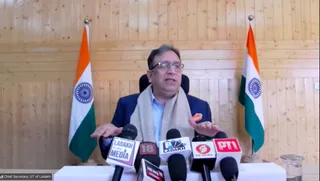

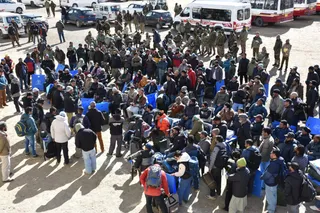
Leh: Union Territory of Ladakh has setup Grievances redressal cells for labourers whereat total number of grievances received in the financial year 2022-23 till end January 2023 was 129, of which 125 grievances have been resolved.
The labourers / workers file their complaints/ grievances with the Assistant Labour Commissioner’s (ALC’s) office of Union Territory (UT) of Ladakh in their respective districts for redressal and the ALCs dispose-off the complaints.
The Government has formulated the Unorganised Workers’ Social Security Act, 2008 with a view to providing social security and welfare of the unorganised workers of India without any prejudice to the workers of any particular States/UTs.
The Administration of UT of Ladakh ensures that all mandatory facilities to the labourers are provided by the Employer and Principal Employer.
After the formation of UT Ladakh, the labour Department of UT has initiated construction of Labour-Sarai-cum-facilitation centres at various places.
Report:
GRIEVANCES REDRESSAL CELLS FOR LABOURERS IN LADAKH
Inspection from time to time for implementation of various labour laws in the UT in order to protect the rights of labourers are also conducted.
Further as far as labourers in the central sphere are concerned, all applicable labour laws are being enforced in the UT of Ladakh through the field offices of the Chief Labour Commissioner (Central).
As per Periodic Labour Force Survey (PLFS), 2020-21 the estimated unemployment rate on usual status for age 15 years and above during 2020-21 in Ladakh was 1.4% and 4.8% for male and female respectively.
Accordingly, the Government of India has taken various steps for generating employment in the country. The Government of India has announced Aatmanirbhar Bharat package to provide stimulus to business and to mitigate the adverse impact of Covid-19. Under this package, the Government is providing fiscal stimulus of more than 27 lakh crore.
This package comprises of various long term schemes/programmes/policies for making the country self-reliant and to create employment opportunities.
The Aatmanirbhar Bharat Rojgar Yojana (ABRY) was launched with effect from 1st October, 2020 to incentivize employers for creation of new employment and restoration of loss of employment during Covid-19 pandemic.
The terminal date for registration of beneficiaries was 31.03.2022. Pradhan Mantri Mudra Yojana (PMMY) was launched by the Government for facilitating self-employment. Under PMMY, collateral free loans upto Rs. 10 lakh, are extended to micro/small business enterprises and to individuals to enable them to setup or expand their business activities.
The Production Linked Incentive (PLI) schemes is being implemented by the Government with an outlay of Rs. 1.97 lakh crore, for a period of 5 years starting from 2021-22 which have potential for creating 60 lakh new jobs.
PM GatiShakti is a transformative approach for economic growth and sustainable development.
The approach is driven by seven engines, namely, Roads, Railways, Airports, Ports, Mass Transport, Waterways and Logistics Infrastructure. This approach is powered by Clean Energy and Sabka Prayas leading to huge job and entrepreneurial opportunities for all.
Government is implementing Prime Minister Street Vendor’s AtmaNirbhar Nidhi (PM SVANidhi Scheme) since June 01, 2020 to facilitate collateral free working capital loan to street vendors to restart their businesses, which were adversely impacted during the Covid-19 pandemic.
The Government of India is encouraging various projects involving substantial investment and public expenditure on schemes like Prime Minister’s Employment Generation Programme (PMEGP), Mahatma Gandhi National Rural Employment Guarantee Scheme (MGNREGS), Pt. Deen Dayal Upadhyaya Grameen Kaushalya Yojana (DDU-GKY) and Deen Dayal Antodaya Yojana-National Urban Livelihoods Mission (DAY-NULM) etc. for employment generation.
Besides these initiatives, various flagship programmes of the Government such as Make in India, Start-up India, Stand-up India, Digital India, Housing for All etc. are also oriented towards generating employment opportunities.
All these initiatives are expected to collectively generate employment in the medium to long term through multiplier-effects.