


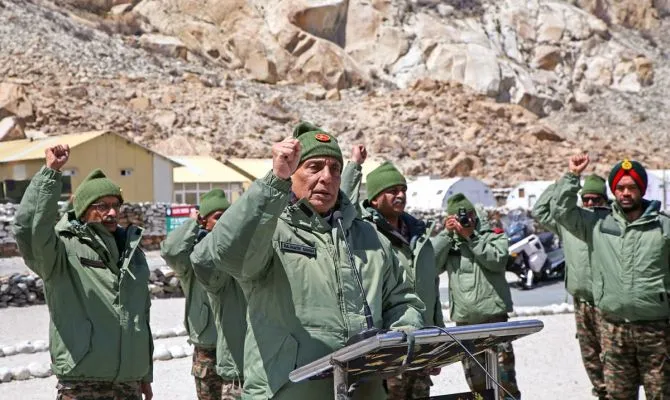
New Delhi: A broad consensus has been achieved by India and China on restoring the “ground situation” along the Line of Actual Control (LAC) pursuant to talks, including for patrolling and grazing cattle in the traditional areas, Defence Minister Rajnath Singh said on Thursday.
Speaking at the Chanakya Defence Dialogue 2024, Singh described the agreement reached between the two countries as a “significant development” that underscores the importance of defence dialogue on the global stage.
“India and China have been involved in talks both at military and diplomatic levels to resolve differences in certain areas along the LAC. Pursuant to the talks, a broad consensus has been achieved to restore the ground situation based on the principle of equal and mutual security,” Singh said.
“The consensus achieved includes patrolling and grazing (cattle) in the traditional areas. This is the power of engaging in continuous dialogue because sooner or later, solutions will emerge,” the defence minister added.
In a major breakthrough in ending the over four-year-long military standoff, India on Monday announced that it has reached an agreement with China on patrolling along the LAC in eastern Ladakh.
It is understood that the agreement will facilitate patrolling in Depsang and Demchok areas as there were major unresolved issues in these two places.
On Wednesday, Prime Minister Narendra Modi and Chinese President Xi Jinping endorsed the India-China agreement on patrolling and disengagement along the LAC in eastern Ladakh on the margins of the BRICS Summit in Russia.
They also issued directions to revive various bilateral dialogue mechanisms, signalling attempts to normalise ties that were hit by a military clash at Galwan in eastern Ladakh in 2020.
Speaking at the event, Singh also said security is a broad and multifaceted concept that encompasses many other factors, including internal stability, economic resilience, and the protection of critical infrastructure, all of which are essential to a nation’s overall security framework.
“Security is often associated with border protection. When we think of security, images of soldiers stationed on the borders, aircraft patrolling the skies, and naval ships guarding the seas typically come to mind. However, as you all know, security extends far beyond border defence,” Singh said.
The defence minister also said that indigenous manufacturing of arms and defence equipment strengthens the security infrastructure as well as the economy of the country.
Had defence been recognised as an integral component of development and studied more comprehensively in the past, India might have achieved self-reliance in the defence sector much earlier, Singh said, adding that self-reliance in defence is a prominent national goal, but does not imply working in isolation from the global community.
“When India speaks of self-reliance, it is important to clarify that it does not imply working in isolation from the global community. Instead, as we pursue our goal of self-reliance, we remain dedicated to fostering an equitable and inclusive world order,” he said.
India is committed to collaborating closely with all the nations to promote a fair and just international system, the defence minister said.
The other day in their first structured bilateral talks in nearly five years, Prime Minister Narendra Modi and Chinese President Xi Jinping also agreed that India and China can have a “peaceful and stable” relationship by displaying maturity and mutual respect, and endorsed the pact on the resolution of the dragging eastern Ladakh border row.
In the meeting, Modi underscored the importance of properly handling differences and disputes and not allowing them to disturb peace and tranquility.
In a post on ‘X’, Modi said, “India-China relations are important for the people of our countries, and for regional and global peace and stability.”
“Mutual trust, mutual respect and mutual sensitivity will guide bilateral relations,” he said.
Foreign Secretary Vikram Misri said at a media briefing that the two leaders noted that the special representatives on the India-China boundary question have a critical role to play in the resolution of the issue and for the maintenance of peace and tranquility in border areas.
Modi and Xi instructed the special representatives to meet at an early date and continue their efforts, he said.
“We hope to schedule the next meeting of Special Representatives at an appropriate date,” he said.
The foreign secretary said Modi and Xi reviewed the state of bilateral relations from a strategic and long-term perspective and they were of the view that stable ties between the two countries will have a positive impact on regional and global peace and prosperity.
Both Modi and Xi stressed that with maturity and wisdom, and by showing mutual respect, India and China can have a peaceful and stable relationship, Misri said.
He said restoration of peace and tranquility in border areas will create space for returning towards the path of normalisation of ties.
Officials will now take the next steps to discuss enhancing strategic communication and stabilising bilateral relations by utilising official dialogue mechanisms, he said.
“Welcoming the recent agreement for complete disengagement and resolution of issues that arose in 2020 in the India-China border areas, Prime Minister Modi underscored the importance of properly handling differences and disputes and not allowing them to disturb peace and tranquility,” the Ministry of External Affairs (MEA) said in a statement.
It said the two leaders affirmed that stable, predictable, and amicable bilateral relations between India and China, as two neighbours and the two largest nations on earth, will have a positive impact on regional and global peace and prosperity.
“It will also contribute to a multi-polar Asia and a multi-polar world,” the MEA said.
“The leaders underlined the need to progress bilateral relations from a strategic and long-term perspective, enhance strategic communication and explore cooperation to address developmental challenges,” it said. (Agencies)