

Chinese Infra activity picks up, Cong questions govt
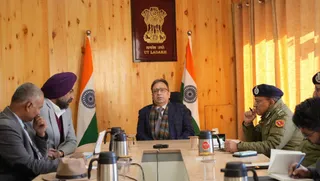
LEH: Amidst the heightened military activity by China along the Line of Actual Control, Army chief General Manoj Pande on Friday extended his visit to the union territory, and visited forward areas of Ladakh to review the operational preparedness there.
This was the fourth day of the Chief of Army Staff’s stay in the union territory of Ladakh, which has been the central point of the over three-year-long military standoff between India and China. Pande, who had arrived in Drass on Tuesday, the eve of the 24th anniversary of Kargil Vijay Diwas, had visited the 14 Corps headquarters at Leh and the Siachen Glacier on the Pakistan front on Thursday.
On Friday, the Indian Army Chief visited some forward areas of Ladakh to review the operational preparedness.
According to the ADG PI – Indian Army, General Manoj Pande visited the forward areas of Ladakh and received a briefing on operational readiness.
The Army Chief also praised the soldiers for their unshakable dedication and urged them to keep working with the highest professionalism and a good attitude, said Indian Army on its Twitter handle.
“General Manoj Pande, the Chief of Army Staff (COAS) visited forward areas of Ladakh and was briefed on operational preparedness. Interacting with troops, the Army Chief complimented the soldiers for their unwavering commitment and exhorted them to continue working with the utmost professionalism and positive spirit,” tweeted Indian Army.
The ongoing visit to Ladakh by the army chief is coming amidst the heightened military activity by China along the Line of Actual Control.
Official sources inform that while little headway has been made in the dialogue process after the Chinese refused troop disengagement at the strategically located Depsang Plains as well as the Charding Ninglung Nallah (CNN) track junction at Demchok in eastern Ladakh during the last meet on April 23, the People’s Liberation Army (PLA) has been consolidating its military positions in terms of bunkers, posts, artillery positions, surface-to-air missile systems, radar sites and ammunition storages along the Line of Actual Control.
Army Chief visits forward areas of Ladakh, reviews Op readiness
Media reports quoting officials say that the PLA has been developing massive infrastructure in terms of new helipads, roads, bridges, dual-use Xiaokang border villages and last-mile connectivity, which has further picked up speed in the last couple of months to support its forward positions.
“China has also massively upgraded all its air bases facing India like Hotan, Kashgar, Gargunsa, Shigatse, Hoping, Lingzhi and Lhasa-Gonggar with new and extended runways, hardened shelters and fuel storage facilities for additional fighters, bombers, AWACS, drones and reconnaissance aircraft. Moreover, seven to eight new airfields and heliports are now also coming up,” sources were quoted saying.
Not just Ladakh, the stepped-up PLA activity is underway along all middle (Uttarakhand, Himachal) and eastern (Sikkim, Arunachal) sector of the Line of Actual Control.
At Pangong Tso, for instance, the PLA has increased the number of troop shelters, weapon systems, jetties, and assault boats near the “no patrol buffer zone” created after the troop disengagement at Pangong Tso in February 2021.
The Army Chief has been keeping an eye on the developments in Ladakh even as last month, General Manoj Pande had visited Ladakh at the first pre-engineered Environment-friendly accommodation for troops constructed by the Indian Army.
Meanwhile, the Congress on Friday asked the Union government whether a consensus between India and China on the border dispute has been reached, pouncing on the foreign minister’s claim that more than “mere pleasantries” were exchanged between the two countries leaders in Bali last November.
Congress general secretary Jairam Ramesh also asked whether Chinese troops from Depsang and Demchok in Ladakh will now be withdrawn.
His questions came a day after the External Affairs Ministry claimed that more than mere courtesies were exchanged between Prime Minister Narendra Modi and China President Xi Jinping at Bali G20 Meet in November 2022.
“Ever since Prime Minister’s public clean chit to China on June 19th, 2020, the Modi government has been acting as if it is being tough on China, and that there have been no compromises or meaningful conversations between PM Modi and President Xi Jinping while Chinese troops remain in violation of previous LAC agreements,” Ramesh said on Twitter.
Army Chief visits forward areas of Ladakh, reviews Op readiness
On November 16, 2022, he said, the Modi government characterised a dinner conversation between the two leaders at Bali as just an “exchange of courtesies.”
On July 25, 2023, he claimed that a Chinese Foreign Ministry statement mentioned an “important consensus” reached by PM Modi and President Xi in Bali.
“On July 27, our Ministry of External Affairs confirmed that more than mere courtesies were exchanged at Bali. Is this a consensus or a concession by PM Modi? Will Chinese troops finally withdraw from Depsang and Demchok where they have blocked Indian patrols for more than three years,” Ramesh asked.
Meanwhile, he claimed that economic relations between the two countries are proceeding “as if the Chinese incursions in Ladakh and Arunachal Pradesh never even happened.”
“So much for ‘lal aankh’!” the Congress leader said. The Congress has been critical of the government’s handling of the border dispute with China.