

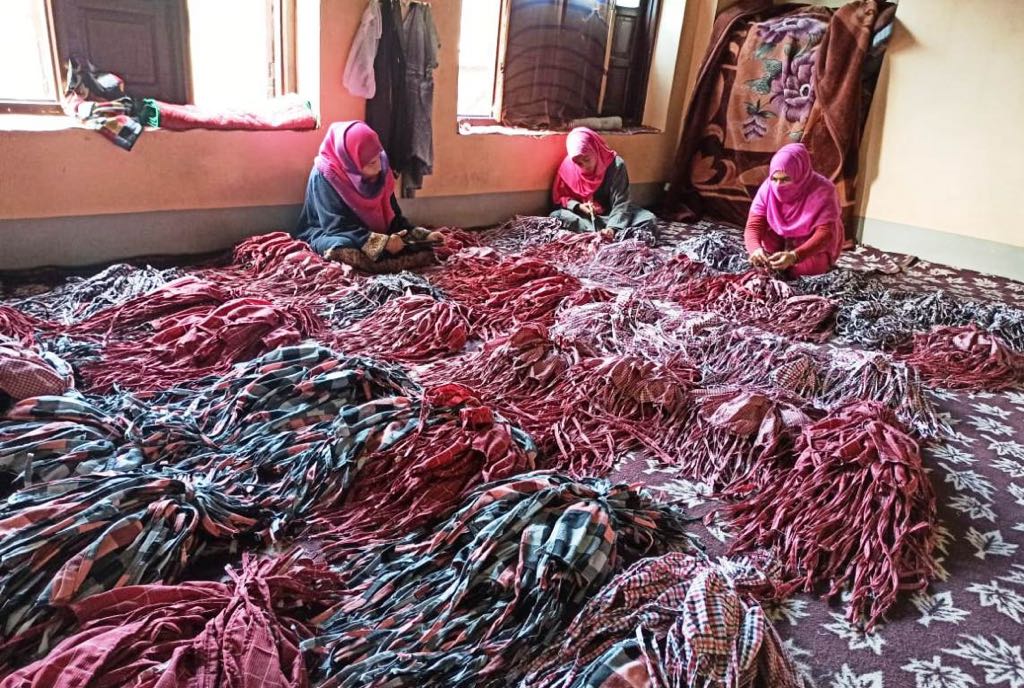
LEH: About 2,500 in Ladakh received assistance under the Government of India’s Hub for Empowerment of Women (HEW) scheme in the financial year 2024-25, according to data released by the Ministry of Women and Child Development. And more than 28,000 women in Jammu and Kashmir benefit from the scheme.
The HEW initiative, part of the broader Mission Shakti programme, aims to empower women by providing access to legal aid, financial literacy programmes, and government welfare schemes.
The scheme’s reach has steadily increased, with 24,574 women assisted in JK in 2023-24, compared to 17,110 in 2022-23. In Ladakh, 799 women benefited this year, up from 160 last year.
Meanwhile, under the Pradhan Mantri Matru Vandana Yojana (PMMVY)—which provides financial assistance to pregnant and lactating mothers—over 1.41 lakh women in Jammu & Kashmir and 2,510 in Ladakh received benefits in 2024-25. The scheme offers a cash incentive of ₹6,000 to eligible mothers to improve maternal health and nutrition.
Despite the rising number of beneficiaries, officials acknowledge challenges in reaching women in remote areas.
In regions like Keran, Gurez, and Kargil, difficult terrain and lack of awareness have hindered accessibility. The government has been conducting door-to-door campaigns and using digital platforms to improve outreach.
The Ministry has also launched a 100-day women’s empowerment campaign under HEW, focusing on health camps, gender sensitisation workshops, and community mobilisation efforts. Special registration drives for PMMVY are being conducted in rural areas of Kashmir and Ladakh to maximise coverage.
With the Union Territory administrations prioritising women’s welfare and financial independence, the success of these schemes will be crucial in shaping gender-inclusive development in the region.
The Hub for Empowerment of Women (HEW) scheme, part of the “Samarthya” sub-scheme of the “Mission Shakti” umbrella scheme, aims to empower women by providing access to services like healthcare, education, and financial inclusion, operating at national, state, and district levels.
The Government initiated a number of schematic and legislative interventions over the past few years for educational, social, economic and political empowerment of women. These have resulted in improving the status of women on many counts.
However, recognising the need for a single window system for inter- sectoral convergence of schemes and programs meant for women, the Government is setting up Hub for Empowerment of Women (HEW) at National, State and District levels under ‘Samarthya’ sub-scheme of ‘Mission Shakti, an Umbrella Scheme for safety, security and empowerment of women.
The Hubs aim to facilitate women’s access to various institutional and schematic set ups for information dissemination and availing services pertaining to healthcare, quality education, career and vocational counseling/ training, financial inclusion, entrepreneurship, backward and forward linkages, health and safety for workers, social security and digital literacy etc.
Under Deen Dayal Antyodaya Yojana- National Rural Livelihoods Mission (DAY-NRLM), a total 1411 Gender Resource Centers (GRC) have been formed in 13 States of the country till date. The GRCs are called by different names in many States such as ‘Lok Adhikar Kendra in Madhya Pradesh’, ‘Sangini Kendra in Chhattisgarh’ and ‘Pragya Kendra in Odisha’. Based on the level of preparation and their respective gender operational strategies, different States have different plans and models of GRCs.
GRCs are run and managed by Cluster Level Federations (CLFs) or by Block Level Federations (BLFs), as per the local context. GRC is the apex institutional structure in the institutional mechanism to address gender issues under DAY-NRLM. The cases related to rights and entitlements and gender-based violence of Self Help Group (SHG) members are escalated to GRC by Self Help Groups (SHGs), Village Organizations (VOs) or Cluster Level Federation (CLF) based on the merit of cases. GRC refers the cases, if need be, to different public service points such as One Stop Centers, Police, District Legal Service Authorities etc.
