

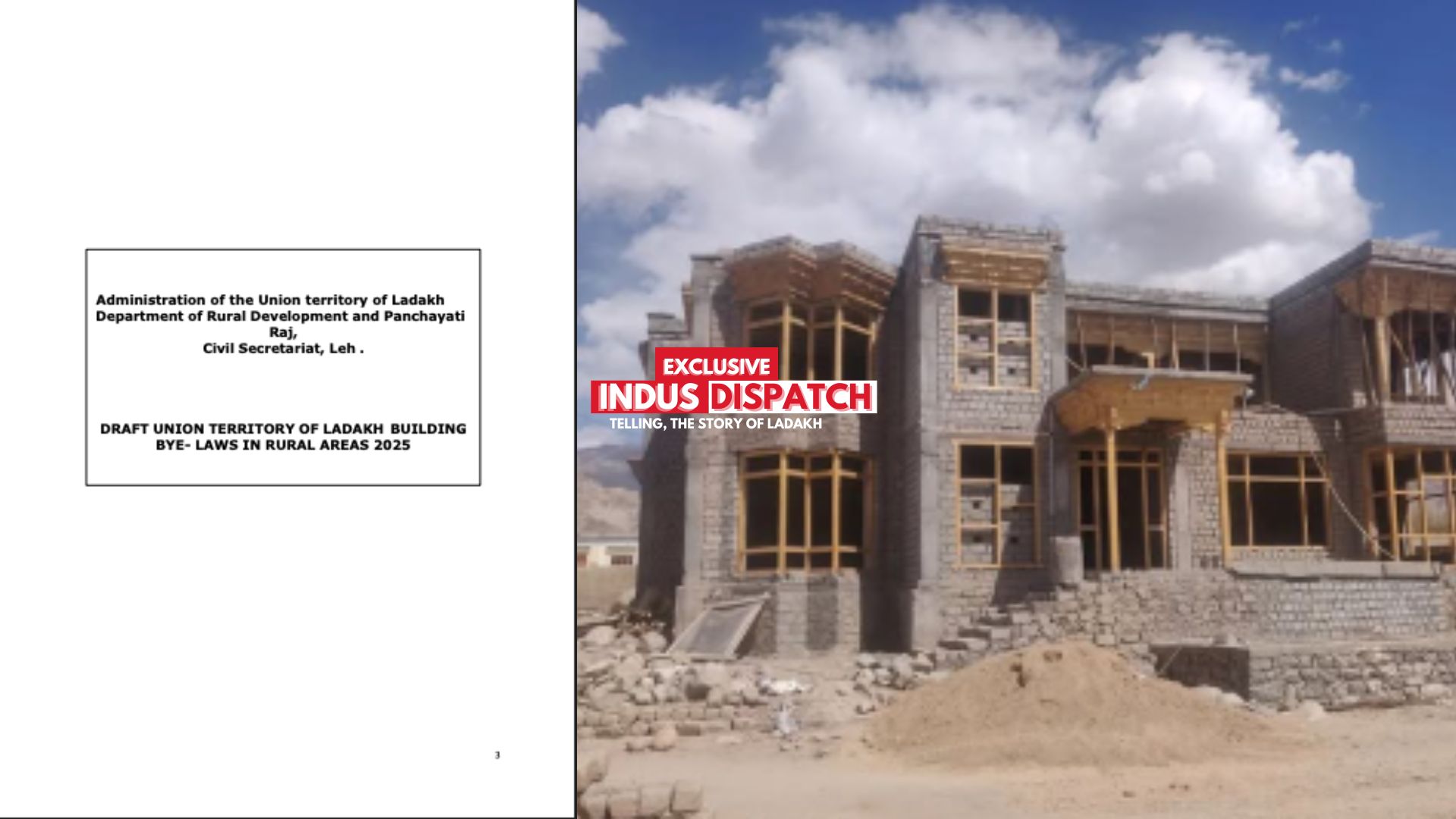
Jammu: In a move aimed at curbing unregulated construction and protecting agricultural land, the Union Territory Administration of Ladakh has issued the “Draft Union Territory of Ladakh Building Bye-Laws in Rural Areas 2025.”
The draft policy seeks to bring uniformity, safety, and sustainability to building activities across rural parts of the region.
The proposed bye-laws are designed to regulate new constructions, extensions, alterations, and reconstructions in rural areas. They will apply to all buildings–residential, commercial, and institutional — including those rebuilt after fire, collapse, or demolition.
Under the draft framework, rural constructions have been divided into three categories: residential individual houses (category I), commercial buildings (category II) and all other types, including group housing, industrial complexes, townships, religious and charitable buildings, private hospitals, schools, and telecom towers (category III).
Notably, the Sarpanch of each Halqa Panchayat has been empowered to grant construction permissions for residential buildings under Category I, acting as the head of the village-level committee. In cases where the Sarpanch’s post is vacant, the Block Development Officer (BDO) will exercise the authority. The Sarpanch will also seek inputs from the Secretary Panchayat (as Member Secretary), the local Junior Engineer, and the Patwari concerned before granting permissions.
For Category II and III buildings, permission will be granted by a five-member committee comprising the Sub-Divisional Magistrate (SDM) or District Panchayat Officer (for areas outside sub-divisions), Tehsildar, Town Planner/AEE REW/AE REW, BDO (as Member Secretary), and the Sarpanch of the concerned Halqa Panchayat. The committee is mandated to seek the technical opinion of the Town Planner for all constructions other than small commercial buildings under 100 square metres.
The draft policy also proposes an Online Building Permit System (OBPS) to streamline and digitize the approval process. The Rural Development and Panchayati Raj (RD&PR) Department will develop the system in consultation with the Chief Town Planner, Ladakh. Authorities will be required to decide on applications within one month of submission.
In keeping with Ladakh’s fragile ecosystem and seismic vulnerability, the bye-laws mandate compliance with seismic safety norms, snow load and slope stability guidelines, and heritage protection measures. A 200-metre no-construction buffer will be maintained around notified heritage sites unless special approval is obtained from the Heritage Conservation Committee (HCC). Building designs in heritage zones must reflect local architecture — mud plaster, timber windows, and sloped roofs.
Further, the draft makes sustainable features mandatory, including solar passive design for buildings above 100 square metres, dual water supply systems for greywater reuse, and composting pits for biodegradable waste management.
The administration has sought public feedback on the draft before it is finalized and implemented across rural Ladakh.
