

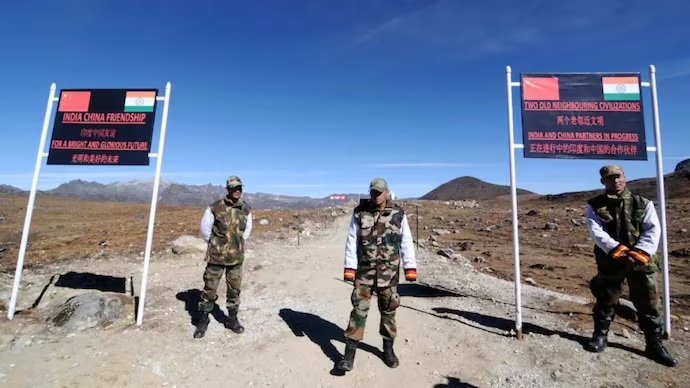
For years, the India–China border story has been dominated by confrontation, patrol face-offs, military build-up, competing maps and the long shadow of the Galwan clash. Now, a new development points to a quieter but important shift. India and China have agreed to establish new high-level military meeting points and direct hotlines in the Eastern and Middle sectors of the Line of Actual Control (LAC).
The India-side locations identified for these new arrangements are Tawang in Arunachal Pradesh and Joshimath in Uttarakhand. Their selection is significant because both lie close to sensitive parts of the disputed frontier. This is not a border settlement and it does not mean either side has changed its territorial claim. Instead, it is an attempt to ensure that an unsettled border does not once again turn into an uncontrollable military crisis.
The agreement emerged from the 25th round of Special Representatives’ talks in Beijing between National Security Adviser Ajit Doval and Chinese Foreign Minister Wang Yi. The two sides reached an eight-point consensus on the boundary question, which included two additional meeting points for General Level Mechanism/Senior Highest Military Commander meetings and two additional border-military hotline channels in the Eastern and Middle sectors.
At first glance, this may appear to be a technical arrangement. In reality, it reflects a major change in the way India and China are trying to manage their difficult border relationship.
From Ladakh to the Wider LAC
After the 2020 crisis in eastern Ladakh, Corps Commander-level talks became one The Chushul–Moldo mechanism has long served as a key channel preventing direct India-China military confrontation in the Western Sector, anchoring the difficult disengagement and de-escalation process. The new decision extends this framework beyond Ladakh, Joshimath will act as India’s meeting point for the Middle/Central Sector while Tawang covers the Eastern Sector with new hotlines linking India’s Eastern and Central Army Commands to their Chinese counterparts.
This matters because border incidents rarely start as major crises—they often begin with patrol encounters LAC alignment disputes construction activity troop movements miscommunication between local commanders. When communication is slow or filtered through multiple layers minor incidents can escalate into serious political flashpoints.
Direct hotlines and structured high-level meetings aim to reduce this risk by enabling faster clarification allowing both armies to respond before rumours and suspicion take hold. Simply put, India and China are building a system to contain local friction locally preventing it from escalating into a national crisis.
Why Tawang Matters
Tawang is no ordinary border location it’s among the most politically sensitive spots in the India-China dispute. India administers it as part of Arunachal Pradesh, while China claims the state as “South Tibet.”
This makes Tawang’s new role striking, by agreeing to a senior military engagement mechanism here, both countries accept the need for practical arrangements even where their political positions remain sharply opposed. This doesn’t mean China has diluted its claim or India has accepted China’s position neither is true. Rather, military communication has become necessary precisely because the dispute stays unresolved.
Tawang also carries deep strategic and emotional weight, tied to history, religion and national identity beyond mere military geography. Any incident here could ripple into a larger diplomatic dispute, which is why a formal high-level mechanism may help prevent local escalation.
Still, expectations should stay realistic a meeting point in Tawang can help manage tensions but cannot resolve the underlying territorial and LAC alignment disagreements.
Why Joshimath Matters
Joshimath brings the Central Sector into sharper focus, an area historically overshadowed by Ladakh in the west and Arunachal Pradesh in the east, despite its strategic importance. Naming it a meeting point suggests both governments want a more formal military-management structure here too, signalling that border tensions aren’t viewed only through the Ladakh lens.
Joshimath’s inclusion underscores a broader reality, India-China competition now spans the entire LAC, as roads, logistics, troop deployments, surveillance and infrastructure boost both sides’ frontier presence. With rising activity comes greater risk of misunderstanding making structured communication increasingly essential.
Dialogue Without Settlement
The Doval-Wang Yi talks went beyond hotlines and meeting points. India and China also agreed to advance discussions through an Expert Group on Boundary Delimitation and a Working Group on Border Management, under the existing Working Mechanism for Consultation and Coordination on Border Affairs, while committing to address ground situations through diplomatic and military channels to avoid misunderstanding.
This is diplomatically important but shouldn’t be overstated the boundary dispute remains far from resolution. The phrase “early and substantial harvest” signals a desire for progress, yet the new groups’ first task is merely agreeing on terms of reference, showing how difficult the larger process remains.
Tawang and Joshimath’s real significance lies in representing a shift from ad hoc crisis response to a wider institutional system for managing disagreement. India and China aren’t settling the border they’re preventing it from becoming unmanageable, a modest but meaningful step after years of tension.
