

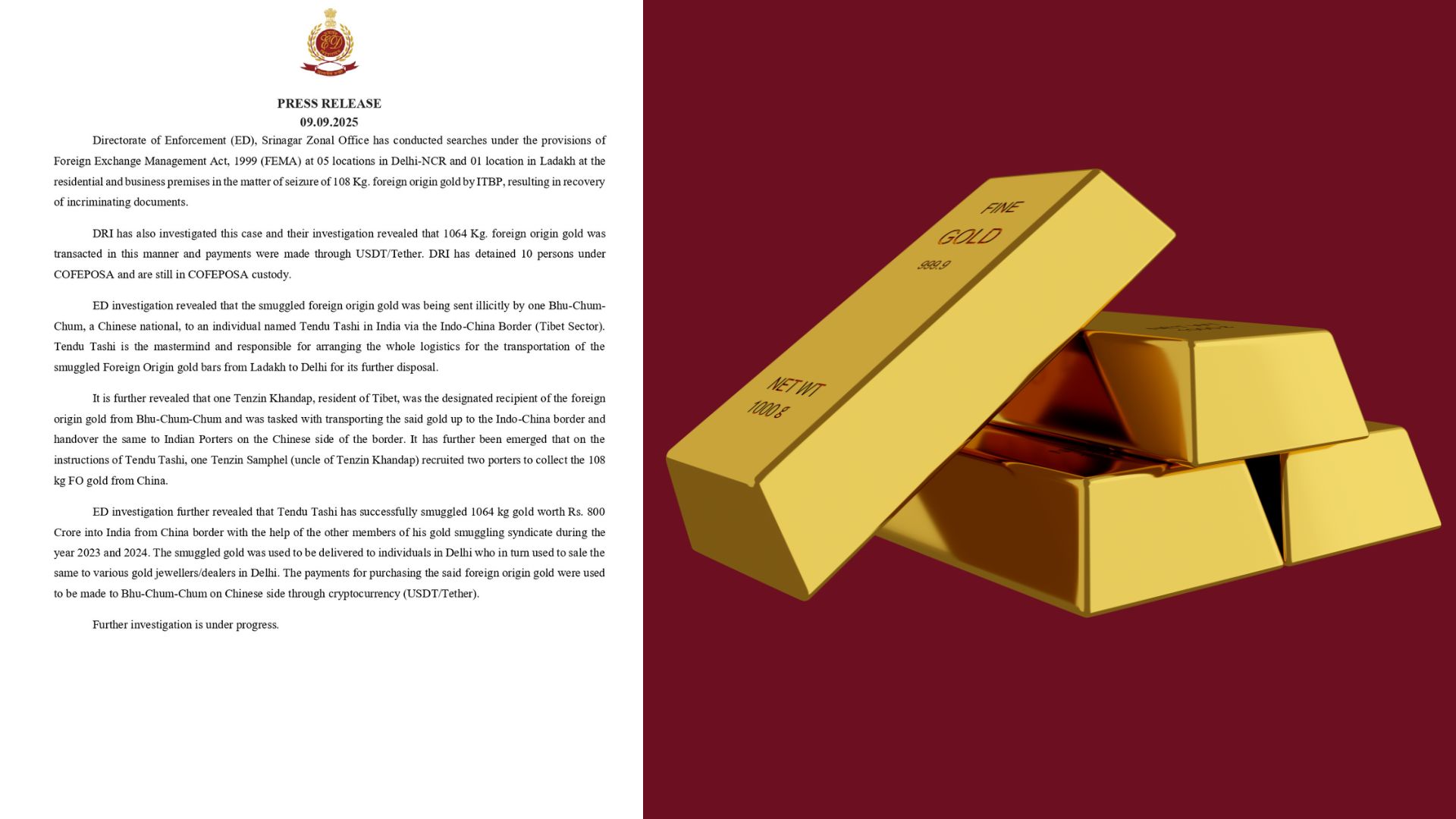
The probe, launched after a significant seizure near the border in July 2024, has exposed a well-organized smuggling syndicate operating through intricate logistics and cryptocurrency payments.
The July 9, 2024, operation by the Indo-Tibetan Border Police (ITBP) led to the seizure of 108 gold bars, each weighing 1 kg, in Sirigaple, Changthang sub-sector of Ladakh.
Two accused, Tsering Chamba and Stanzin Dorgyal, were apprehended, triggering a wider investigation into the network behind the smuggling.
According to the ED, the mastermind Tendu Tashi, an Indian national, orchestrated the entire operation from Ladakh to Delhi. The gold, originating from China, was smuggled by Bhu-Chum-Chum, a Chinese national, and handed over via Tenzin Khandap, a resident of Tibet, to Indian porters along the border.
“Instructions from Tendu Tashi led to recruitment of porters, including Tenzin Samphel, to transport the gold across the Indo-China border,” the agency said. The gold was then transported to Delhi and sold through a network of dealers and jewellers.
The payments for the contraband gold were reportedly made through cryptocurrency (USDT/Tether) to Bhu-Chum-Chum on the Chinese side. The ED has also conducted searches at five locations in the National Capital Region (NCR), including Delhi, and one site in Ladakh, as part of the investigation.
The Directorate of Revenue Intelligence (DRI) is also probing the case, adding another layer to the investigation into this high-value smuggling racket that exploited border vulnerabilities and digital payment channels to move illicit wealth.
This revelation has raised serious concerns about cross-border gold trafficking and the use of cryptocurrencies to finance illegal activities, prompting calls for tighter enforcement along sensitive border areas.
