

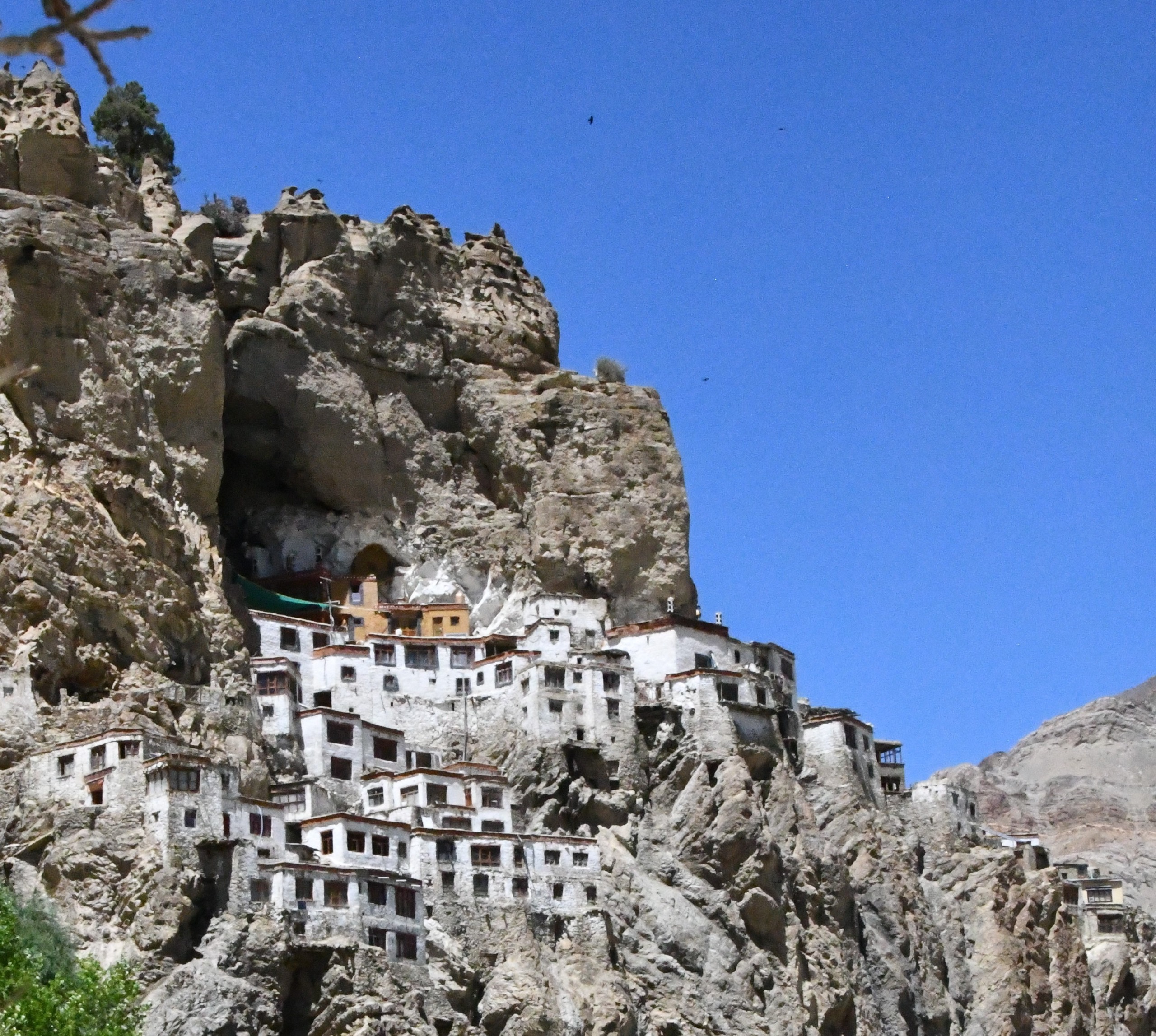
Kargil: The Himalayan Cultural Heritage Foundation (HCHF) has submitted an urgent report calling for the immediate conservation of Phuktal Monastery, one of Ladakh’s most iconic and endangered cultural landmarks.
The report, compiled following a recent site visit, was submitted to the Chief Executive Councillor of LAHDC Kargil and other relevant authorities.
Phuktal Monastery, perched dramatically along a cliffside in the remote Zanskar Valley, has served as a centre of meditation and Buddhist learning for centuries.
It is historically linked with revered Buddhist scholars such as Zanskar Lotsawa Phagpa Sherab and Changsem Sherab Zangpo, and gained global recognition through Hungarian scholar Alexander Csoma de Kőrös, who stayed at the monastery during his pioneering research into Tibetan Buddhism.
The HCHF site visit, conducted in collaboration with monastery representatives, revealed severe structural vulnerabilities. Environmental degradation due to increased rainfall, snowfall, and recent rockfall events has damaged key structures, including the Dukhang (Assembly Hall) and several sacred Thangkas.
The report warns that the monastery’s surrounding cliffs are increasingly unstable, threatening both the structure and its irreplaceable cultural assets.
One major concern highlighted is the potential impact of vibrations from ongoing road construction near the site. Extending vehicular access closer to the monastery could dangerously destabilize the already fragile rock formations.
The report also notes that the decline of traditional practices—such as the use of open fires and butter lamps, whose soot once naturally reinforced rock surfaces—has removed a once-effective protective layer within the cave environment.
The report recommends an immediate geological survey by expert engineers and the deployment of appropriate rockfall protection systems designed for high-altitude cliffside structures. Temporary restoration work on the damaged Dukhang is currently underway, but the report stresses that this must be led by a qualified conservation architect and executed using traditional building methods and locally sourced materials. The use of cement in previous repairs is deemed inappropriate and should be replaced.
Several sacred Thangkas damaged by the rockfall also require urgent professional conservation. The report advises the monastery to safely store all affected artworks until trained conservators can begin restoration. Many other Thangkas and wall paintings show signs of water damage, soot buildup, and structural cracking, and are also in need of expert care.
Dr. Sonam Wangchok, founder of HCHF, has assured full support for the monastery’s preservation efforts. He emphasized that Phuktal is not only a spiritual and cultural cornerstone for Zanskar but a globally significant heritage site. He called for coordinated action, guided by expert assessments and handled by trained professionals, to ensure the long-term protection of this irreplaceable legacy.
The report concludes with a strong appeal for immediate and sustainable conservation efforts that respect the traditional architecture, cultural value, and ecological sensitivity of the site.
