

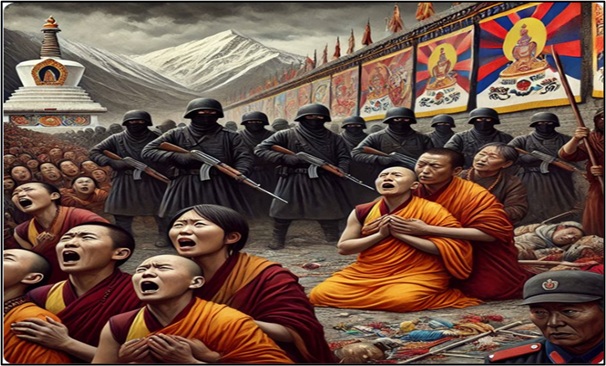
The Tibetan people have faced decades of cultural and religious suppression since from their first uprising day on 10th Mar 1959, under the rule of the Chinese Communist Party (CCP). This systematic oppression has been designed to erase Tibetan identity and assimilate the region into mainstream Chinese culture. The CCP’s policies have led to widespread human rights abuses, including censorship, surveillance, forced assimilation, and religious persecution. Human rights abuses include censorship, surveillance, and forced assimilation, with Tibet consistently ranked among the worst places for civil rights. The international community must address these abuses to protect Tibetan rights and cultural heritage.
According to a news article published in www.10net.in on 02 Sep 2024, the Sinicization of Tibet is a comprehensive program initiated by the CCP to assimilate Tibetan culture into the dominant Han Chinese culture. This process involves a range of economic, social, cultural, religious, and political changes aimed at remaking Tibetan society in the image of China. The government-sponsored migration of large numbers of Han Chinese into the Tibet Autonomous Region has been a major component of this strategy, leading to accusations of Han settler colonialism. Critics argue that these policies have resulted in the disappearance of elements of Tibetan culture, with the Central Tibetan Administration describing them as “cultural genocide”. The CCP claims that its policies have modernized Tibet and improved the quality of life for Tibetans, but these assertions are contested by human rights groups and the Tibetan diaspora.
According to the International Campaign for Tibet report 2022, Tibetan Buddhism, the primary religion of Tibet, faces severe restrictions under Chinese rule. The CCP views Tibetan Buddhism as a threat to its authority and has implemented policies to control and suppress it. Monasteries and nunneries are closely monitored, and monks and nuns are subjected to “patriotic re-education” programs designed to instill loyalty to the CCP.
The International Campaign for Tibet has reported that China continues to persecute Tibetan Buddhists, arresting and torturing those who promote their language and culture or practice their religion freely. The forced disappearance of Gedhun Choekyi Nyima, recognized as the 11th Panchen Lama by the Dalai Lama, remains a significant concern. China’s attempt to control the Tibetan reincarnation system, including plans to select the next Dalai Lama, is seen as an affront to Tibetan religious traditions.
A report by human rights experts of the United Nations 2023, China’s use of residential boarding schools as a tool for forced assimilation of Tibetan children into Han Chinese culture. Over a million Tibetan children have been separated from their families and placed in these schools, where they are taught in Mandarin and encouraged to adopt Han customs. This policy undermines the intergenerational transmission of Tibetan language and culture, threatening the very identity of the Tibetan people.
Tibet has been consistently ranked among the worst places in the world for civil rights and political freedom by Freedom House. The Tibetan flag and national anthem are banned, and possessing pictures of the Dalai Lama can lead to imprisonment and torture. Writers, singers, artists, and teachers are jailed for celebrating Tibetan national identity or criticizing China’s rule.
China’s interest in Tibet is not only cultural but also economic. Tibet is rich in natural resources, including hydroelectric power, which China seeks to exploit for its own benefit. The construction of dams and infrastructure projects often results in the displacement of Tibetan communities without their consent, further eroding their autonomy and cultural heritage.
Despite these severe human rights abuses, China’s actions in Tibet often go unchecked on the international stage. The international community must take a stronger stance against China’s cultural and religious suppression in Tibet. Reports from organizations like the International Campaign for Tibet and the UN highlight the need for decisive action to protect Tibetan rights and freedoms.
China’s cultural and religious suppression of the Tibetan people is a grave concern that requires immediate attention from the global community. The systematic erosion of Tibetan identity through Sinicization, religious persecution, forced assimilation, and economic exploitation must be addressed through diplomatic pressure and support for Tibetan autonomy. The preservation of Tibetan culture and religion is not only a human rights issue but also a matter of cultural diversity and global heritage.
As the world observes Tibetan Uprising Day on 10 March, it is crucial to amplify the voices of Tibetans and stand against China’s oppressive policies. The international community must recognize the severity of these abuses and work towards ensuring that Tibetans can practice their religion, speak their language, and celebrate their culture without fear of persecution. Only through collective action can we hope to preserve the rich cultural heritage of Tibet and protect the rights of its people.
Sources:
https://www.10net.in/2024/09/02/the-sinicization-of-tibet/
https://en.wikipedia.org/wiki/Sinicization_of_Tibet
https://savetibet.org/why-tibet/religious-freedom/
https://freetibet.org/freedom-for-tibet/occupation-of-tibet/
https://savetibet.org/state-department-report-highlights-chinas-persecution-of-tibetan-buddhism/
