

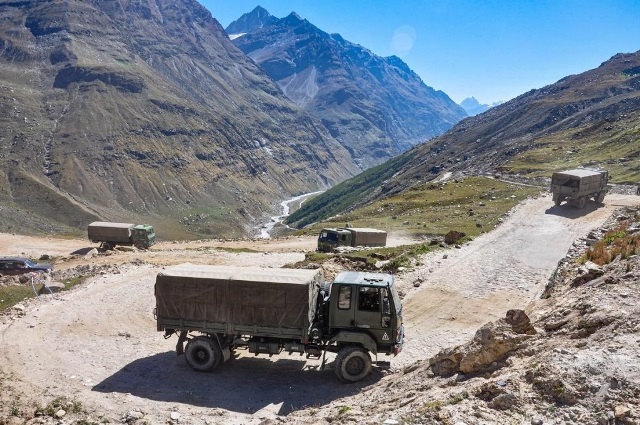
LEH/NEW DELHI: In a year bookended by intractable conflicts and geopolitical fragmentation, India focused on ramping up military prowess by broadly firming up defence procurement worth Rs 4.22 lakh crore even as Indian and Chinese militaries completed pulling back their troops from border face-off points in eastern Ladakh.
The disengagement of frontline forces at the last two friction points of Demchok and Depsang along the Line of Actual Control (LAC) following an understanding reached on October 21 marked a major thaw over four years after deadly clashes between the two nations’ troops in the Galwan Valley severely strained the bilateral ties.
At the same time, the Indian military guarding the nearly 3,500 km LAC maintained an assertive approach, and bolstered its overall surveillance mechanism to closely track activities by People’s Liberation Army (PLA) on the Chinese side of the de-facto frontier.
The year also saw India expanding its strategic heft in the key maritime domain with the Indian Navy deploying more than 30 ships in the face of Houthi militants targeting a significant number of cargo vessels in and around the Red Sea with drone and missile attacks.
The Indian Navy responded to over 25 such incidents and safely escorted over 230 merchant vessels carrying around 90 lakh metric tonnes of cargo valued at over USD 4 billion, according to official data.
The defence ministry said in a year-end review that the Indian Navy’s swift actions saved more than 400 lives.
India also leveraged its strategic strength in key waterways and firmly asserted its influence over the Indian Ocean against the backdrop of China’s relentless efforts to increase its presence in the region.
While the national security planners looked at formulating innovative policies drawing lessons from conflicts and tensions in various geographies around the world, the armed forces focused on boosting combat prowess by procuring new military hardware and technologies.
The Defence Acquisition Council (DAC) and Defence Procurement Board (DPB) accorded Acceptance of Necessity (AoN) for 40 capital acquisition proposals worth Rs 4,22,129 crore in 2024 (up to November), the defence ministry said in a year-end report.
Out of these, AoNs worth Rs 3,97,584 crore (94.19 per cent) have been accorded for procurement from indigenous sources. In the last few years, the government has been focusing on promoting domestic defence manufacturing through a series of policy initiatives.
A major focus of the government was to develop indigenous military hardware to deal with future national security challenges.
However, the government’s ambitious plans towards roll out the theaterisation to bring greater synergy among the Army, the Navy and the Air Force did not see much of a momentum.
In October, Prime Minister Narendra Modi inaugurated the Tata Aircraft Complex for production of C-295 transport aircraft for the Indian Air Force (IAF). The IAF is getting 56 C-295 transport aircraft under a previously finalised deal worth Rs 21,935 crore.
Forty of these aircraft will be built in India. The first domestically manufactured C-295 is likely to be delivered in 2026.
Another significant milestone to enhance India’s military might was induction of indigenously-built Arihant-class nuclear-powered submarine ‘INS Arighaat’ into the Indian Navy in August 29.
The government has also approved construction of two indigenously designed nuclear attack submarines.
In another move, India signed a mega deal with the US in October to procure 31 Predator long-endurance drones from American defence major General Atomics under the foreign military sales route at a cost of nearly USD 4 billion to boost Indian military’s combat prowess.
India is acquiring the drones primarily to crank up the surveillance apparatus of the armed forces, especially along the contested frontier with China.
The high-altitude long-endurance drones are capable of remaining airborne for over 35 hours and can carry four Hellfire missiles and around 450 kgs of bombs.
Indian Navy’s Russian-manufactured guided missile frigate INS Tushil was commissioned into the force at Russia’s coastal city of Kaliningrad this month.
In 2024, Indian Light Tank (ILT) ‘Zorawar’ achieved a major milestone as it fired a number of rounds at different ranges at an altitude of more than 4200 metres with consistently accurate results.
The year also saw India successfully test firing a number of key missiles and other weapon systems.
In November, India tested a nuclear capable ballistic missile named K-4 that has a range of around 3,500 km. It was tested from a nuclear-powered submarine in the Bay of Bengal. With the test, India became part of a small group of nations having the capability to fire a nuclear missile from land, air and undersea.
In the same month, India successfully flight-tested a long-range hypersonic missile. The testing was seen as a major milestone as very few countries have the weapon system.
Generally, the hypersonic missiles, capable of carrying conventional explosives or nuclear warheads, can fly in the range of five times the speed of sound (Mach 5 which is roughly 1,220 km) per hour at sea level.
The Indian military also focused on inducting critical technologies such as artificial intelligence and quantum computing in line with the changing nature of warfare.
In 2023-2024, India’s defence production went up to a record-high of Rs 1,26,887 crore, reflecting a growth of 16.7 per cent over the previous financial year.
Similarly, the defence exports touched a record Rs 21,083 crore in 2023-24, a growth of 32.5 per cent over the previous fiscal when it was Rs 15,920 crore.
In July, the government set aside 6.22 lakh crore as defence outlay for 2024-25. Out of the total allocation, Rs 1.72 lakh crore was given capital expenditure that largely includes purchasing new weapons, aircraft, warships and other military hardware.
The Indian armed forces also participated in a number of mega wargames and hosted several of them throughout the year.
The notable among them was the Malabar exercise featuring the navies of India, the US, Australia and Japan. India hosted the Malabar exercise in October that included both sea and harbour phases with a focus on expanding cooperation in the Indo-Pacific.
The wargame featured participation of various key naval platforms from the participating nations, including guided missile destroyers, multi-purpose frigates, submarines, fighter aircraft and helicopters.
The Indian Navy has to deal with a couple of major accidents.
In July, frontline warship INS Brahmaputra was severely damaged in a major fire.
At least 13 people were killed in a crash between a passenger ferry and a navy speedboat in Mumbai this month.
The three services also got new chiefs in 2024.
In April, Admiral Dinesh Kumar Tripathi, who is a communication and electronic warfare specialist, became the 26th Navy Chief after R Hari Kumar retired from service.
In June, Gen Upendra Dwivedi, who has vast operational experience along the frontiers with China and Pakistan, assumed charge as the 30th Chief of the Army Staff, succeeding Gen Manoj Pande.
Air Chief Marshal Amar Preet Singh assumed charge as chief of the Indian Air Force in September, succeeding Air Chief Marshal V R Chaudhari. (Agencies)
