

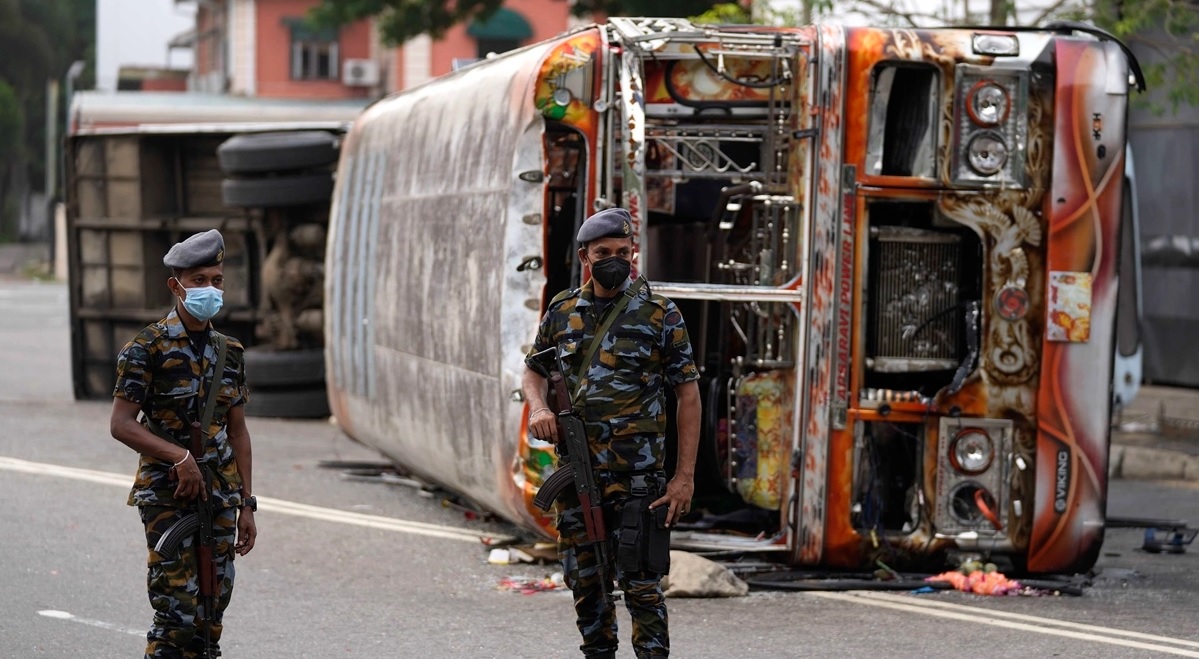
The Sri Lankan civil unrest starting from the second week of March, reached the violent nadir last Monday, 9th May when eight lives were lost and about 200 injured. The supporters of Mahinda Rajapaksa, the head of one of the powerful political families in South Asia, the Prime Minister of Sri Lanka, attacked the peaceful protesters demonstrating outside his house in Colombo.
The video footage of goons and musclemen beating up a lone lady amongst the demonstrators unleashed a wave of anger across the country. The protesters damaged public property, torched the city buses, and in South Hambantota, the ancestral house of Rajapaksa was burnt down. Rajapaksa himself was escorted out of Colombo to a naval base in Trincomalee where he is hiding with his family.
Immediately after the unexpected and unprovoked violent clashes outside his official residence in Colombo, Rajapaksa resigned as the Prime Minister. He said, he did it, in order to pave the way for formation of a united government in Sri Lanka to handle the present crisis, which is one of its kind since the Island nation got independence in 1948.
At the same time, on that Monday, one Sri Lankan lawmaker from Rajapaksa’s party shot to death a 27-year-old young man and then killed himself as he was overpowered by the crowd. Mahinda’s resignation has not assuaged the anger of Sri Lankans across the country, who are demanding that President Gotabaya Rajapaksa must also quit. On the contrary, the President has imposed emergency for the second time this year.
The protest, which was simmering, burst out as the unbearable economic conditions hit the people hard. They were suffering from frequent power shortages, paucity of basic goods, mainly food and fuel, and escalating prices. Pathetically, people suffered from unavailability of critical medicines.
The economic crisis was the second blackest phase of Sri Lanka’s modern history, 13 years after the civil war, which caused heavy bloodshed, while depriving and displacing a large number of Tamils, fighting for a separate homeland in Jaffna area. Even the majority Sinhalese community suffered from the civil war and the government lost personnel and property.
How did the current economic impasse come about? Observers and experts would say that it is mainly the result of gross economic mismanagement. The Rajapaksa government introduced deep tax cuts since 2019 when it took office, the Sri Lankan tourism, the main revenue spinner, was hit badly by the Covid-19 pandemic, the remittance from abroad reduced, and inflexible foreign exchange rate hit Sri Lankan trade. The rating agencies lowered the ranking of Sri Lanka since 2020 and thereby locked it out of international financial markets. Consequently, the foreign exchange reserves depleted by more than 70 per cent.
Rajapaksas did not handle the situation prudently. They dithered in negotiation with IMF for a bailout package in the hope that the tourism industry will bounce back, and remittances will recover. They perhaps thought shrewdly that by seeking help from India and China, they could tide over the economic mess which could just be a bad patch. They knew that India and China are jostling for influence over the strategic Island nation of 22 million people. They were wrong in their calculation.
Another serious allegation concerning the bad economic strategy and wrong policies is the fiscal profligacy indulged in by the government with Chinese money. China got Sri Lanka in a debt trap by financing a slew of white-elephant projects. To name a few, Rajapaksa signed in 2017, a 99-year lease for $1.4 billion project to develop Hambantota port. The project has not been viable yet and Sri Lanka has lost $300 million in six years.
Second, overlooking the port, a conference centre has been built with $15.5 million from China. The centre has practically no use. Third, nearby Rajapaksa’s hometown, an airport has been built with $200 million of Chinese debt. The airport is so sparingly used that it could not cover its electricity bills from its earnings. Fourth, China holds a port city project covering 665 acres of land around Colombo, seducing the Sri Lankan government that Colombo could be developed as an international trade centre like Dubai. Thus, China holds 10 per cent of $51 billion external debt of Sri Lanka. Clearly, Sri Lankan government has walked into a debt trap laid by China.
What are the reactions to the Sri Lankan crisis by the major stakeholders? The European countries and the United States have urged Sri Lankan government to respect democratic norms, not to stifle dissent, and protect human rights. Beijing says it is supporting Colombo to restructure its debt. Out of $3.5 billion loan that Beijing has extended, Sri Lanka will get a reprieve of $1.5 billion out of restructuring. The UN Human Rights Chief, Michelle Bachelet told off the Sri Lankan government for violently assaulting the peaceful protesters. In a statement, she called for resumption of negotiations and dialogue between various parties and ensure that democratic process is revived.
Incidentally, the UNHR Chief is a former Chilean President. The Sri Lankan current quagmire reminds of a similar violent episode in Chile in 2020. The Swedish Ambassador to Chile relayed to me the rise of violent protest in Santiago spreading across the country. The trigger was the sudden rise in the price of metro tickets. But people were suffering from deepening inequalities across the country, from huge costs of healthcare and poor funding in education. The metro ticket opened the proverbial Pandora’s box throwing Chile into an inferno of violent protests. The Chilean and current Sri Lankan episodes send a signal to the countries in South Asia and elsewhere on how not to let people feel the financial pinch beyond a limit.
Talking of India’s response, New Delhi has remained politically neutral. The Indian government has neither criticised the Sri Lankan government nor has supported it. New Delhi has obliquely commented that, “India backs peoples’ rights, democracy, stability and economic recovery”. An MEA statement has further said that “India will be guided by the best interests of the people of Sri Lanka expressed through a democratic process”. India has supported Sri Lanka with $3.5 billion. The Union Government and the Government of Tamil Nadu have sent rice and other supplies in order to mitigate the shortages of essential items. New Delhi has also promised a hand to Sri Lanka in working out a bailout plan from the World Bank.
In sum, we ought to note that a crisis like what we presently see in Sri Lanka is waiting to happen in any country unless economy is efficiently managed. In particular, the basic items for human needs should be available and the prices of essential goods should be under control, like the prices of petrol and diesel. Furthermore, Sri Lankan crisis tells us that muscular nationalism and majoritarian mobilisation may not be an endless source of support. New Delhi, as the biggest country in South Asia and in a sense, ‘the big brother’, should take serious note of Sri Lankan developments, help them steer out of the crisis by all possible means, and legitimately reclaim the leadership of South Asia.
