

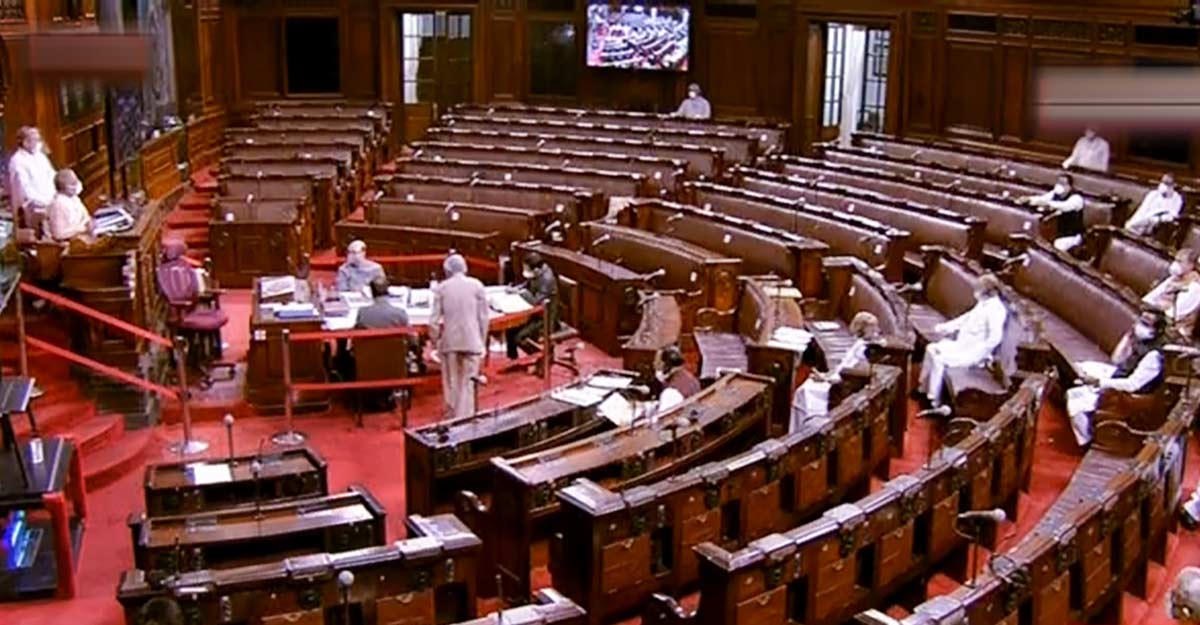
In political Delhi’s ‘heat wave’ is searing over ‘hot’ 57 Rajya Sabha seats across 15 States which entitles them VVIP status and bullet proof “untouchable” jackets for life. What is heating it more is ‘outsiders’ grabbing most. Accentuating that Rajniti is all about conducting public affairs for private advantage. With the devil taking the hindmost!
No matter if Rajya Sabha’s character and quality sharply deteriorates. Personal loyalty to the leader, nay chamchangiri, monetary considerations and political connections get precedence over competence and experience. The House has become a hunting ground for Party bosses to bring their favourite ‘outsiders’ from any State as long as they have the relevant strength.
One look at the list of Rajya Sabha MPs explains it all. Union Finance Minister Sitharaman is from Andhra but has filed re-nomination from Karnataka, ditto State-mate Jairam Ramesh. Congress’s ex-Prime Minister Manmohan Singh belongs to Punjab but is elected from Assam, Delhite Ajay Maken from Haryana, Haryanvi Surjewala from Rajasthan, Maharashtrian Mukul Wasnik from Rajasthan. Samajwadi’s Jaya Bachchan resides in Mumbai but is elected from UP as is ex-Congress mantri Delhite Kapil Sibal.
Seldom, if ever, have these MPs ever spoken about the States they represent! Resulting in the House failing to evolve a distinct role as torch bearer of State’s concerns thereby functioning more and more as a parallel (and competing) political chamber to Lok Sabha, regaling its role to being somewhat secondary and a “revising chamber”. Often, shouting has replaced serious debate.
Alas, today thanks to ‘outsiders’ the House is seeing diminishing returns thereby disturbing the ideal balance between Union and States, demolishing the country’s federal structure. Whereby, States’ voice has got lost in the din of ‘outside’ power brokers who strut about like peacocks in the Rajya Sabha kaleidoscope.
Appalling, in an era where political image has come to be branded like detergents, ‘outsiders’ have converted House of Elders into an invoice for self and pelf, instead of dealing with chronic maladies that plague India.
Additionally, ‘outsiders MPs’ also undermine the country’s integrity over the long haul. Bemoaned a North-East leader: If outsiders are nominated our people will lose even their limited chance of sending a few senior politicians from our States to serve the Rajya Sabha on retirement from active politics. Do our sensitivities count in Delhi?”
Raising a moot point: Does an outsider represent aspirations of the State? No. Many of them do not even know the language of the State from where they are returned and are not familiar with its ethos, culture etc.
Take the case of Karnataka and Tamil Nadu. The two States have a running battle over division of Cauvery river waters. Would a person, who is a Karnataka resident, represent the State’s interest better or the one who belongs to Tamil Nadu but has been elected by the Karnataka Assembly, or vice-versa?
Also, if there was no residential qualification, all 250 Rajya Sabha members, excluding 12 nominated ones, could be from one State and possibly from one city! Primarily the reason why our Constitution-makers wanted it to consist of persons of experience and eminence than those in Lok Sabha.
It was intended to give an opportunity to seasoned people, who may not be in the thickest of political fray, but might be willing to participate in debate with an amount of learning and importance which one does not ordinarily associate with Lok Sabha.
In 2003 Parliament amended the Representation of People Act dispensing with the domicile requirement for getting elected to the Rajya Sabha. Sadly, in 2006 Supreme Court upheld its Constitutional validity, stating “the principle of federalism is not territory related. As long as the State has a right to be represented by its chosen representatives who are citizens of the country, it cannot be said that federalism is affected.”
Thus, a candidate need not be a State domicile from where he seeks elections. Thereby opening floodgates of powerbrokers and Lok Sabha losers finding ‘safe’ Rajya Sabha seats for a price and more.
In fact, Dr Ambedkar in the Constituent Assembly asserted: “The Council of States ex-hypothesis represented the States. It’s essential character, as originally planned and agreed on all sides, was primarily to function as the instrument for the effective expression at the Parliamentary level of the point of view of the units, expressing their interests and concerns.”
Accordingly only persons ordinarily resident in a State and registered as voters there were permitted to represent that State in the Council. Unlike in Lok Sabha whereby any voter can contest from any constituency in the country. Nehru too clarified in Lok Sabha 1953: Rajya Sabha was neither the “Upper House nor House of Elders. It was the Council of States with clearly specified functions.”
Moreover, Rajya Sabha, unlike Lok Sabha, enjoys special powers vis-a-vis States. For instance, Article 249 empowers it to legislate with respect to matters in the State List. All that it needs to do is declare by a resolution, supported by not less than two-thirds members present and voting, that it was “necessary or expedient in the national interest” to do so. Hence, it basically reflects the character of the Indian Union and seeks to give States individually and collectively a voice in governance of the Republic, no less, no more.
Even the National Commission to Review the Working of the Constitution report in 2006 recommended: “In order to maintain the basic federal character of Rajya Sabha, the domiciliary requirement for eligibility to contest elections to the House from the concerned State is essential.”
Obversely, a few argue the domicile criterion as inconsequential because any representation to Rajya Sabha hardly adds to the comparative worth of the House. Hypothetically, even if one were to see merit in domicile as the criterion for representation, domicile would still fail to extract recognition from those representatives, belonging to the Lok Sabha.
What next? Time for our powers-that-be to desist from playing further havoc by nominating ‘outsiders.’ The rules that govern membership to Parliament must be re-written. One view is the Rajya Sabha could still be made to play a more useful role. JP strongly favoured a Party-less Council whereby only those who had served one stint in a State Assembly or Lok Sabha and no more than two terms should be made MP. After all, representation to Rajya Sabha is based on the collective good as embodied in the State.
Today, we have MPs enjoying four-six terms of six years each in Rajya Sabha without ever fighting an elections to either State Assembly or Lok Sabha.
Clearly, the Elders must set the Council of States in order as it first and foremost represents States. What it desperately needs is more substance than style along-with domicile criterion which assigns authenticity to representation whereby State’s interests are looked after. If this practice of ‘outsiders’ and loyalists continues be prepared to shed tears for the Rajya Sabha.
