

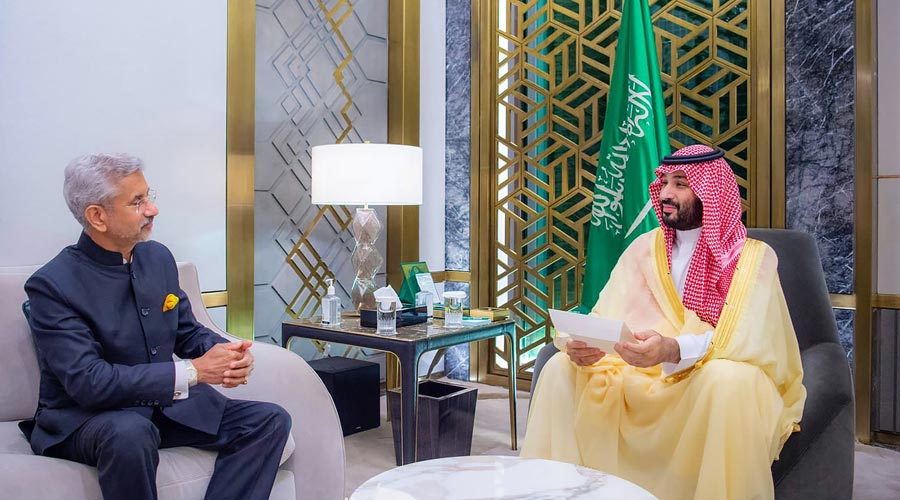
The External Affairs Minister S. Jaishankar was in Saudi Arabia on a three-day visit beginning 10 September. It was his first official visit to the country since taking over South Block. He was armed with a letter from Prime Minister Narendra Modi conveying greetings of their upcoming National Day on September 23, to the Crown Prince. At the same time, as a part of reciprocal courtesy, the EAM extended an invitation to the Crown Prince to visit India at an early date. In material terms, the EAM was tasked with consolidating the growing ties between both the countries.
Jaishankar began his schedule by interacting with 2.2 million-strong Indian community which is the largest expatriate group in the Kingdom. He commended the Indian expats in Saudi, “consciously or unconsciously, all of you through your achievements, contribution, profession and friendship have collectively built up what is the Saudi perception of India. For that, your country will be always grateful”. He added, “in many ways all of you set the image of India and what Saudis think about and what we are about”.
In order to encourage and seduce investment in and attention to India, Jaishankar said that India had made powerful efforts to grow its economy and emerge as a higher- income country and that it will be the fastest growing major economy in the world this year with at least 7 per cent of growth despite the challenges posed by the Ukraine crisis. He ended by assuring, “one of our foreign policy priorities is to ensure that our people get good treatment abroad”.
The EAM met his counterpart Prince Faisal bin Farhan Al Saud in Riyadh. Both the ministers co-chaired the inaugural meeting of the Committee on Political, Security, Social, and Cultural Cooperation (PSSC), which works under the umbrella framework called India-Saudi Arabia Strategic Partnership. Both the ministers evaluated the progress in relations across the domains – political, trade, energy, investments, defence, security and culture. Several areas were prioritised for further work in improving cooperation, such as food security, healthcare, pharmaceuticals, defence industry and entertainment.
Jaishankar met the Secretary General of the Gulf Cooperation Council (GCC), Dr. Nayef Falah Mubarak Al-Hajraf and discussed India-GCC relations. They signed a MoU on mechanism of consultations between India and GCC. One of the mechanisms is to institutionalise annual dialogue between India and GCC, which will be aided by several working groups on different areas of cooperation. GCC plays an important role in the Middle-Eastern regional situation and India enjoys cordial relations with the Council. GCC is a regional, inter-governmental, political and economic union consisting of six countries – Bahrain, Kuwait, Oman, Qatar, Saudi Arabia and United Arab Emirates.
His next stop was the Prince Saud Al Faisal Institute of Diplomatic Studies, where he addressed the Saudi diplomats. In his speech he underlined the importance of India-Saudi Strategic Relationship at a time when the world is at crossroads. He said, “our collaboration holds promise of shared growth, prosperity, stability, security and development”.
Let us remember that Saudi Arabia is important for India for aforesaid multiple reasons. On trade, Saudi is the fourth largest partner. More than 18 per cent of crude oil imports come from there. During April-December 2021, bilateral trade was USD 29.28 billion – imports from Saudi Arabia were valued at USD 22.65 billion and exports worth USD 6.63 billion.
To trace the history, Indo-Saudi relations go back to 1000 AD when trade between Southern India and Arabia flourished and became the backbone of the Arabian economy. In fact, Arab traders monopolised the spice trade between India and Europe until the advent of European imperialist powers. India was one of the first countries to establish ties with the third Saudi State after the unification of Saudi Arabia through a military and political campaign, which trounced various tribes, sheikhdoms, city states, emirates and kingdoms of most of the Arabian Peninsula. The unification process started in 1902 and ended in 1932.
The formal diplomatic relations between India and Saudi Arabia were established soon after India became independent in 1947. The relationship has grown since then with ups and downs. The bilateralism has been backed by visits by Indian Prime Ministers to Saudi Arabia: Jawaharlal Nehru (1955), Indira Gandhi (1982), Manmohan Singh (2010) and Narendra Modi (2016 and 2019). Likewise, in 2019, Saudi Crown Prince Mohamad bin Salman visited India. The elephant in the room has been Pakistan which has strong religious link with Saudi Arabia: both are Sunni Islamic countries.
However, Saudi Arabia realised the radical changes in international geopolitics and the need for realigning with the new configuration of powers. Once upon a time, a development, which was unthinkable, happened. The Middle-Eastern countries made rapprochement with Israel and a new alliance came up, which is called I2U2 comprising India, Israel, UAE and USA. Hence, having disentangled from the past, Saudi Arabia has begun to look at India with a new strategic perspective. To start with, Saudi Arabia honoured Prime Minister Modi with their highest civilian award. During the first visit of Modi in 2016, Saudi announced investment of 100 billion USD in India.
Since then, today’s Indo-Saudi cooperation is not just restricted to the traditional area of oil-energy trade. The relationship has become multi-dimensional including defence, maritime security, counter-terrorism, science and technology, strategic oil reserves, investments, tourism and so on. This closeness has been necessitated by the respective needs of the countries. Massive economic reform programmes are being carried out in Saudi Arabia for which India’s technological and skill-power assistance are needed. Similarly, New Delhi needs Saudi investments in India’s development along with cooperation in economic and security matters.
Cooperation in security matters constitutes mutual interest as both countries are concerned by the security concerns in their respective regions. While India continues to face cross-border terrorism, Saudi Arabia is vulnerable to recurring missile and drone attacks on its major oil fields. The strikes on Aramco’s oil processing plant, Abqaiq, and the Khuris oil field on September 14 in 2019 are cases in point. Both countries agreed to conduct a Comprehensive Security Dialogue. In the maritime security domain, both countries agreed to allow their navies to hold joint naval exercises.
All in all, India and Saudi Arabia relations are driven by both realpolitik and the strategic interests. They have begun to realise that by focussing on their national and mutual interests, they will benefit a lot more than by letting their relations be dictated by a third party. The jinx has been broken. Perhaps, the die has been cast. The visit of the Foreign Minister should enhance the relations and in the immediate as well as long run, it is for the leadership of both countries to give teeth to their talks, agreements as well as the very common place diplomatic tool, the optics.—INFA
