

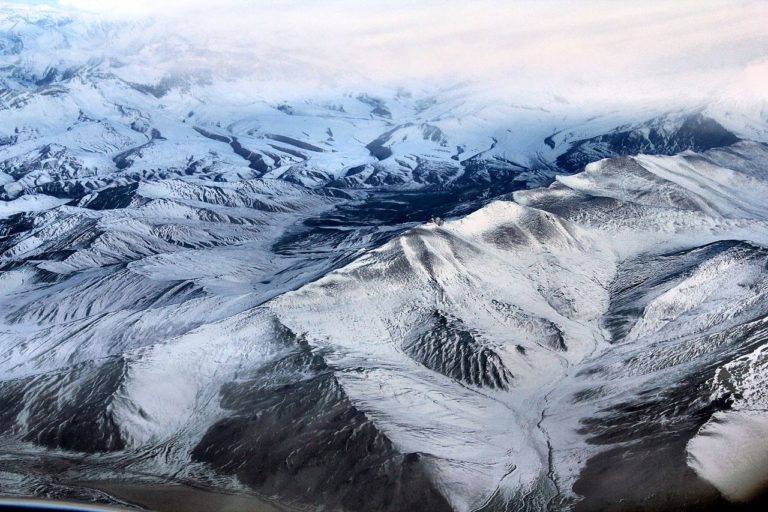
Gigantic Himalayan tragedies rock and destabilise the Indian economy as development becomes fad. The 15.9 per cent wholesale inflation, stock sensex crash by 2931points in a week, rupee below 78, prolonged heat wave, low wheat yield, millions of tree felling and blasts for roads are connected saga. The latest least discussed washout of Assam’s New Haflong railway station is a testimony of the magnitude and a tell-tale of India’s future.
Affecting of the fragile Himalayas is stated to be the reason for most calamities and severe heating up of the Indian subcontinent and economic woes. An Indo-US Monsoon study linked the Himalayas to formation of cyclones up to South Africa. About 10,000 Himalayan glaciers are receding at a rate of 30 to 60 metres (100 to 200 feet) per decade as temperatures rise with road and dam constructions. Around 10.76 million trees were felled between 2015 and 2018 for development, as per a Rajya Sabha answer. Supreme Court for now stays chopping of 11000 trees in Dehradun.
The nation has learnt little from the June 2013 Kedarnath tragedy that wiped out a large chunk of the Himalayas considered the soul of god – Devtatma killing 6000. The cost of damages is difficult to assess but a sample can be taken from the compensation given to flood hit people in Bihar. For Rs 5-lakh houses Rs 6000 is doled out. Uttarakhand allocates one-third of its annual budget to disaster relief and in 2021 spent additional Rs 7000 crore.
Arunachal Pradesh’s largest Dibang dam will chop 2.7 lakh more trees. The Haflong washout would not have happened but for the false desire for creating a single-gauge all over. The British time metre gauge track, created for a purpose on the fragile patches, now being preserved for heritage purposes has its old Lower Haflong station intact. The mudslide from nearby hills loosened by blasts engulfed the station, marooning a number of trains, putting about 2500 people at great risk, at least five deaths, blocks a tunnel, and links to Tripura-Mizoram-Manipur.
It is fashionable to discuss about Uttarakhand, but the North-East is becoming worse with losing about 1.45 million hectares (Mha) of tree cover between 2001 and 2020, amounting to roughly 76 per cent of the country’s total tree cover loss, according to a global study by the University of Maryland’s Global Land Analysis & Discovery (GLAD) laboratory released by Global Forest Watch (GFW). It says India as a whole lost 1.93 Mha of tree cover in 2001-20, including Uttarakhand’s 50,000 hectares.
Assam has the highest share of the national tree cover loss, 14 per cent. From 2001 to 2020, the state lost 269 kilohectare (kha) of tree cover — 9.8 per cent decrease. Among other Northeast states, Mizoram lost 247 kha, Nagaland 225 kha, Arunachal Pradesh 222 kha, Manipur 196kha, Meghalaya 195 kha and Tripura lost 102 kha tree cover in 20 years, the report said. The top five States in the list with the maximum tree cover loss are in the North East. The seven sister States are also among the 10 worst performers in terms of tree cover loss.
Arunachal with proposed 169 hydropower projects is in throes of protests against construction of mega dams over Brahmaputra and its tributaries. All Assam Students Union that once pleaded for dam on Subansiri in 1985 now opposes it. The protests intensified after June 2008, when excess water was released from the Ranganadi dam, the first in Arunachal without prior warning to downstream communities. Massive flood submerged large swathes of land, killing at least 10 people and affecting around three lakh.
“No-more-dam” movement is popular in Arunachal but resistance weak. So now comes the world’s largest concrete gravity Dibang dam with 2880 MW capacity in a fragile region. It would lead to clearing 1,165 hectares of rare traditionally protected biodiversity forest home to the Idu Mishmi tribe. Hundreds of families in 39 villages of Dibang Valley will be displaced. Sudden glacier meltdowns are probable at dam site.
The pattern is almost a repeat at Kedarnath restoration at the insistence of former Uttarakhand chief minister Harish Rawat. Dr D.P. Dobhal, a senior glaciologist of National Institute of Mountaineering, says that the suggestions in their report, in accordance with higher Himalayan geology, were ignored in the new construction.
The Ministry of Environment and Forest (MoEF}on December, 2014 filed an affidavit driven by “pain, anguish and outrage” demanding stoppage of work at 3292 MW seven Uttarakhand hydropower projects, including Tapovan Vishnugad. Seven years later in 2021 it files another saying consensus reached with the power, Jal Shakti Ministry and the Uttarakhand government to continue work on these projects.
And in February, 2021 Tapovan saw flash flood killing 200 in Chamoli. After a study 53 scientists from JNU, and IIT Indore, in June 2021, found that the flood was caused by falling debris, rocks 20 metre in diameter and blocking Nanda Devi glacier leading to 27 million cubic metres of water and debris barreling down the Ronti Gad, Risigana and Dhauliganga river valleys rising 220 metres above the valley flow. This trapped workers and engineers at Tapovan. The rivers are attractive for hydropower projects but little learnt from the Vishnuprayag debacle of 2013 where for kilometres Alkananda has vanished.
The floods, landslides and forest fires are becoming frequent in the Himalayas as reckless road, rail and dam constructions, tree felling, blasting and tunneling in the fragile hills cause continuous landslides or loose rock-falls a regular affair. A Wadia Institute of Himalayan Geology (WIHG) study has found that 51 per cent of Uttarakhand is ‘high’ and ‘very high’ landslide-prone. The local aspirations and large moneys often lead to undesirable ends.
The recent spate of activities on the higher Himalayas for creating road — railways to Karnaprayag, and comfort zones for tourism are adding to the problems. Today, most dams have only one-third the capacity of the power generation these were ostensibly built for but during rains the overflows dip the people in woes. None explains the rationale of such projects and why now being repeated in N-E.
Another side effect of the projects is 100s of kilometers of embankment constructions following the Tehri dam apprehending calamities. If the cost of these is added to the Tehri, it would be stupendous and exposes the human folly.
Policy paradigm has to recognise, National Disaster Management Authority warns, check on construction for protecting the Himalayas. It is key to boosting the sagging Indian economy be it the stocks, commodities or manufacturing.
