

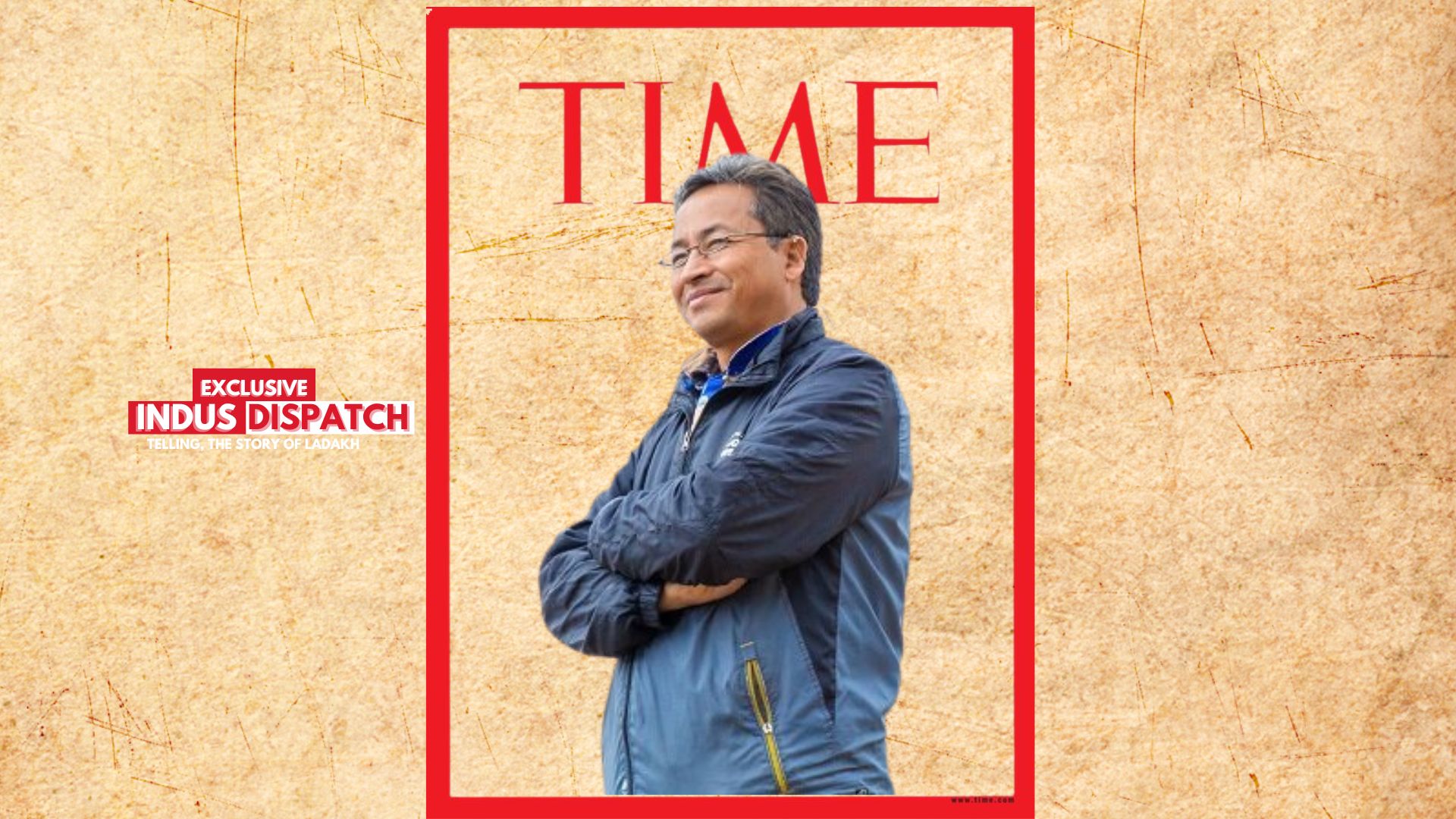
Leh: The Ladakhi climate activist Sonam Wangchuk who is currently in Jodhpur jail has recently been named by the Time magazine in its annual list of 100 influential climate activists.
Wangchuk was arrested by the authorities in connection with September 24 violence in Leh and has since been in detention under the National Security Act.
Here is what the Time magazine said in citation for Wangchuk:
In the high Himalayas in Ladakh, India, Sonam Wangchuk grew up hearing the stories of his ancestors “moving a mother and father glacier into a cave to make a baby glacier,” he says.
Wangchuk went on to become an engineer, educator, and an activist leader, and was arrestee in late September for protesting for greater autonomy in the region. But he has also spent the past decade introducing new science to the ancient cultural practice of grafting glaciers to grow new ice.
At 11,500 ft., where life depends on meltwater from quickly shrinking glaciers and thawing permafrost, the method of storing ice in shaded areas to create artificial glaciers counters water scarcity and dates back to the 13th century.
To modernize the practice, in 2015 Wangchuck ran a mile-long pipe from a glacier stream down into his village. During the winter, the water flows out and freezes into a six-story conical artificial glacier fountain—or an ice stupa, as he named it after the sacred Buddhist dome-shaped shrines.
“Scattered droplets in negative 20-degree air fell down like sand, freezing and naturally forming a cone,” says Wangchuk. As it melts, the ice stupa produces 264,000 gallons of water to support farmers facing climate-induced drought in the critical months of May and June. By 2017, his ice stupas held up to 3.2 million gallons each (measuring 12 stories high) and were being built in surrounding high-altitude desert villages and in Chile, Pakistan, and Nepal. Thanks to Wangchuk’s efforts, for example, climate refugees were able to return to their abandoned village of Kulum, Ladakh.
Freezing pipelines, however, have required villagers to manually unclog them in the bitter cold. To solve this, Wangchuk developed “smart stupas.”
Deploying a system of motorized valves run by a central processing unit, and a new weather station, built by local college students, the stupas now automatically detect blockages and drain the pipes in cold temperatures. The affordable technology (built for $2,000 each), introduced this year, was just adopted by the Ladakh government and is now in the tendering process to be scaled and deployed across the region.
About Time Magazine: Time is an American news magazine based in New York City. It was published weekly for nearly a century. Starting in March 2020, it transitioned to every other week. It was first published in New York City on March 3, 1923, and for many years it was run by its influential co-founder, Henry Luce.
What is Time’s list of 100: The Time 100 is a list published by the magazine of the 100 most influential people in the world in different walks of life. First published in 1999 as the result of a debate among American academics, politicians, and journalists, the list is now a highly publicized annual event. It is generally considered an honor to be included on the list, but, much like the magazine’s Person of the Year, Time makes it clear that entrants are recognized for changing the world, regardless of the consequences of their actions.
