

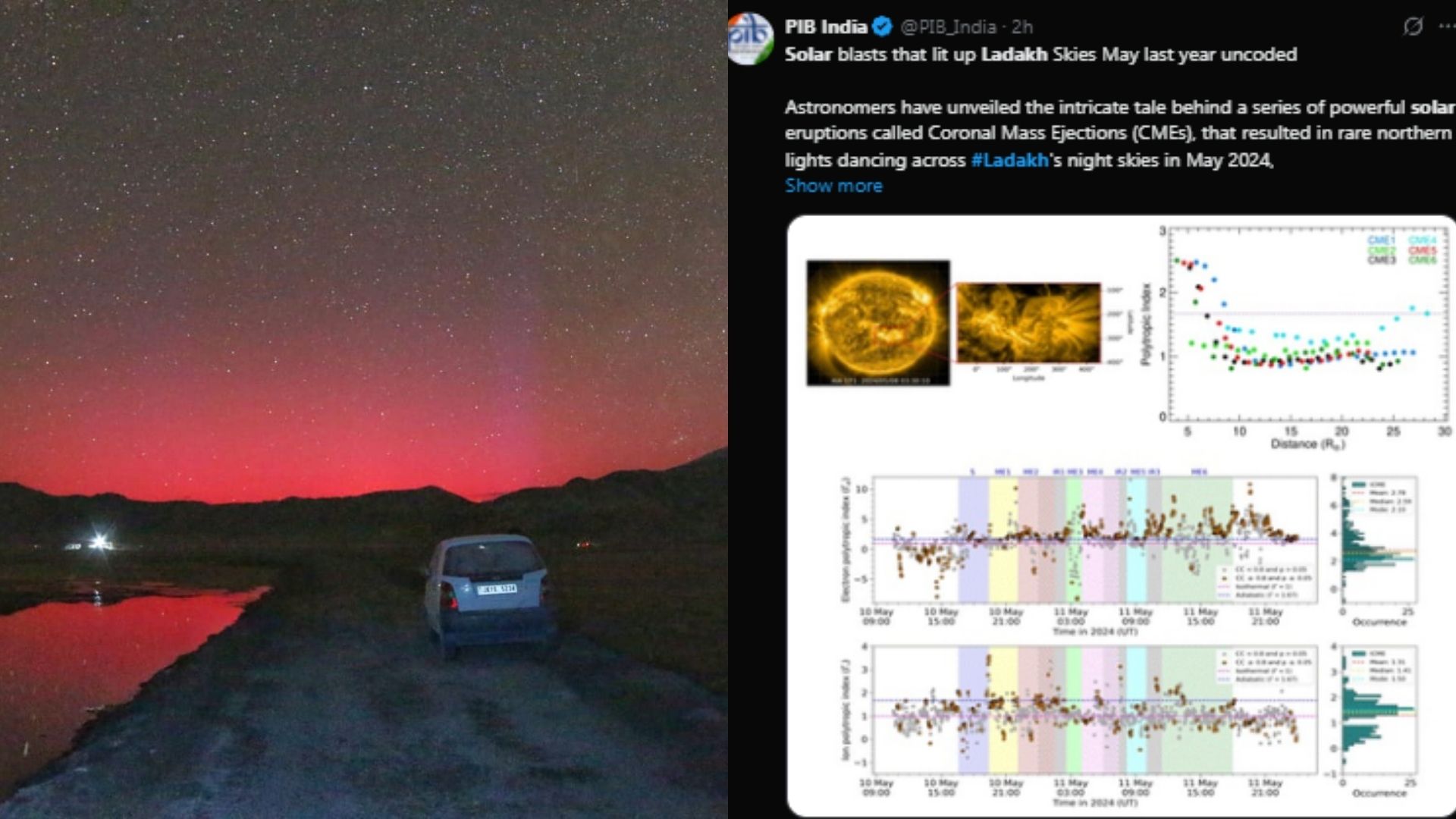
Leh: In May 2024, residents of Ladakh witnessed something extraordinary—vibrant, aurora-like lights dancing across the night sky, similar to what’s usually seen in the Arctic Circle. Now, astronomers have uncovered the reason behind this rare spectacle: an intense solar storm caused by a powerful chain of eruptions on the Sun, unlike anything observed in the past two decades.
These eruptions, known as Coronal Mass Ejections (CMEs), are huge blasts of magnetized plasma that shoot out from the Sun’s outer layer. When directed toward Earth, CMEs can trigger geomagnetic storms that disturb satellites, communication networks, and even power grids.
The storm that lit up Ladakh began on May 10, 2024, and was sparked by a rare and complex series of six CMEs erupting one after another from a highly active region on the Sun. Scientists from the Indian Institute of Astrophysics (IIA) used data from NASA and the European Space Agency (ESA) to study this event closely.
Leading the research was Dr. Wageesh Mishra, whose team at IIA’s Indian Astronomical Observatory in Hanle, Ladakh built a model to study how these six solar blasts interacted with each other on their journey to Earth. Not only did the team track their paths, but they also examined how their heat and magnetic energy changed over time.
Surprisingly, the CMEs didn’t just release heat—they changed behavior mid-journey. Initially, they emitted heat, but later began to absorb and trap it, maintaining a nearly steady temperature as they moved farther from the Sun.
Closer to Earth, data from NASA’s Wind spacecraft revealed an even more unusual phenomenon. The final solar cloud was made up of two twisted magnetic structures—like tangled ropes—containing compressed magnetic fields and unusual patterns of heating and cooling between particles.
According to Soumyaranjan Khuntia, the study’s lead author, this was made possible by a model called FRIS (Flux Rope Internal State), which allowed researchers to track how each CME heated and evolved over time.
“This is the first study, both in India and internationally, that has managed to follow the complete thermal journey of multiple interacting CMEs across such a long distance in space,” said Dr. Mishra. The study was recently published in the peer-reviewed journal Astronomy and Astrophysics, from the European Southern Observatory.
Co-author Anjali Agarwal added that this research could help scientists in the future to predict major space storms by monitoring the heat and magnetic changes of CMEs—an important step in safeguarding Earth’s space-based technology and infrastructure.
The 2024 event has not only illuminated Ladakh’s skies, but also shed new light on how solar storms behave—and how we might better forecast them in the future.
