

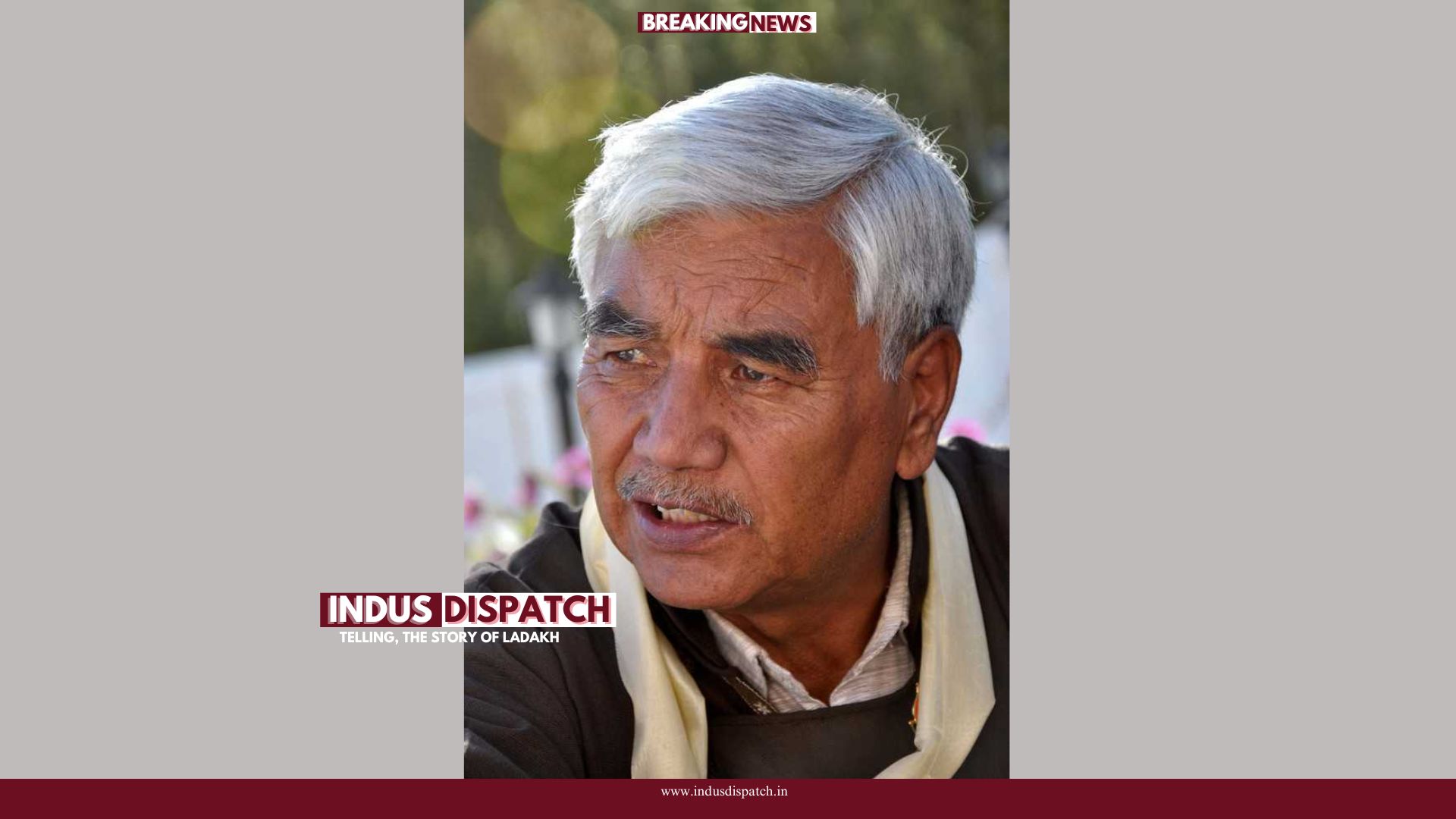
Leh: In a moment of immense political significance for Ladakh, senior leader and widely respected statesman Thupstan Chhewang has officially resigned as Chairman and member of the Apex Body, and also from the High-Powered Committee (HPC) constituted to negotiate Ladakh’s constitutional safeguards with the Ministry of Home Affairs.
This marks the departure of one of Ladakh’s most prominent voices at a time when the region is navigating critical negotiations for constitutional protection, including Sixth Schedule status.
In a statement shared via press note, Chhewang reiterated his decision to stay away from electoral politics and partisan affiliations.
“In keeping with this stance, I hereby resign as Chairman and member of the Apex Body, as well as from the High-Powered Committee. I prefer not to be entangled in competing interests,” he said in the note.
He thanked all members of the Apex Body and Kargil Democratic Alliance (KDA) for their “wholehearted support” during his tenure.
Thupstan Chhewang’s resignation comes as a deep moment of introspection for Ladakh’s political leadership, especially with the dialogue process entering a sensitive phase.
Over the years, Chhewang has built a legacy that rises far above party politics — a figure of balance, unity, and dignity, who has time and again chosen principle over power.
Even after leaving electoral politics in 2018, Chhewang remained central to Ladakh’s political discourse, often seen as a bridge between Leh and Kargil, and a key interlocutor for the Union Government.
In Delhi, he has long been regarded as a go-to person for any central leadership wishing to understand Ladakh, its aspirations, and its historical sensitivities.
He is respected across Buddhist and Muslim communities for his inclusive approach and long-term vision.
Born in Shey, Thupstan Chhewang hails from Ladakh’s royal lineage and spiritual heritage. His father, Shey Lonpo Sonam Tsephel, was a visionary educationist, and his mother, Princess Norzin Wangmo, descended from the last independent king of Ladakh. He was mentored by his uncle, the revered 19th Kushok Bakula Rinpoche.
Educated in Jammu, Srinagar, and later in Sarnath and Delhi (Law Graduate, 1967), Chhewang’s life has been defined by public service. His political journey began in 1972 with a youth protest during the visit of CM Syed Mir Qasim, leading to his arrest.
Over the decades, he led movements for Scheduled Tribe status, local autonomy, and Union Territory status. In 1995, he became the first Chief Executive Councillor of the Ladakh Autonomous Hill Development Council (LAHDC), Leh. In 2000, he founded the Ladakh Union Territory Front (LUTF).
He served twice in the Lok Sabha — in 2004 as an LUTF candidate and again in 2014 as a BJP MP — before resigning in 2018 over disagreements with party leadership. In 2021, he was unanimously elected President of the Ladakh Buddhist Association.
In a related development, senior Congress leader and President of Ladakh Territorial Congress Committee, Nawang Rigzin Jora, also announced his withdrawal from the sub-committee of the Apex Body and from the High-Powered Committee. In a formal letter addressed to the Chairman of the Apex Body, Jora wrote:
“I am withdrawing/recuing myself from the sub-committee… as well as from the High Powered Committee. Congress party, however, shall continue to be part of the Apex Body and support every effort towards achieving our avowed objective (Sixth Schedule and Statehood) and criticise the ones that go against it.”
The timing of both resignations has raised serious concerns about the state of unity among Ladakh’s leadership during a decisive phase.
These resignations come at a time when Ladakh’s political unity — once hailed as unprecedented after the 2019 reorganization — appears to be under strain.
The Apex Body and the KDA had come together in a rare show of cross-regional solidarity to press for constitutional safeguards for Ladakh, which was carved out as a separate Union Territory after Article 370 was abrogated.
The formation of the HPC was seen as a major step forward. However, the lack of progress, unclear commitments from the Centre, and internal political differences may be creating pressure on regional leadership.
The twin exits of Thupstan Chhewang and Nawang Rigzin Jora have sent shockwaves across Ladakh’s political and civil society circles. At a time when the region is at a crucial juncture in its struggle for constitutional safeguards, their sudden withdrawal has left many in disbelief.
People across Leh and Kargil are expressing deep concern over what they see as a fracturing of the hard-earned unity that had formed the bedrock of the joint movement led by the Apex Body and the Kargil Democratic Alliance (KDA).
Local leaders, student bodies, religious organizations, and civil society members are now reportedly making informal efforts to reach out to both Chhewang and Jora, urging them to reconsider or at least clarify their positions further.
