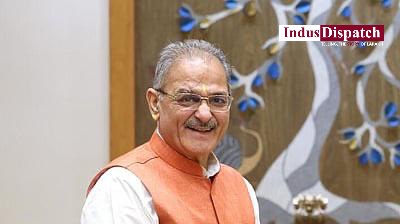
Jammu/Leh: Meet the new Governor of the hill state of Himachal Pradesh. He is just fresh from the cold desert plateau of Ladakh with brief yet eventful stint as Lieutenant Governor.
Kavinder Gupta is not the kind of regular politician who will thump his chest on an everyday basis or jostle for more prominent space in his party, the Bharatiya Janata Party, which has already become unprecedentedly crowded in Jammu and Kashmir.
Gupta is, in fact, something quite different. A poet at heart, a lover of literature, and a thinker by temperament, he has always preferred reflection over rhetoric. He is not a man of high pitch to dominate the discourse. Rather, he speaks softly, almost gently, yet leaves behind a profound impact.
In the increasingly divisive political landscape of Jammu and Kashmir, Gupta enjoys a rare reputation — respect that cuts across party lines and ideological divides. “Kavinder ji ek nehayat hi khandani shakhs hai,” remarked a senior leader of the National Conference who once shared political space with him. The phrase loosely translates to “Kavinder ji is a thoroughly dignified gentleman from a cultured background.” Another colleague described him as “izzatpasand” — literally meaning “one who values honour and dignity,” a person who carries himself with grace and self-respect.
That reputation did not emerge overnight. It was forged through decades of quiet persistence.
Born in Jammu on December 2, 1959, Gupta entered public life early. As a teenager he joined the Rashtriya Swayamsevak Sangh at the age of thirteen, immersing himself in ideological training and organisational work. During the tumultuous years of the Emergency, he spent around thirteen months in jail — a formative experience that left a deep imprint on his political thinking.
His political ideas took deeper shape during his student years in Punjab. There he worked with the Vishva Hindu Parishad and later the Akhil Bharatiya Vidyarthi Parishad, two organisations that nurtured many leaders who would eventually shape the BJP’s ideological and organisational framework.
By the turbulent 1990s, when militancy and uncertainty gripped Jammu and Kashmir, Gupta had already emerged as one of the most visible youth leaders associated with the broader RSS–BJP ecosystem in the region. Those years demanded both resilience and conviction — qualities that gradually defined his public persona.
His real administrative imprint began in the 2000s when he was elected Mayor of Jammu. Gupta served three consecutive terms from 2005 to 2010 — a rare distinction in the civic history of the city. During his tenure he sought to advance the ideological identity agenda associated with the BJP and RSS, but without losing sight of the basic responsibilities of civic governance. Roads, sanitation, urban services and the everyday functioning of the municipal system remained central to his approach, allowing him to maintain goodwill even among communities that did not necessarily share his political views.
The next turning point came in 2014. Riding the wider national wave that accompanied the rise of Narendra Modi, Gupta contested and won the prestigious Gandhinagar constituency in Jammu. Soon afterwards, in March 2015, he became Speaker of the Jammu and Kashmir Legislative Assembly — the first leader from the BJP to occupy that position in the state’s political history.
In April 2018 he briefly served as Deputy Chief Minister in the coalition government led by Mehbooba Mufti, though the alliance between the BJP and the PDP collapsed within weeks.
Yet politics is often about survival as much as success. The BJP’s generational transition after 2014 — which saw veterans such as Lal Krishna Advani and Murli Manohar Joshi gradually stepping aside — had echoes in Jammu and Kashmir as well. Leaders with whom Gupta had begun his political journey, including Chaman Lal Gupta, Ashok Khajuria and Piara Singh, faded from the frontline over time, while stalwarts like Vaidhya Vishnu Dutt and Daya Kishen Kotwal had long passed away.
Through these shifting seasons, Kavinder Gupta endured.
His later appointments to high constitutional responsibilities — including as Lieutenant Governor of Ladakh and now as Governor of Himachal Pradesh — reflect a steady rise built over decades of organisational loyalty and administrative experience.
Indeed, Gupta’s journey is historically notable for another reason. Among leaders from Jammu, very few have risen to such constitutional positions. In the past, figures like Vishnu Kant Shastri and Babu Parmanand had served as Governors. Shastri, though originally from Jammu’s Vinayak Bazaar, had long settled in West Bengal before rising to that office — and incidentally also served as Governor of Himachal Pradesh during the era of Atal Bihari Vajpayee.
With Kavinder Gupta’s appointment, Jammu once again finds representation at the highest constitutional levels.
With his latest rise, Kavinder Gupta joins the rare league of leaders from Jammu — such as Dr Karan Singh and Om Mehta — who continued to command the attention and confidence of their central party leadership in Delhi.
And in that quiet, understated ascent lies the real story — the rise and rise of a leader who rarely raised his voice, yet steadily climbed the ladder of public life, one careful step at a time.