

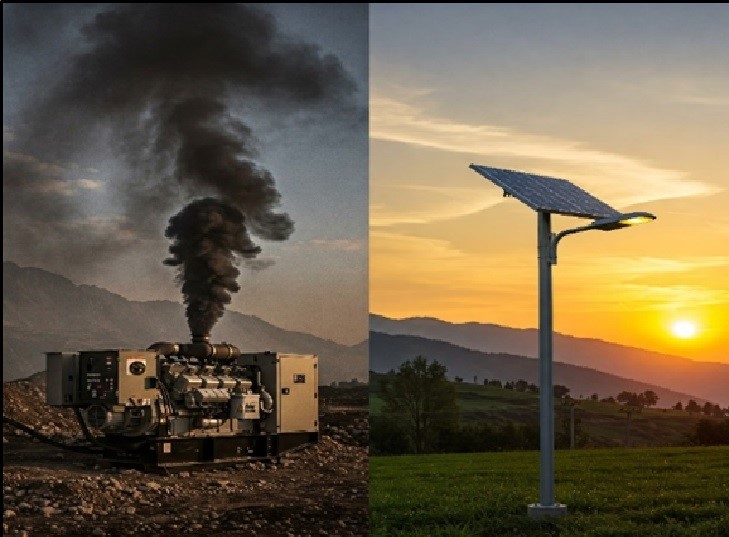
The stark beauty of Ladakh, with its towering mountains and pristine landscapes, hides a harsh reality: energy scarcity.
The strategically vital region relies heavily on diesel generators, a polluting and expensive solution, especially during the harsh winter months when the vital hydel power plant on the Indus River freezes.
After visiting various sites, I learned that in this challenging environment, the Indian Army has emerged as an unsung beacon of sustainability, spearheading renewable energy initiatives that are not only reducing environmental impact but also bolstering energy security.
One such impactful project is Operation Sadbhavana, under which the army has installed a cumulative 196 solar streetlamps at the villages of Laga, Gurgurdo, Kaksar, Kharasa, Barsoo, Sumdo, Taru, University of Ladakh, Koyul, Durbuk, Tangtse, Sachakol, Pun Pun, Lukung, Kharnak, Upper Hunderman, Hemisukpachan, Karzok, Chumar and Panchthang.
While seeming like a small step, this initiative leads to significant results. Traditional streetlamps, consume a hefty 3kWh of energy daily (assuming 12 hours of operation), this contributes substantially to Ladakh’s energy demands. The switch to solar power translates to an annual saving of approximately 214,620 kWh of energy. This is not just an abstract number; it represents a tangible reduction in diesel consumption and corresponding emissions.
Ladakh’s dependence on diesel generators comes at a steep price. With diesel prices soaring, the financial burden on the region is immense. Moreover, the environmental cost is even higher.
Diesel generators are a major source of carbon emissions, contributing to climate change and air pollution. A single generator, even with moderate usage, can consume vast quantities of fuel, releasing harmful pollutants into the fragile Himalayan ecosystem.
The army’s initiative has reduced this dependence. By switching to solar, the 196 streetlamps alone will save an estimated 141,649.2 kWh of energy per annum that would have otherwise been generated by diesel.
Assuming efficient and ideal generator operation due to low ambient temperature it would have required 70,824.6 litres of diesel to produce the energy for operating traditional street lighting infrastructure.
Given that two thirds of Ladakh’s energy is produced by diesel generators and during winter months when the rivers freeze all energy is produced by the generators.
Diesel has direct emissions of 2.56 kgCO2e per litre (scope 1). On top of this, diesel has indirect upstream emissions of approximately 0.61 kgCO2e per litre (scope 3). This adds up to total life-cycle emissions or well-to-wheel emissions of 3.17 kgCO2e per litre.
While carbon emission factors primarily focus on greenhouse gas emissions that are accounted for within the reporting scopes, a complete emission factor also accounts for additional effects that may be classified as “out-of-scope.”
These include biogenic emissions, which result from natural processes like decomposition or the combustion of biogenic carbon stocks like wood, as well as emissions from other greenhouse gases not covered in the traditional carbon footprint calculations such as Montreal Protocol gases. Accounting for out-of-scope emissions ensures a more comprehensive evaluation of the environmental impact.
On top of the total life-cycle emissions of 3.17 kgCO2e per litre, diesel also results in biogenic emissions of around 0.1 kgCO2e per litre. This is because diesel is typically a mix of mineral diesel and a small share of biodiesel (5-10%). The direct CO2 emissions from biodiesel are biogenic and therefore constitute out-of-scope emissions. Taking an overall emissions profile this gives us approximately 3.27kgCO2e per litre of diesel
By reducing diesel consumption, the Army’s Solar Streetlamp Project has mitigated the release of an estimated 231,596.442 kgCO2e annually – a significant contribution to combating climate change. This figure is even more impressive considering it excludes the potential environmental benefits of mitigating the use of the hydel power plant infrastructure that accounts for approximately one third of Ladakh’s energy profile.
The Solar Streetlamp Project is a powerful example of how small-scale interventions can have a large-scale impact. It highlights the army’s proactive role in promoting sustainable development and environmental stewardship in Ladakh.
By embracing renewable energy, the Indian Army is not just illuminating the streets; they are illuminating the path towards a greener and more secure future for the region. Their efforts serve as an inspiration, demonstrating that even in the most challenging environments, innovation and commitment can pave the way for a brighter tomorrow.
References :-
• https://ecoigloo.com/blog/electricity-in-ladakh-the-story/
• https://www.generator.co.in/how-much-diesel-does-it-take-to-produce-1-kwh/
• https://www.carbonaltdelete.eu/en/insights-list/carbon-emission-factors-more-than-just-a-number/
Shaurya Yaduvanshi is a final year student pursuing a degree of B.Tech.(Renewable and Sustainable Energy Engineering) at UPES (University of Petroleum & Energy Studies), Dehradun. He is particularly interested in Hydrogen as the fuel of the future in the energy and Transport sector.
