

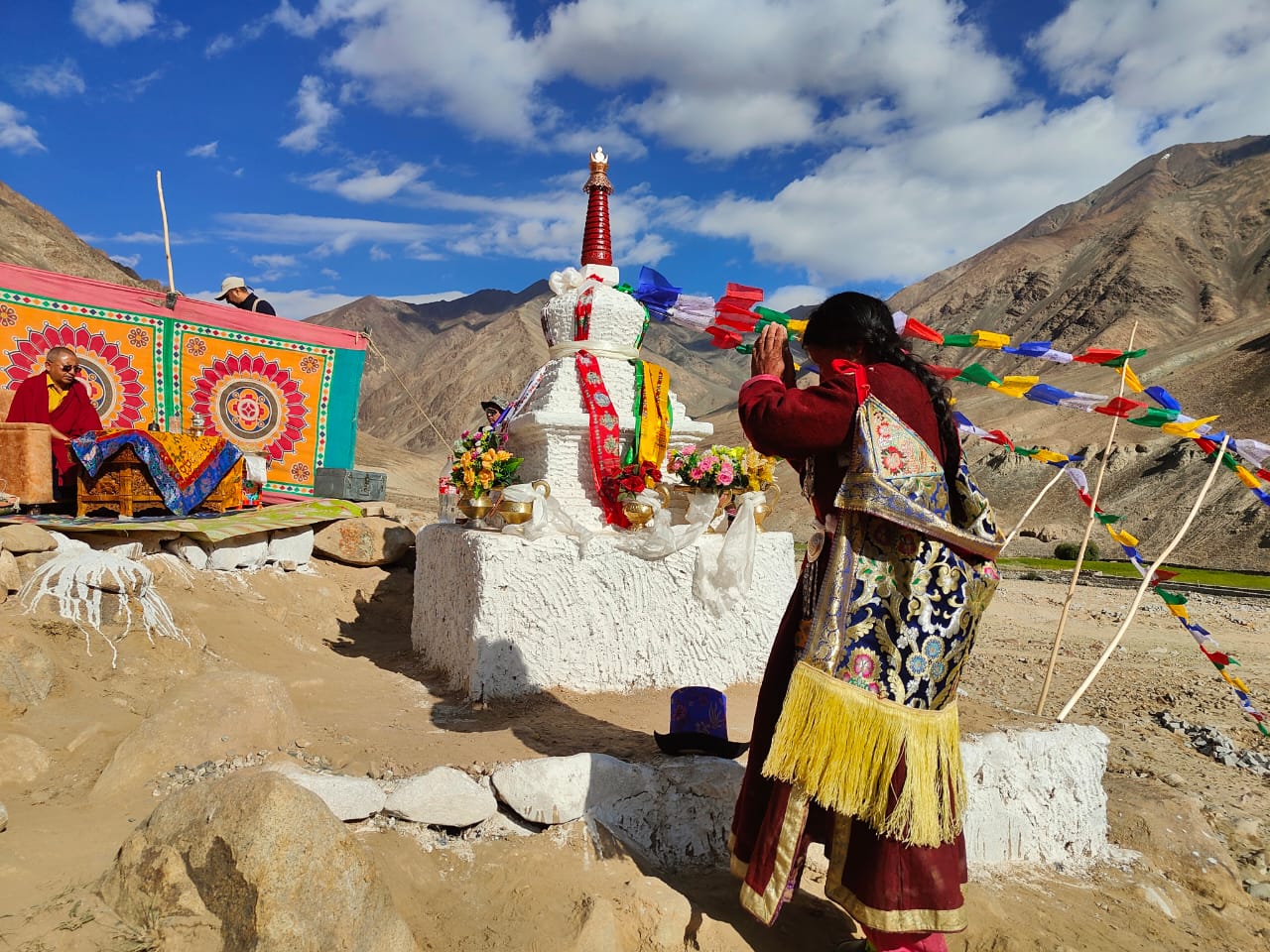
Tharuk: The Nature Conservation Foundation (NCF), in collaboration with the villagers of Tharuk, successfully completed the construction of a stupa near a traditional Shangdong (Wolftrap) in the Serkungchan valley.
This initiative, part of the ‘Shangdong to Stupa’ project, marks a significant step towards wildlife and nature conservation in the region.
The ‘Shangdong to Stupa’ project, launched by NCF in 2018, aims to discontinue the use of shangdongs by constructing stupas as a symbol of seeking forgiveness for past practices and committing to wildlife protection. The first stupa under this project was constructed in Chushul, and since then, NCF has built six more across various parts of Ladakh.
The seventh stupa in Tharuk village was initiated at the request of Dr. Stanzin Namgail, former Programme Coordinator of NCF and a native of Tharuk. The project commenced on 14th July 2024, with the support of Skarma Sonam and the NCF team, along with stupa makers from Nubra and the villagers of Tharuk.
The construction was completed on 19th July, and the stupa was consecrated on 20th July 2024 by His Eminence Bakula Rangdol Nima Rinpoche, Khenpo Shedrup, and monks from Shachukul Monastery.
During the consecration ceremony, HE Bakula Rangdol Nima Rinpoche encouraged the villagers to live harmoniously with wildlife and protect the natural beauty of their surroundings.
He praised the collaborative efforts of NCF and the Tharuk villagers, highlighting the project as a model for other regions in Ladakh and the Himalayan area where similar practices are still in use.
Skarma Sonam of NCF provided an overview of the project, emphasizing its origins and the importance of community involvement. He expressed gratitude to the villagers of Tharuk for their commitment to the initiative.
Gyalpo, a member of the Tharuk village, extended his thanks to the NCF team for their assistance and to HE Bakula Rinpoche for blessing the event and traveling from Leh to participate.
This project stands as a testament to the power of community-led conservation efforts and sets a precedent for sustainable wildlife protection practices in the region.
