

The recent three-train accident in Balasorein which at least ‘275 people’ have been killed with over 1000 injured brings to light the lack of adequate safety mechanisms in an era of technological progress. This is said to be the third deadliest accident in recent years, with one in June 1981 when a passenger train plunged into the Baghmati river, killing over 800 people and the other in August 1995 when the Purushottam Express collided with the Kalindi Express killing over 300 passengers.
Experts have been seeking more emphasis on the safety factor in train travel rather than it being faster. The indigenous Automatic Train Protection (ATP) System called ‘Kavach’, which was developed internally by Indian Railways at a cost of Rs 16.88 crore and launched in 2022, perhaps is said to have not been applicable on this route. The System is said to be missing in most super-fast trains, like in this case the Coromandel Express. However, Railway Minister Vaishnaw maintained the train crash had nothing to do with it, rather it’s ‘an issue of electric point machine’, a vital device for railway signalling, and electronic interlocking.The change, he said, that was done to ‘electronic interlocking’, and ‘the root cause and the people responsible have been identified.’
While the government has ordered a CBI investigation, the Congress has questioned the rationale and instead demanded the Railway minister’s resignation. It said: ‘The CBI is meant to investigate crimes, not railway accidents. The CBI, or any other law enforcement agency, cannot fix accountability for technical, institutional and political failures. In addition, they lack the technical expertise in railway safety, signalling, and maintenance practices,”
And while the government and Opposition slug it out, it’s critical that the Railways gets its priorities right. Though it claims to be in the red financially, it must earmark more resources to implement the ‘Kavach’ system or as is being now said the ‘electric point machine’. The recent crash again exposes the systematic under-funding of the rail safety fund and the slow roll-out of safety mechanism. Besides, the trend of carrying more passengers by continuously adding trains may find some justification but the question of safety as well as affordability must be considered. Expanding the signalling system, introducing anti-collision devices, converting over 400 unmanned crossings to manned level crossings and what holds good for the common man must be studies in totality.
Undeniably, there’s heavy congestion in long distance trains, specially in eastern, south-eastern, southern and northern railways, and getting a ticket at short notice is difficult in such trains. Given the increasing population, it’s obvious there’s need for more express trains, but the question of affordability of such travel is a factor too.
There is need to introspect on the crazily expensive high-speed rail lines run on standard gauge and funded largely by loans from global banks and agencies. The technology is imported, and the running cost is phenomenal. The flagship bullet train between Mumbai and Ahmedabad costing a whopping Rs 1.08 lakh crore is one such example. While the project faced serious opposition, specially from farmers and the Left parties, it is ironic that the same Left has proposed a similar project – the SilverLine – for Kerala. It is a toned down, semi-high-speed version of the same.
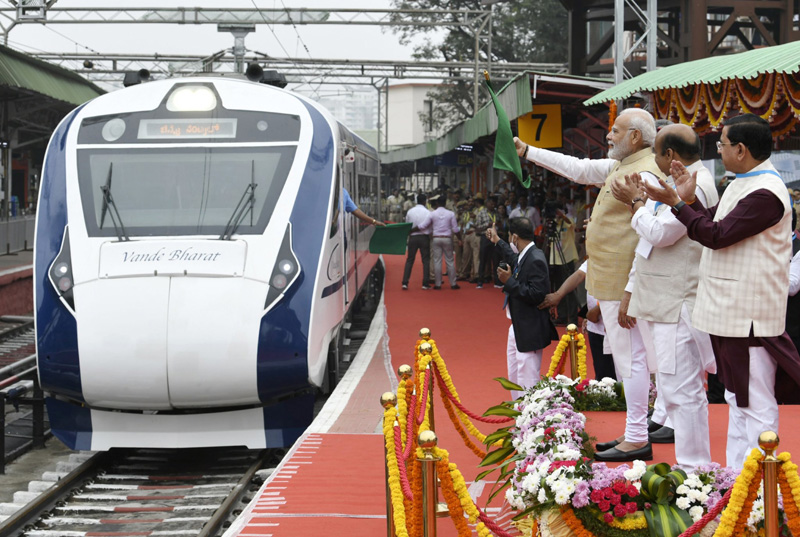
Train 18 or the Vande Bharat was the result of such an approach. This semi-high-speed train comprises electric multiple units that can attain a speed of up to 160 km per hour. A significant advantage is that it can run on India’s broad gauge rail network, making it adaptable across the nation. Its success is undoubtedly a landmark as achieves a top speed of 180 kmph. and the next version will reach up to 240 kmph. But can the common man afford the ticket or for that matter is it advisable to run such trains on congested routes, are questions that need to be addressed.
A single journey in AC Chair Car costs Rs 1590, while the Executive Chair Car costs Rs 2880 for an eight-hour travel. In contrast the number of trains in the popular Jan Shatabdi segments are not being increased whose fares are half the cost in AC Chair Car compared to Vande Bharat and may only benefit the upper middle class and the rich. Shouldn’t the government be adding more Jana Shatabdi like trains that have relatively low fares?
The Railways could consider also spending more on renovating unreserved coaches and make these comfortable. There should be more sitting arrangements; at least three or four such coaches should be there in every mail/express train for poor people to travel.
Speed is no doubt necessary as Indian Railways run trains at a low price compared to most countries of the world,and perhaps like dynamic fares, some system must be evolved so that the BPL and EWS groups can avail of discounts. Moreover, the government could also think of introducing some sort of card system whereby a person could get a 50 percent discount once a year for travelling from his place of work to his hometown, like LTC facility that is extended to Central government employees.
The whole planning and modernisation of railways cannot and should not be accomplished without considering the demands of the common man and his affordability. Moreover, there are innumerable small traders who travel frequently by train to metros to buy products which they sell in small towns. In fact, the focus of generating resources for the railways has to be from goods train, optimum utilisation of infrastructure, modernising stations and even setting up hotels, rest rooms and restaurants.
One may mention here that private hotels are doing brisk business and agencies like IRCTC could set up hotels at tourist destinations in different parts of the country. These could be profitable centres and could subsidise the unremunerative expenditure of sleeper class coaches, unreserved coaches etc. It is also a well-known fact that overseas consultancy of Indian Railways is quite lucrative and generates revenue.
The whole issue of railway finances must be considered in the light of making railtravel available to all sections of society – whether rich or poor. It goes without saying that better services are needed for all sections of travellers. And above all safety, for the concept of life being cheap in India must change.—INFA
