

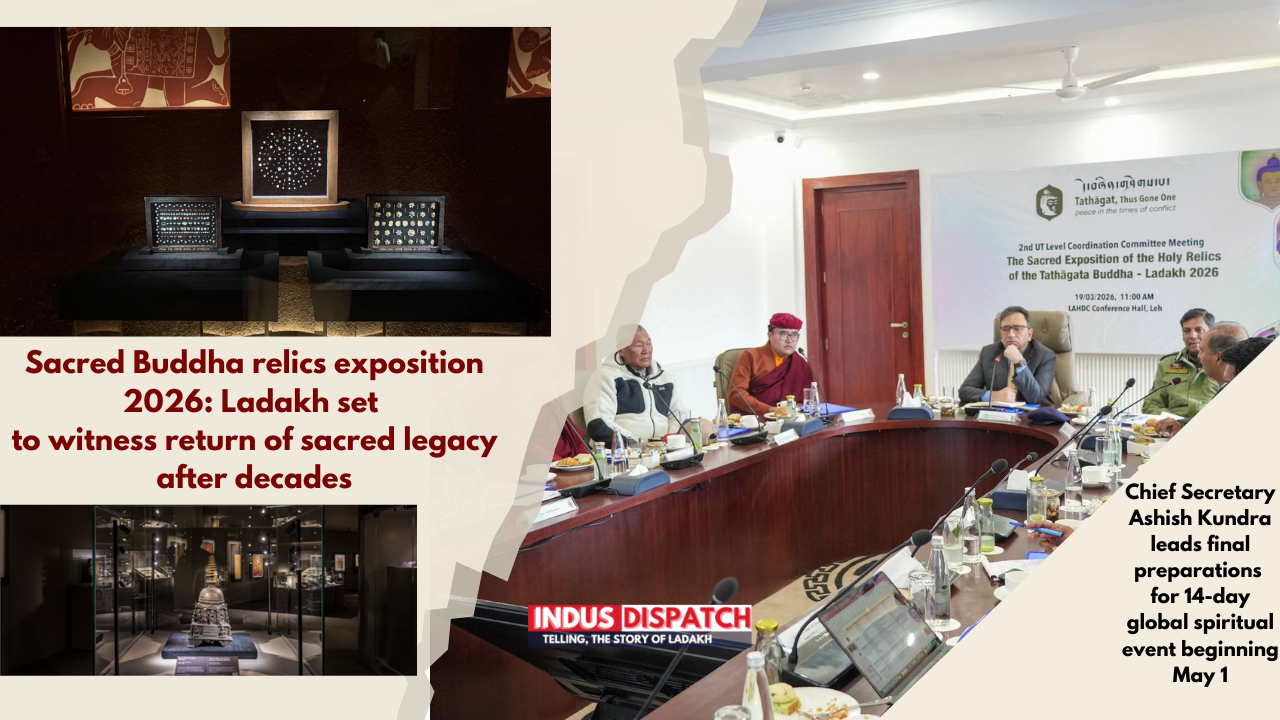
Leh: With less than two months to go for one of the most significant spiritual gatherings in the region’s recent history, preparations for the Sacred Exposition of the Holy Relics of Tathagata Buddha have gathered momentum in Ladakh.
The second UT-Level Coordination Committee meeting, chaired by Chief Secretary Ashish Kundra at the Hill Council Conference Hall in Leh, laid out an extensive roadmap for the smooth conduct of the event scheduled from May 1 to May 14, 2026.
The exposition, being organised under the theme “Peace in times of Conflict,” is poised to become a defining moment for Ladakh’s spiritual and cultural landscape. Addressing officials and stakeholders, the Chief Secretary described the event as a major opportunity to position Ladakh as a global destination for spiritual and cultural tourism, emphasising that the initiative marks a new beginning in this sector for the Union Territory.
Administrative Secretary, Tourism, Sanjit Rodrigues, presented a comprehensive overview of the programme structure, detailing the timeline from the arrival of the relics to the inaugural and closing ceremonies.
The exposition will feature a diverse range of activities, including seminars, interfaith dialogue, meditation and yoga sessions, Buddhist chanting and prayer ceremonies, as well as cultural programmes and exhibitions across key venues such as CIBS, Dharma Centre, MIMC, Leh Palace and the Leh Main Market.
The Chief Secretary stressed the urgency of finalising the list of dignitaries, including revered Rinpoches from various Buddhist sects and representatives of key organisations such as the Ladakh Buddhist Association (LBA) and the Ladakh Gonpa Association (LGA).
These representatives are expected to be part of the ceremonial reception of the Holy Relics both in Delhi and at Leh Airport.
He informed that the Ministry of Culture has granted permission for the exposition to be held for 14 days from May 1, coinciding with the 2569th Buddha Purnima, a date of profound spiritual significance. Additionally, a proposal has been submitted to extend the exposition to Zanskar between May 10 and May 12, enabling devotees in remote areas to participate in the sacred event.
A key highlight of the meeting was the focus on logistical precision and visitor experience.
Kundra directed officials to ensure timely preparation of a shatterproof casket for safely transporting the relics and reviewed arrangements for the main ceremony at Jivetsal, where the relics will be placed for public viewing.
He also emphasised the need for meticulous visitor management, including designated areas for prostration and arrangements for photography with the relics.
The Chief Secretary further informed that the Lieutenant Governor of Ladakh has reached out to various ministries of the Government of India to invite ambassadors from Buddhist-majority nations, underscoring the international significance of the event.
An official website for the exposition is also set to be launched soon to facilitate wider outreach and information dissemination.
Kundra’s hands-on approach and forward-looking vision have been widely appreciated by officials and stakeholders alike. His consistent monitoring, attention to detail, and emphasis on coordination among departments have ensured that preparations are progressing in a structured and time-bound manner, reflecting strong administrative leadership at a crucial juncture.
In a bid to ensure seamless execution, the Chief Secretary directed the Culture Department to prepare a detailed day-wise cultural programme, including participation from international troupes in coordination with the International Buddhist Confederation (IBC).
He also called for close collaboration among all stakeholders to organise exhibitions and associated events effectively.
Beyond the spiritual core, the exposition will host a wide range of parallel activities, including interfaith harmony dialogues, medical camps, live screenings, exhibitions, Chöd performances, mass Buddhist chanting, and even an ice-hockey match—aimed at engaging diverse audiences and enhancing the overall experience.
Recognising the expected influx of visitors, Kundra instructed that a separate meeting be convened with hotel associations, tour operators, and other tourism stakeholders to ensure adequate arrangements for accommodation, travel, and hospitality services.
Earlier this month, on March 6, the Chief Secretary personally visited Jive-Tsal in Choglamsar to assess on-ground preparations. Accompanied by senior officials including DGP Mukesh Singh, DC Leh Romil Singh Donk, and SSP Traffic Vikas Kumar, he reviewed infrastructure readiness, crowd management strategies, security arrangements, sanitation, and parking facilities. Representatives from LBA, LGA, and other local organisations were also present during the inspection, reflecting a collaborative approach to the event.
The administration has also planned a week-long mass prayer across monasteries ahead of the relics’ arrival, aimed at creating a spiritually uplifting atmosphere across Ladakh. In addition, a fortnight-long cleanliness drive from April 15 to April 30 will be undertaken with the participation of the Indian Army, ITBP, Ladakh Police, municipal bodies, and local organisations.
The sacred relics are expected to arrive in Leh around April 28–29, followed by a grand ceremonial reception on May 1.
The relics will then be placed at Jivetsal for public for approximately two weeks, allowing devotees, pilgrims, and tourists from across India and abroad to seek blessings.
Notably, this will be the second historic exposition of Buddha relics in Ladakh, the first having taken place in 1950 for 79 days. Building on that legacy, the 2026 event is expected to draw unprecedented participation and global attention.
With preparations in full swing and a clear administrative roadmap in place, Ladakh is set to host a spiritually enriching and globally significant event that blends devotion, culture, and diplomacy—firmly placing the region on the world’s spiritual tourism map.
