

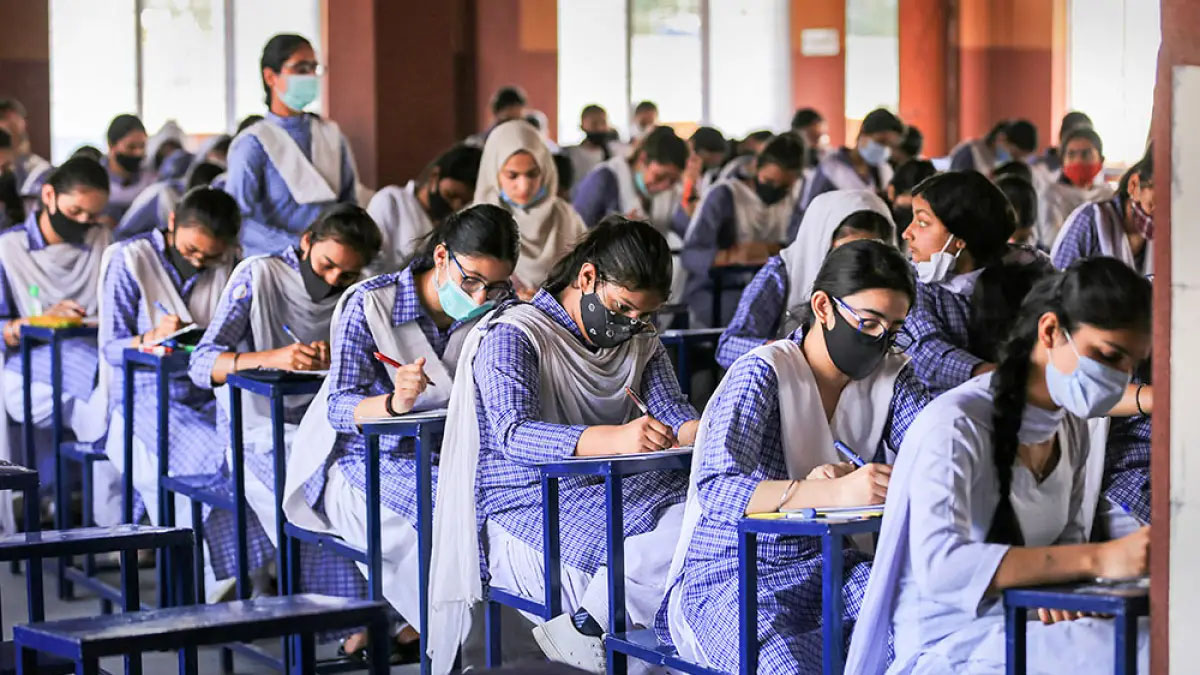
Primary education in the country is neglected as the States do not have the resources to invest in schools and upgrade their standards. Though there has been some increase in budgetary allocation, experts believe that both school education and higher education will stagnate and may actually decline in real terms, if inflation is taken into account. There has been a paltry increase of around Rs 13,000 crore from the current fiscal with about Rs 39,000 crore set aside for the National Education Mission.
This comes at a time when there is imperative need to spread education in villages and also improve its quality after the learning losses suffered during the Covid-19 pandemic. While 100 5G labs are proposed to be established, one such lab in each sub-division, or at least in 100 colleges, should have been taken up. What plans the government has in the ‘aspirational blocks programme’ are not known and has not been enunciated in the Finance Minister’s budget speech. Also, how the District Institutes of Education and Training (DIET) would be developed as centres of excellence is missing in the budget speech. The financial allocation to develop these centres of excellence as of now could be viewed as jargon given that a concrete plan is not spelt out.
However, the promise of recruiting 38,000 teachers and support staff in the next three years for 740 Eklavya Model Residential Schools, serving 3.5 lakh students, appears quite encouraging. Experts expected that more such schools should been opened and each sub-division, if not each block, should get one such school. At least some initiative by the Centre to the States to open one such school in each sub-division on a financial arrangement of 50:50 basis would have helped greatly in upgrading school education.
The recently released Annual Status of Education Report (ASER) found that gender disparity prevails in education as there is a tendency to invest more to educate their sons. There are many States where girls’ enrolment still languished at every level by over 10 percent in Gujarat, Haryana, Madhya Pradesh and Maharashtra. Needless to say, enrolment does not mean attendance. ASER found attendance at government schools to dip from 88.6 percent in Tamil Nadu to under 60 percent in Bihar, Madhya Pradesh and Uttar Pradesh. Any figure under 75 percent found in twelve States suggests habitual absence, dropouts, or ghost enrolments. Teachers are missing as well, sometimes because they play truant, chiefly owing to unified posts. In 2020, there were 17.1 percent vacancy positions across India, 57.5 percent in Sikkim and around 40 percent in Jharkhand and Bihar and it is believed that the situation has worsened today.
Delving into the report, which based its findings on 2021 data, it was found that most States experienced large learning losses during the pandemic. However, once schools reopened, States made a concerted effort to build or re-build foundational competencies, which has resulted in a partial and in some cases, a full recovery. While the last few rounds of ASER did not capture the state of foundational learning, it is understood that the government conducted a study through the NCERT in 2022 to find out whether students were picking up basic skills on literacy and numeracy. The NCERT study found that as many as 37 per cent of students enrolled in Class-III have very limited foundational numeracy skills such as identifying numbers and carry out simple mathematical operations, while even the most basic knowledge is absent in 11 per cent learners.
The National Education Policy(NEP) speaks of “economically suboptimal and operationally complex schools” – translated, those in remote areas with relatively few students. The People’s Archive of Rural India in a report about rural communities in Odisha, Jharkhand and Madhya Pradesh termed them as guinea-pig states for the acronym-happy Union government’s SAT programme (Sustainable Action for Transforming Human Capital). People’s archive of Rural India (PARI) reported that under Sustainable Action for Transforming Human Capital-Education (SATH), nearly 9000 sub-scale schools were shut down in Odisha. From an unclear and undated Niti Aayog report, the tally seems to be 20,000 in MP and 6000 in Jharkhand.
This being the state of primary education, there is a serious need to investigate the condition of schools in the backward districts of the country. Quality of education needs to be improved for which there has to be a sufficient number of teachers and their attendance has to be strictly monitored, either by the panchayats or voluntary organisations. The infrastructure of schools needs to be revamped. It goes without saying that only concentrating in metros and big towns will not help; the rural schools have to be upgraded.
Business houses, whether in the public or private sector, need to be involved and each of these should be asked to take up one or two schools in their area of operation for upgradation. Even religious organisations should be motivated to run schools, if necessary, with panchayats. The States lack financial resources to take up the task of school upgradation and, as such, financial resources must be made available from the Centre, in a mix of loan and also grant for at least one school in every block.
For all this to happen, a specific plan of action is possibly needed with experts on an all-India level. The attendance of teachers, their capability of teaching, the reasons for poor performance of students and, last but not the least, financial requirement of each sub-division or district needs to be evaluated. Also, the possible funding option has to be found out.
There are many ways of running schools with good and dedicated teachers at low cost. Apart from part-time teachers, retired professional and voluntary organisation professionals could be used to teach and run schools. Even religious organisations should be motivated to set up schools in remote areas and government support should be extended. If there is sincerity and zeal to impart education to children, it would be easy to get teachers at a very low cost. However, the school’s education should not be allowed to be polluted by political interference and needs to be run in a professional manner.
What is needed is involvement of educated people across the country, specially in rural areas and small towns to take up the task of imparting education with all sincerity. This is easy to say but, in reality, the implementation of this is not quite easy as in today’s social environment politics and corruption has intruded in every institution. Unless there is motivation, it is difficult to witness any change at the grass-root level though it cannot be put past our leaders coming up with misleading statements about India’s changing profile.—INFA
