

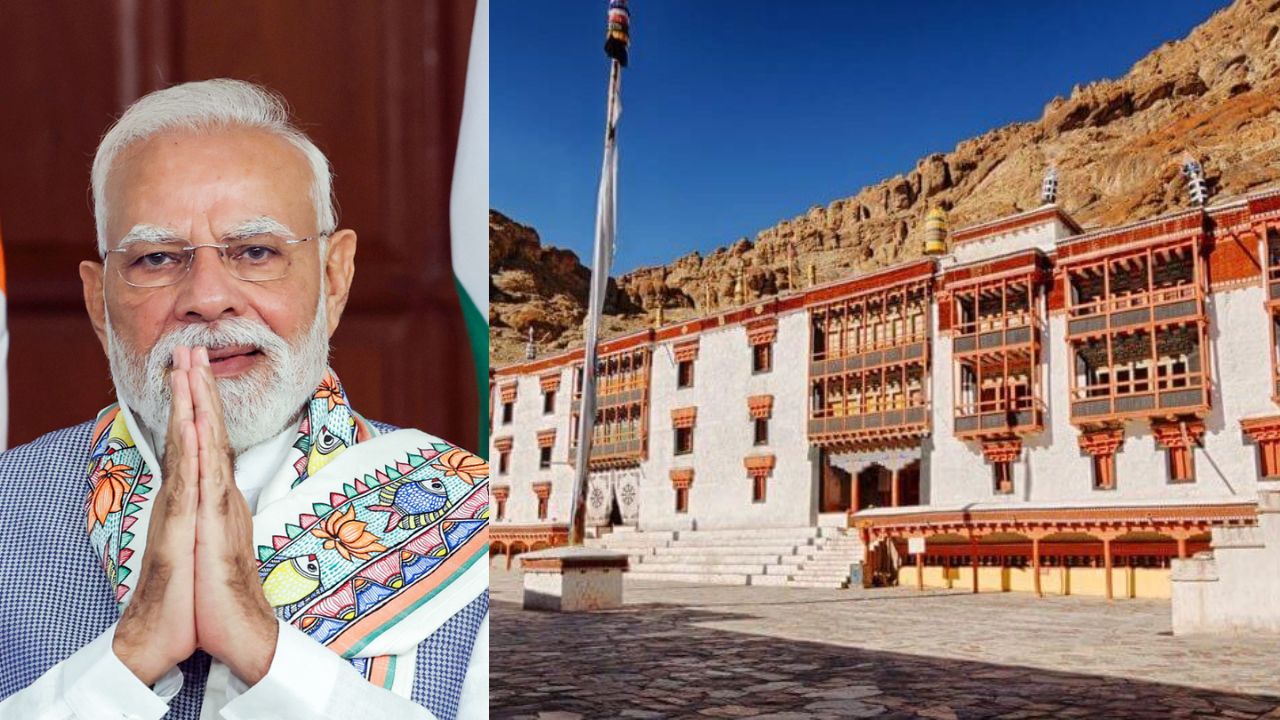
Leh: Ladakh’s centuries-old cultural and spiritual heritage found a prominent place on the national stage after Prime Minister Narendra Modi highlighted contributions from Hemis Monastery during his latest address of Mann Ki Baat, drawing attention to the region’s invaluable manuscript tradition.
Speaking about the ongoing Gyan Bharatam Survey, an initiative aimed at documenting and preserving India’s vast repository of ancient manuscripts, the Prime Minister cited Hemis Monastery as a key contributor. He noted that the monastery has shared information about rare Tibetan manuscripts, underscoring Ladakh’s role in safeguarding Buddhist literary heritage.
The Gyan Bharatam Survey, which is open to public participation, encourages individuals and institutions to upload images and details of manuscripts through a dedicated mobile application. According to the Prime Minister, each submission undergoes verification before being included in a national database, ensuring authenticity and proper documentation.
Reacting to the mention, Stanzin Mingur, a lecturer at the Central Institute of Buddhist Studies (CIBS), Leh, described it as a moment of pride for Ladakh. He said the acknowledgment at the national level would significantly enhance awareness among the local population about the importance of preserving ancient texts.
“It is a matter of happiness that Ladakh, particularly Hemis Monastery, was mentioned by the Prime Minister. We have already submitted manuscripts from the monastery on the Gyan Bharatam platform, and this recognition will motivate more people to come forward,” Mingur said.
He added that many monasteries in Ladakh house rare manuscripts written in Tibetan script, some of which date back several centuries and are critical to understanding the region’s religious, cultural, and historical evolution. However, a large portion of these manuscripts remains undocumented and vulnerable to deterioration due to age and environmental conditions.
The Prime Minister, in his address, emphasized that India’s strength lies in public participation and collective efforts to preserve its heritage. He cited examples from across the country, including manuscripts in Tai script from Arunachal Pradesh, Gurmukhi manuscripts from Punjab, palm-leaf manuscripts, and inscriptions on copper plates shared by institutions in Rajasthan.
The inclusion of Hemis Monastery in this national narrative is being seen as a significant boost for Ladakh’s cultural institutions, many of which have long been working quietly to conserve fragile manuscripts without wider recognition.
Experts believe that initiatives like the Gyan Bharatam Survey can play a crucial role in digitizing and preserving such heritage, especially in remote regions like Ladakh, where climatic conditions and limited resources pose challenges to conservation.
With the survey set to continue till mid-June, local scholars and cultural bodies are now expected to intensify efforts to document and upload more manuscripts. The recent mention in Mann Ki Baat is likely to act as a catalyst, encouraging monasteries, researchers, and residents across Ladakh to actively participate in preserving their unique cultural legacy.
The development has not only brought national visibility to Ladakh’s manuscript wealth but also reinforced the importance of community-driven efforts in protecting India’s diverse and ancient knowledge traditions.
