

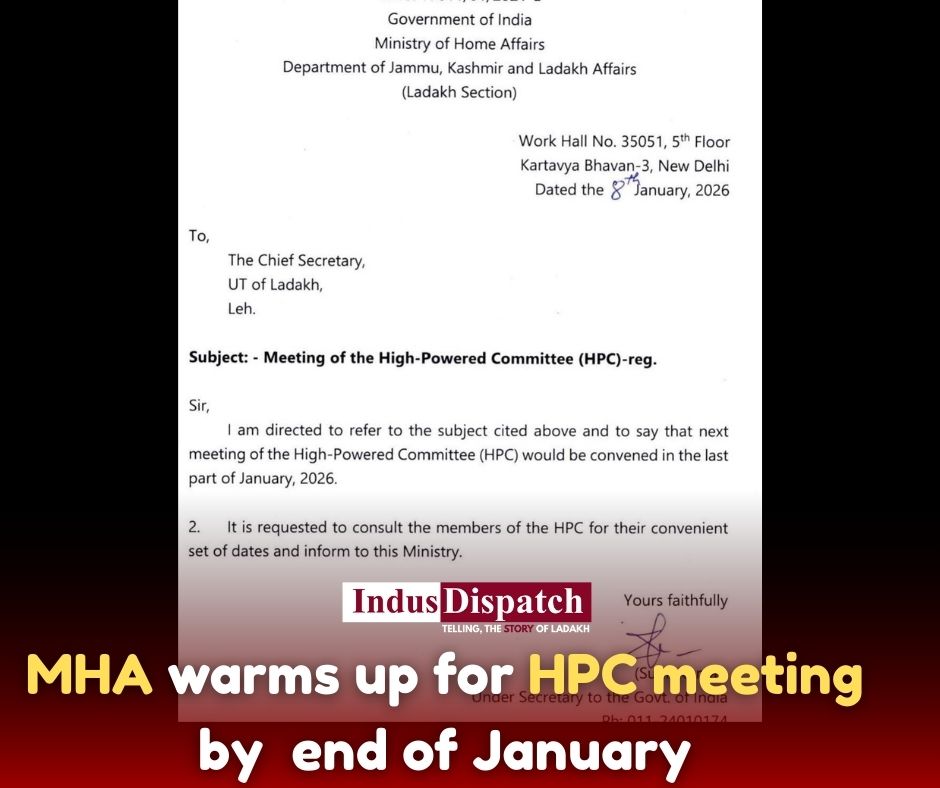
New Delhi / Ladakh — The Ministry of Home Affairs (MHA) has moved to reconvene the High Powered Committee (HPC) on Ladakh towards the end of January, most likely after Republic Day, in renewed efforts to advance long-pending talks with local leadership. The MHA has formally written to the Ashish Kundra, Chief Secretary of Ladakh, requesting consultations with the designated HPC members from the region and the submission of a convenient date for the rescheduled meeting.
The HPC was constituted by the Government of India in early 2023 under the chairmanship of the Union Minister of State for Home Affairs to address concerns arising after Ladakh’s reorganisation as a Union Territory in 2019. Its mandate includes the protection of land and employment, measures for inclusive development, empowerment of the Ladakh Autonomous Hill Development Councils for Leh and Kargil, and the examination of possible constitutional safeguards for the region. Representatives from Ladakh, including members of the Leh Apex Body (LAB) and the Kargil Democratic Alliance (KDA), were invited to participate alongside senior government officials and the Lieutenant Governor of Ladakh.
The LAB and the KDA — the principal interlocutors representing Ladakhi civil society and political interests — have engaged with the HPC through multiple rounds of talks. While these engagements have yielded incremental outcomes, such as discussions on local job quotas and recognition of regional languages, they have yet to produce a decisive breakthrough on the core political demands raised by local stakeholders.
Background to last HPC meeting
The previous notable meeting of the HPC took place in October 2025, though dialogue was intermittently suspended amid unrest in the Union Territory. According to the MHA, the consultative mechanism delivered “good results” in certain areas, including enhanced reservations for Scheduled Tribe communities and improved representation of women in the Hill Development Councils, with recruitment for government posts also underway. However, talks were disrupted following violent protests in Leh in September 2025, in which four civilians were killed and dozens injured. The unrest led to heightened tensions between local bodies and the administration, prompting the Leh Apex Body to temporarily step back from the dialogue process until what it described as the restoration of normalcy.
Draft proposal from Ladakh representatives
In November 2025, leaders of the LAB and KDA jointly submitted a 29-page draft proposal to the MHA ahead of the proposed HPC discussions. The document calls for full statehood for the Union Territory of Ladakh with a 30-member legislative assembly, special constitutional safeguards, and the extension of the Sixth Schedule to provide protection for tribal land, employment, and cultural identity. It also seeks general amnesty for detained climate activist Sonam Wangchuk and others arrested following the September protests, arguing that such steps would serve as confidence-building measures.
The draft, however, has drawn criticism on two counts. Sections of Ladakhi civil society have pointed out that the proposal lacked wider public consultation across districts and communities. Others have questioned its silence on the issue of financial viability, arguing that demands such as statehood must be accompanied by a clear assessment of fiscal sustainability and long-term economic capacity.
The proposed reconvening of the HPC is expected to test whether renewed engagement can narrow these differences and revive momentum in the dialogue between New Delhi and Ladakh’s leadership.
