

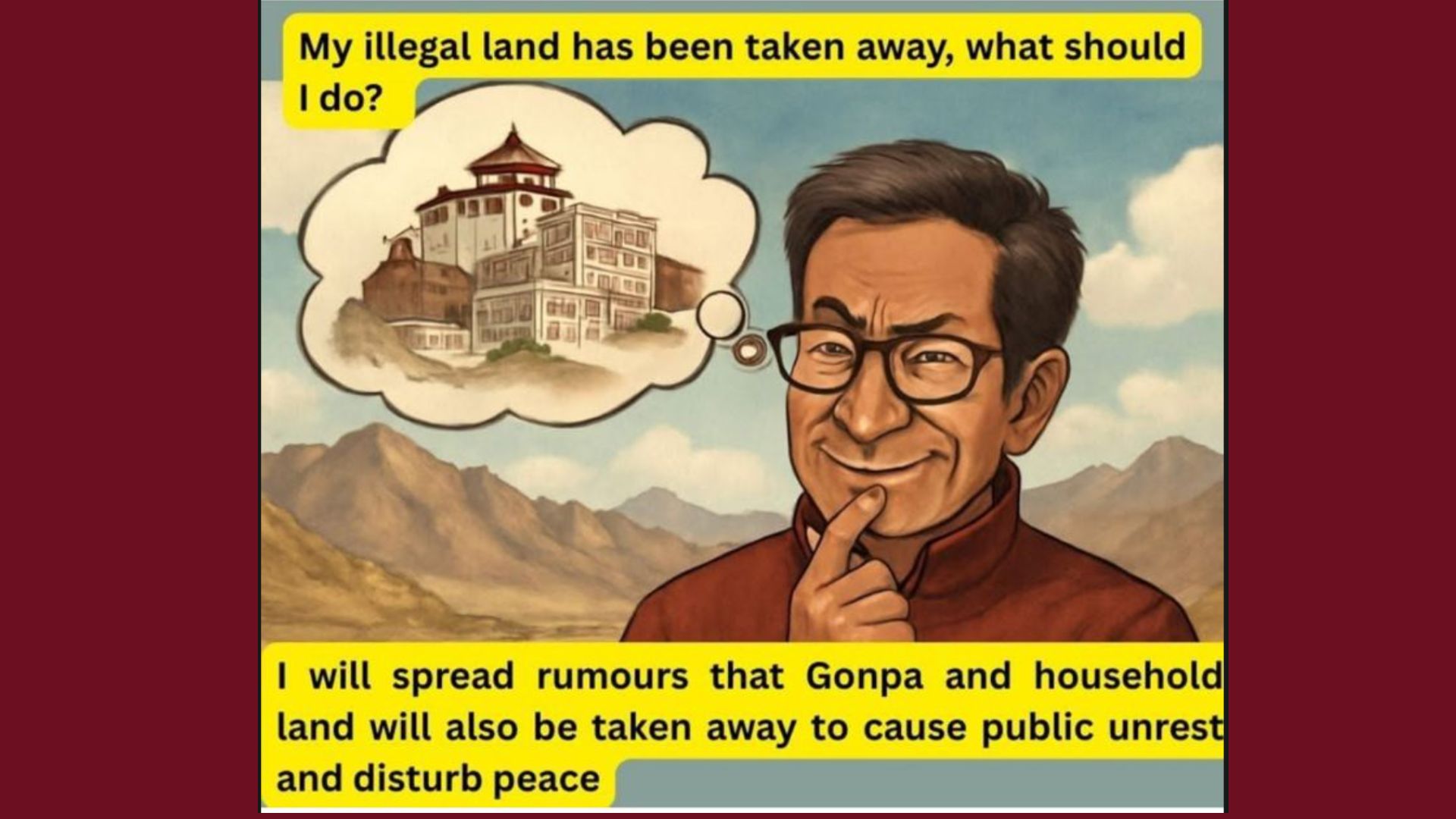
Leh: Sonam Wangchuk, the Ladakh-based innovator who rose to fame as the inspiration for Aamir Khan’s character in 3 Idiots, has found himself at the centre of a storm after a national media platform accused him of being a “foreign-backed agitator” working to destabilise Ladakh.
The report, authored by columnist and geopolitical analyst Raja Muneeb for News18, paints Wangchuk not as the celebrated eco-warrior he is known to be, but as a manipulator entangled in land disputes, financial defaults, academic controversies, and alleged foreign links.
The allegations come at a time when Wangchuk is already engaged in protests over Ladakh’s demand for constitutional safeguards and when his Himalayan Institute of Alternatives, Ladakh (HIAL), is facing official cancellation of land allotment.
The convergence of these issues has triggered sharp debates within Ladakh’s political and social circles.
Land Allotment Dispute
At the heart of the controversy is the land allotted to HIAL in 2018. Nearly 1,200 kanals of government land in Phyang village were handed over on conditions that included completing construction within two years and paying a premium of Rs 14 crore.
According to Chief Executive Councillor (CEC) Tashi Gyalson, neither condition was met. Instead, arrears reportedly swelled to almost Rs 30 crore by 2023, leading to the land’s cancellation.
“Before doing the lease deed, the premium has to be deposited. But Sonam Wangchuk has not deposited the premium of Rs 14 crores,” Gyalson told reporters on August 27.
He added that multiple complaints from villagers had also reached the administration, alleging violations by HIAL.
Villagers of Phyang too have expressed frustration, accusing Wangchuk of securing their support through promises that were never fulfilled.
In 2020, the office of the local Nambardar wrote to the Hill Council demanding cancellation, stating that HIAL was seeking more land despite not utilising the existing allotment properly.
Academic Recognition Under Question
The article also questions the academic credibility of HIAL, calling it an “unrecognised university” that misled students.
Although land was allotted in 2018, the institute reportedly applied for university status only in 2022. In the meantime, it organised convocations and distributed certificates.
“Which institution-affiliated diploma did they issue? Your hand-made degree will not work,” Gyalson said, underlining the lack of UGC or AICTE approval.
He alleged that if nothing else, HIAL could at least have tied up with an existing private university.
Ice Stupa Criticism
Even Wangchuk’s celebrated Ice Stupa project has not escaped criticism. The report cites villagers who accused the initiative of leaving behind plastic waste in the mountains and diverting water in ways that disturbed the local water table—contradicting Wangchuk’s claims of promoting sustainable solutions.
Allegations of Foreign Links
Perhaps the most serious charge in the article is Wangchuk’s alleged “foreign connections.” It highlights his participation in a “Breathe Pakistan” conference earlier this year, followed almost immediately by his return to India to lead protests in Pune.
The article suggests this sequence raises troubling questions about whether his campaigns are being used to serve agendas beyond India’s borders.
The article goes further, alleging that Pakistani social media accounts have been actively amplifying narratives portraying Wangchuk as a victim of the Indian state, thus aligning with the interests of India’s adversaries.
Wangchuk’s Defence
Wangchuk, however, has consistently denied such allegations. He argues that bureaucratic red tape and political motives are responsible for the hurdles faced by HIAL.
His wife and co-founder, Gitanjali J Angmo, has also defended the institute, claiming that recognition was delayed due to systemic issues rather than willful violations.
Wangchuk has further insisted that the cancellation of land was linked to his outspoken support for Ladakh’s demand for Sixth Schedule protections, not to financial or regulatory lapses.
A Polarised Debate
The controversy has left Ladakh divided. While many villagers and political representatives back the administration’s action, Wangchuk’s supporters view him as a victim of a targeted campaign designed to suppress dissent.
The accusations of foreign backing, coupled with unresolved questions around land dues and unrecognised degrees, have only intensified scrutiny of his work.
As the debate rages on, what remains clear is that Sonam Wangchuk—once universally celebrated as Ladakh’s eco-innovator—has now become a deeply polarising figure.
