

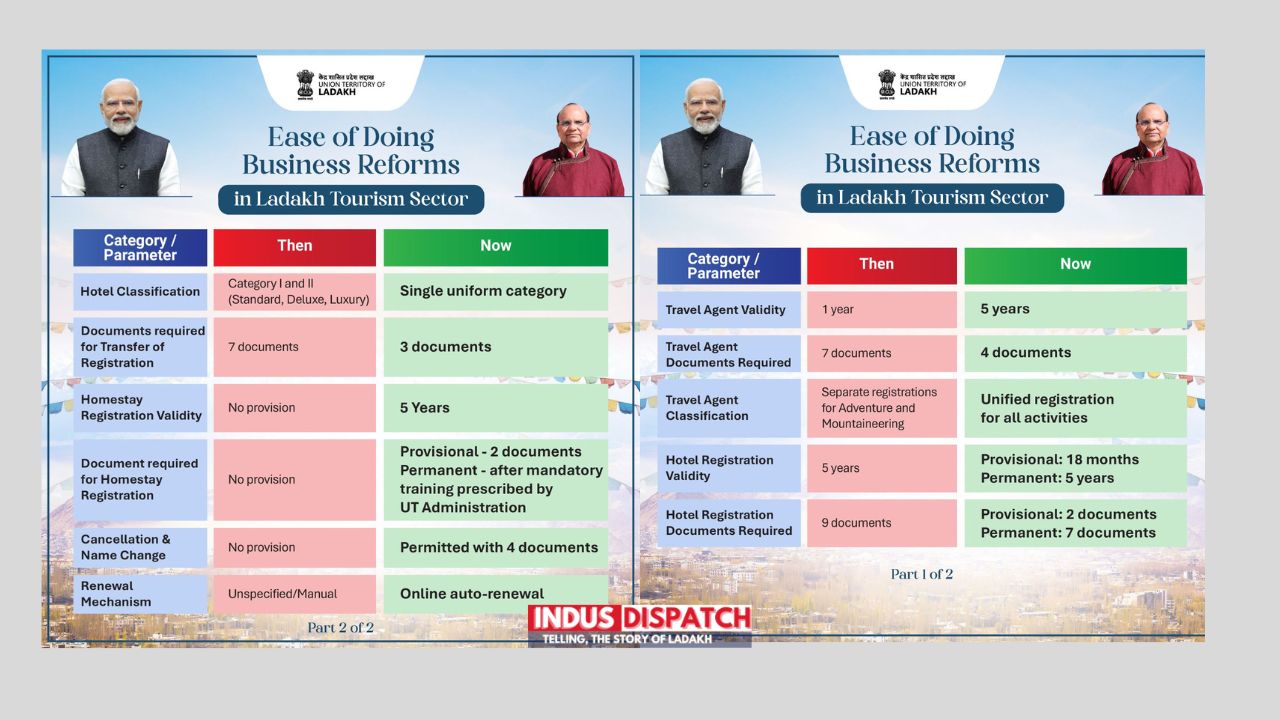
Leh: In a landmark move aimed at transforming Ladakh’s tourism landscape, Lieutenant Governor Vinai Kumar Saxena has approved a comprehensive set of “Ease of Doing Business” reforms to deregulate the hospitality sector, reduce compliance burdens and create a unified, transparent and citizen-friendly system for tourism stakeholders.
Announcing the reforms through a tweet, the Lieutenant Governor said the initiative is designed to simplify procedures for registration of hotels, homestays and tour operators, while eliminating outdated requirements that have long been seen as barriers to entry.
To give a major boost to the tourism sector in Ladakh, I have approved major reforms related to “Ease of Doing Business”, aimed at deregulating the hospitality sector, reducing compliance burden on stakeholders and creating a unified, streamlined, and citizen-friendly… pic.twitter.com/h63K855WWm
— LG Ladakh (@lg_ladakh) April 23, 2026
He stated that documents such as character certificates, proof of requisite bank balance and educational qualifications for tour operators have been removed, making the process more accessible, transparent and efficient.
The reforms introduce sweeping changes across multiple categories within the tourism sector. For travel agents and tour operators, the validity of registration has been significantly enhanced from one year to five years, reducing the need for frequent renewals.
At the same time, the number of documents required has been brought down from seven to four. In a major structural change, separate registrations for adventure tourism and mountaineering activities have been merged into a single unified registration, enabling operators to offer multiple services under one license.
Hotel registration norms have also been rationalised. While the validity of permanent registration remains five years, the administration has introduced a new provision for provisional registration valid for 18 months. This is expected to facilitate quicker establishment of new hospitality units. Documentation requirements have been reduced considerably, with only two documents needed for provisional registration and seven for permanent registration, compared to the earlier requirement of nine documents. Additionally, the previous classification system that divided hotels into categories such as Standard, Deluxe and Luxury has been replaced with a single uniform category, simplifying regulatory procedures.
In a first, a structured framework for homestay registration has been introduced. Homestays will now have a registration validity of five years. Operators can apply for provisional registration with minimal documentation and subsequently obtain permanent registration after completing mandatory training prescribed by the UT Administration. This move is expected to formalize and promote the growing homestay sector, particularly in remote and rural areas.
Further easing compliance, the reforms provide clear provisions for transfer of registration, cancellation and change of name, significantly reducing the number of documents required—from seven earlier to just three or four in most cases. A major technological upgrade has also been introduced with the implementation of an online auto-renewal system, replacing the earlier manual and often cumbersome renewal mechanism.
The Lieutenant Governor said that these reforms are aligned with the vision of Prime Minister Narendra Modi’s guiding principle of “Minimum Government, Maximum Governance.” He noted that the objective is to create a regulatory environment that is free from archaic rules and unnecessary bureaucratic interference, while ensuring ease of access and operational flexibility for businesses.
Officials said the reforms are expected to significantly improve the ease of doing business in Ladakh’s tourism sector by encouraging entrepreneurship, attracting investment and enhancing service delivery. By simplifying entry barriers and standardising processes, the administration aims to create a more competitive and inclusive ecosystem for tourism-related enterprises.
At the same time, the government believes that these measures will contribute to a better experience for tourists by ensuring a more organised, transparent and reliable hospitality sector. The reforms are also expected to generate employment opportunities, strengthen local livelihoods and provide a major boost to Ladakh’s economy, which is heavily dependent on tourism.
With these changes, Ladakh positions itself as a more business-friendly destination, seeking to balance regulatory oversight with growth and innovation in one of its most vital sectors.
