

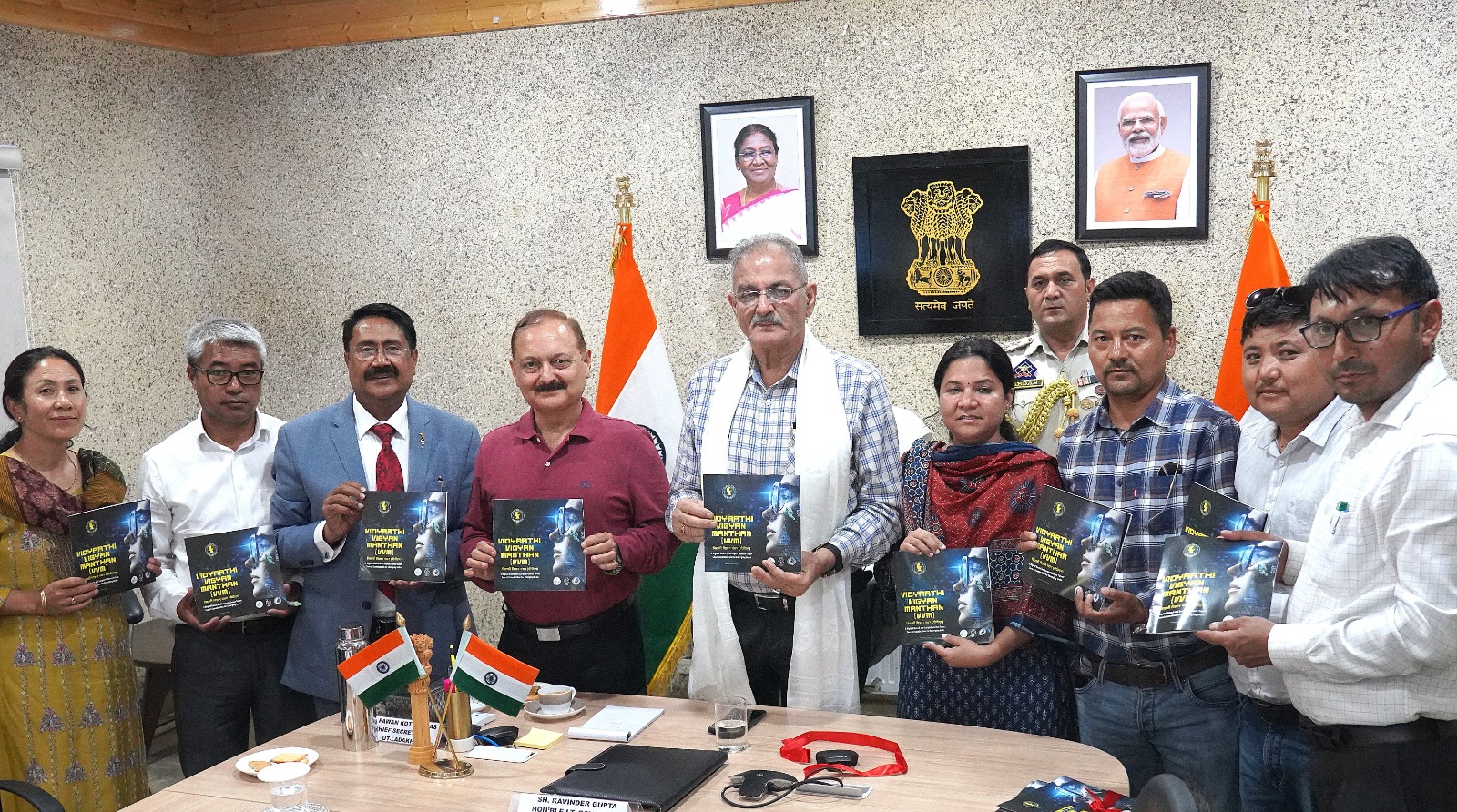
Leh: Lieutenant Governor Kavinder Gupta stressed the importance of providing potable drinking water through fully functional household tap connections (FHTCs) to rural households.
He highlighted the need for ensuring uninterrupted year-round water availability, community accountability, and timely payment of user charges for effective operation and maintenance under the Jal Jeevan Mission (JJM). Defaulters who delay payments will face penalties, he warned.
Chairing a comprehensive review meeting at the LG Secretariat, the LG assessed progress in various departments including Public Health Engineering (PHE), Irrigation & Flood Control (I&FC), Food, Civil Supplies & Consumer Affairs, Legal Metrology, School Education, Higher Education, and Skill Development.
In an effort to promote science education, Kavinder Gupta launched the Vidyarthi Vigyan Manthan (VVM), a nationwide digital science talent search examination for students of Standards VI to XI, conducted by Vijnana Bharati in collaboration with NCERT and the National Council of Science Museums.
He also directed educational institutions to organise Tiranga Rallies ahead of Independence Day under the Har Ghar Tiranga Abhiyan, aiming to instill patriotism and national unity among students.
Administrative Secretary Rahul Sharma, IAS, briefed on key initiatives including the Jal Jeevan Mission, proposed 24×7 water supply schemes in Leh and Kargil valued at Rs 707 crore, and irrigation projects by the I&FC Department. He also detailed the Food, Civil Supplies & Consumer Affairs Department’s efforts in free grain distribution under the NFSA 2013, food procurement, and financial management.
Post-lunch, Administrative Secretary Bhanu Prabha, IAS, presented updates on school education programs such as Samagra Shiksha, PM SHRI schools, and PM Poshan, while highlighting challenges in enrolment, staffing, and teacher training. She also discussed the implementation of the National Education Policy (NEP) 2020 and the low Gross Enrolment Ratio (GER) in higher education.
On skill development, she emphasized training initiatives led by Polytechnic colleges, the Ladakh Skill Development Mission, and Enterprising Ladakh. The University of Ladakh’s Vice-Chancellor, Prof. Saket Kushwaha, shared details of the university’s ongoing projects.
The LG underlined that improving the quality of education within Ladakh is crucial to encourage youth to remain and contribute locally instead of migrating elsewhere. He called for relevant, resource-rich education and enhanced teacher training tailored to local needs to boost student learning outcomes.
He also stressed introducing Information and Communication Technology (ICT) programs at ITI Leh to prepare youth for a technology-driven future. Kavinder Gupta encouraged harnessing renewable energy sources like wind power on the University of Ladakh campus to promote sustainability and reduce energy costs. He further directed skill training of Ladakhi youth to enable their employment in major projects, such as the solar power initiative at Pang.
Lastly, the LG highlighted ongoing efforts to identify and delete bogus ration cards to prevent fraudulent access to subsidised food and ensure resource integrity.
