

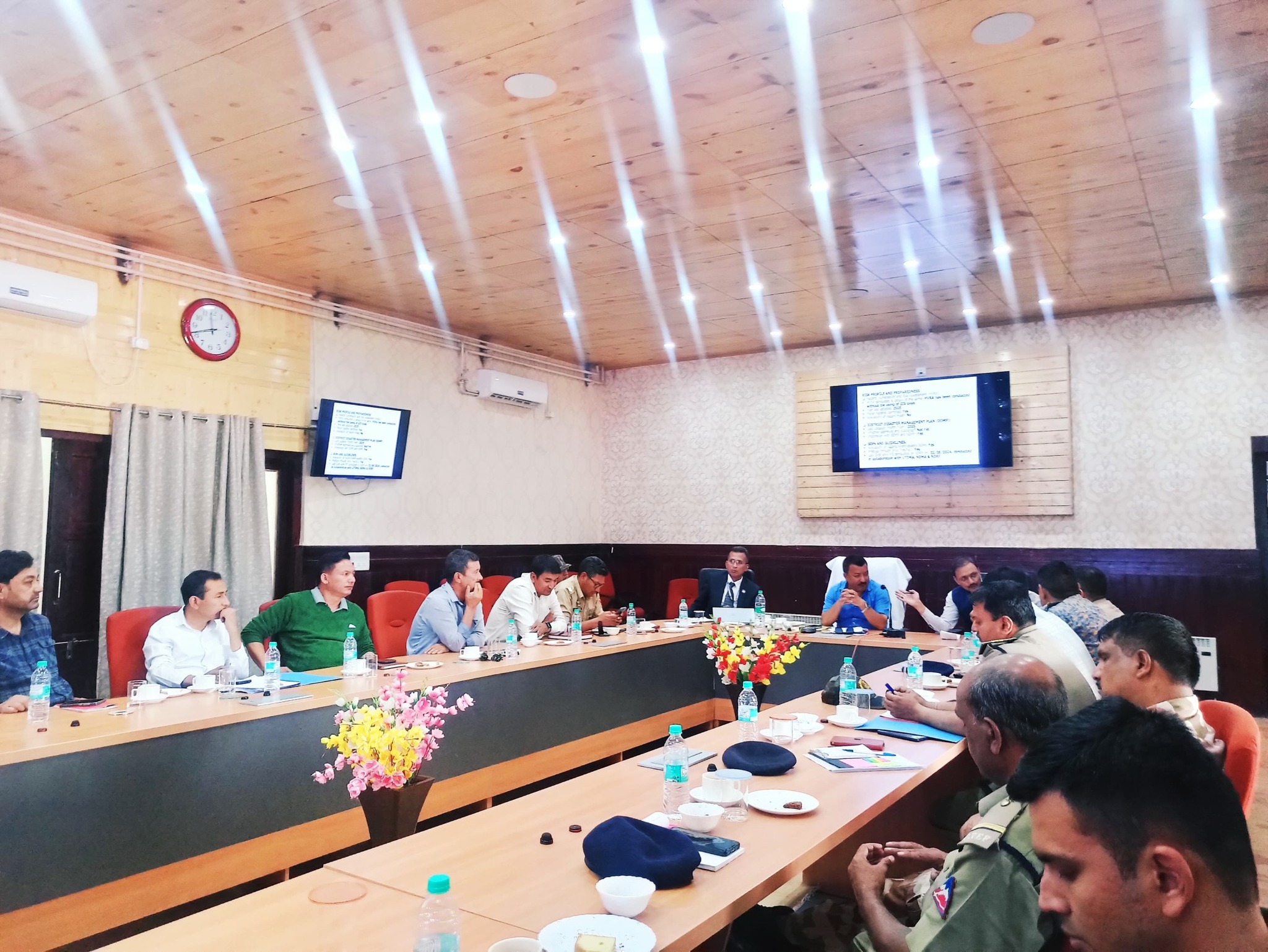
LEH: A high-level meeting on disaster management and mitigation was convened today at the DC Office Conference Hall in Leh, bringing together key officials from the administration, armed forces, police, NDMA, DDMA, IMD, and other departments. The meeting aimed to review existing preparedness, enhance inter-agency coordination, and strengthen Leh’s disaster response framework.
The meeting was chaired by Additional Deputy Commissioner Leh, Ghulam Mohd (JKAS), in collaboration with Lt. Col. Sanjive Kumar, Joint Advisor of the National Disaster Management Authority (NDMA), and Rajan Kumar, Senior Consultant with NDMA. Addressing the gathering, Ghulam Mohd highlighted the urgent need to establish a dedicated disaster management team in Leh, stressing that the region currently lacks a professional system for planning and response. He also pointed out the absence of coordination among line departments and emphasized the importance of developing local-level plans based on financial realities.
Lt. Col. Sanjive Kumar provided a comprehensive presentation on India’s disaster management system and the evolving responsibilities of the states under the Disaster Management Act. He explained the recent amendments to the Act, including the creation of a State Disaster Database, the nomination of the State DGP as a member of the State Executive Committee, the inclusion of district-level officers and experts in disaster planning, the identification of nodal departments based on hazard types, and the formation of a dedicated State Disaster Response Force.
Rajan Kumar expanded on the Prime Minister’s 10-Point Agenda on Disaster Risk Reduction, which promotes the use of technology and social media in disaster management, encourages women’s leadership, supports risk mapping, and seeks broader international cooperation. He stressed that regions like Ladakh must be equipped with modern tools and institutional support to better prepare for potential disasters.
The District Disaster Management Authority (DDMA) of Leh raised several serious concerns, including the shortage of trained manpower, the absence of an early warning system, and the lack of sanctioned schemes tailored for Ladakh’s unique geography. Officials recommended the creation of permanent posts such as Disaster Management Officer and GIS Expert. They also called for dedicated training programs and long-term financial support from the NDMA.
One of the successful examples of local disaster response, the GLOF incident in Rumbak in August 2021, was discussed. Despite the limited availability of advanced technology and no formal standard operating procedures with the Armed Forces, the district’s swift action was recognized. Leh currently has 100 trained Apda Mitra volunteers, and ongoing training and mock drills have continued to strengthen community-level preparedness.
The meeting was attended by senior officials including the Superintendent of Police, the IMD Director, the Chief Medical Officer, Executive Engineers, Sub-Divisional Magistrates from Nubra, Nyoma, Khaltsi, Liker, Durbuk, and Kharu (via video conference), and the Commandant of 13 Battalion NDRF. Representatives from the Indian Army, Air Force, ITBP, and engineering wings like Project HIMANK and Project VIJAYAK were also present.
Following the discussions, the central committee visited the Emergency Operation Centre (EOC) in Leh. They suggested that more focus be placed on promoting the use of national disaster management apps and publicizing the equipment already installed across the district. They further recommended that this information be disseminated through DDMA platforms and social media channels to ensure public awareness and inter-agency coordination in future emergencies.
