

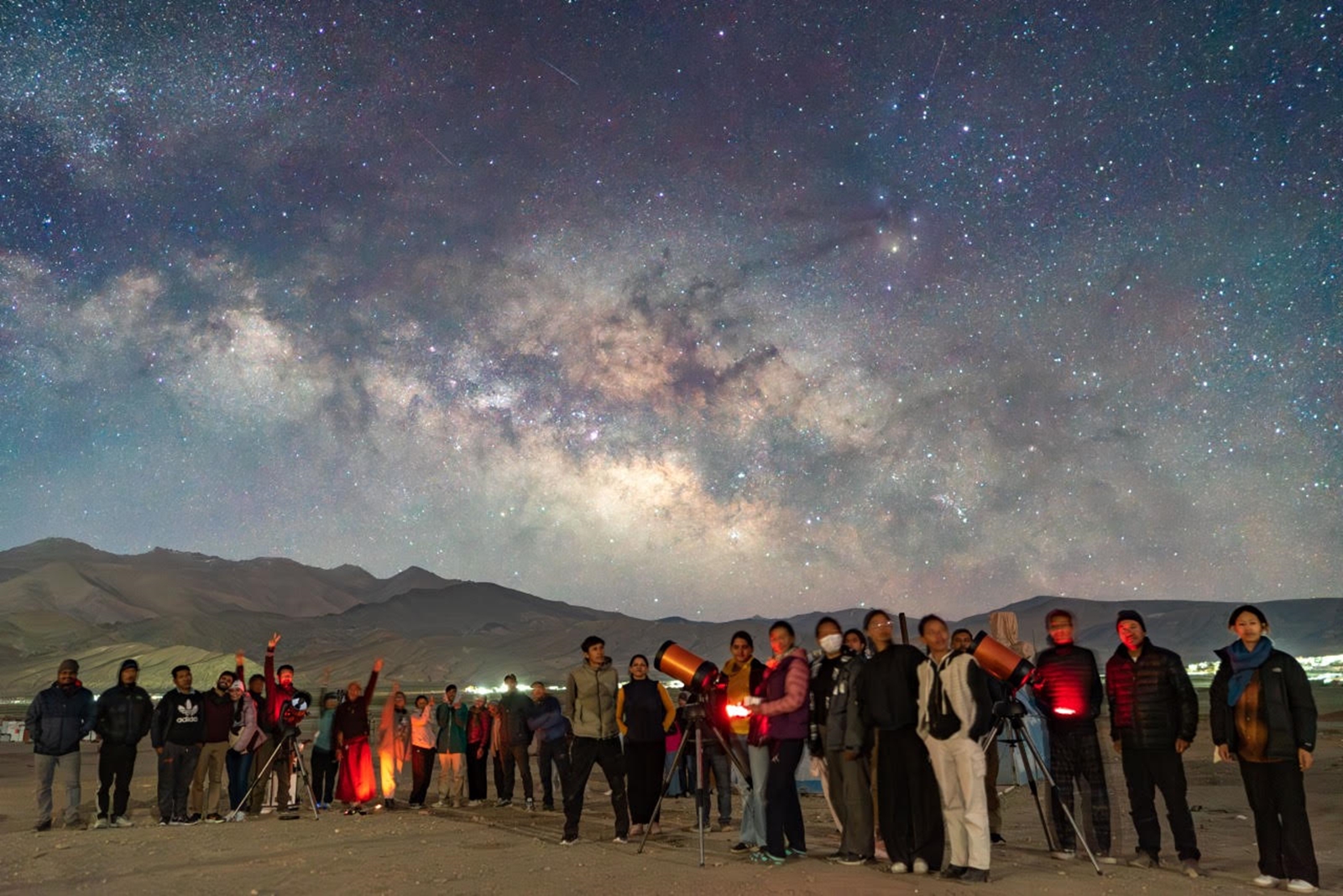
Leh: Ladakh is set to become an even bigger hub for astronomy in India, with the government approving two new state-of-the-art telescopes and the upgrade of an existing observatory in the region. The move comes in this year’s Union Budget and is expected to strengthen India’s position in observational astronomy, both nationally and globally.
The National Large Solar Telescope (NLST), planned in the Merak region near Pangong Tso, will be a 2-metre aperture solar telescope. Operating in visible and near-infrared wavelengths, NLST will allow scientists to study solar dynamics, magnetism, and energetic solar events, while also tracking space-weather processes that impact Earth and national space assets. Once operational in 5–6 years, it will become India’s third ground-based solar observatory, joining Kodaikanal in Tamil Nadu and Udaipur in Rajasthan. Combined with data from ISRO’s Aditya-L1 solar mission, NLST will strengthen India’s expertise in heliophysics.
The second telescope, the National Large Optical–Near Infrared Telescope (NLOT), will be a 13.7-metre segmented-mirror facility in Hanle, India’s only Dark Sky Reserve. Using 90 hexagonal mirror segments working as one, NLOT will be among the world’s largest optical-infrared telescopes. Its high-altitude, cold, and dry conditions will provide exceptionally clear data, enabling frontier research on exoplanets, stellar evolution, supernovae, and the origins of the universe. India’s experience in constructing the international Thirty Meter Telescope (TMT) will support the building of NLOT’s complex components.
Meanwhile, the 2-metre Himalayan Chandra Telescope (HCT), a pioneer facility in Ladakh, is set for its first major upgrade in 25 years. Its primary mirror will be expanded to 3.7 metres, and operations will continue in optical-infrared wavelengths. The upgraded HCT will complement international facilities like LIGO-India and the Square Kilometre Array, further expanding India’s observational reach.
Together, NLST, NLOT, and the upgraded HCT will provide Indian astronomers with unmatched observational capabilities in this region of the world. From solar studies to exploring the distant universe, these telescopes are set to make Ladakh a global destination for cutting-edge astronomy research.
