



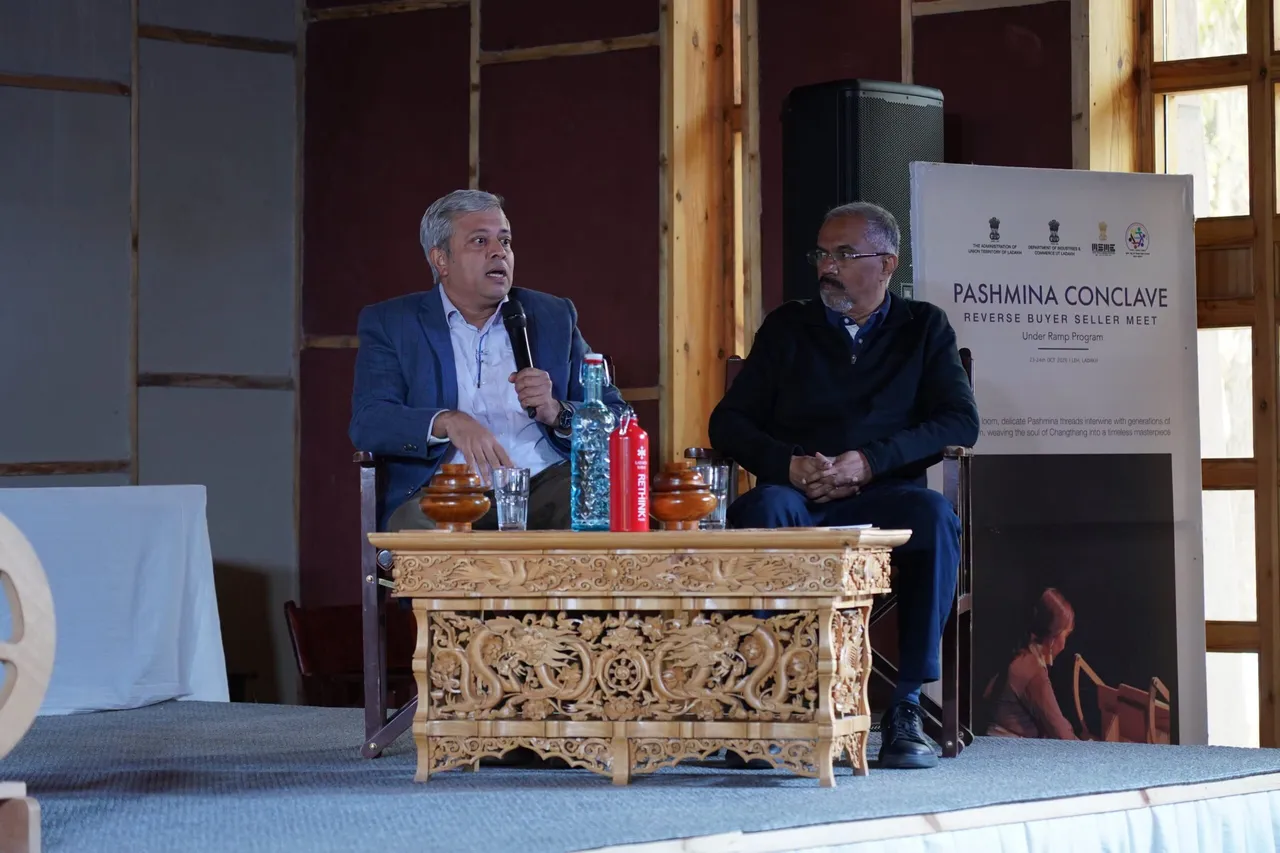
Leh, October 24: Sustainable livestock management, scientific authentication and stronger global branding dominated the second day of the Ladakh Pashmina Conclave 2026, as experts explored ways to improve fibre quality, protect the identity of authentic Pashmina and expand market opportunities for the region’s traditional craft.
Held at Ladakh Sarai Resort in Ayu, Saboo, the technical sessions brought together scientists, researchers, industry representatives, entrepreneurs and other stakeholders to discuss challenges across the Pashmina value chain, from high-altitude grazing grounds to finished products and international markets.
A session on goat production, grassland restoration and fibre yield examined the need to improve productivity while preserving the fragile rangelands on which Changpa pastoral communities depend. Presentations were delivered by Dr Feroz Din Sheikh of the University of Ladakh’s Stakna Campus, Dr Khursheed Ahmad Dar of SKUAST, Dr Ronnie Lamb, who joined online, and Dr Rashmi Singh, who spoke about the International Year of Rangelands.
Another session explored the characteristics and applications of yak and sheep wool, including opportunities to diversify fibre-based products and strengthen livelihoods in pastoral communities.
Discussions on spinning, weaving, testing and certification focused on the role of scientific methods and modern processing technologies in improving the quality and commercial value of Ladakh Pashmina. R. Naresh, founder and managing director of Shuttles & Needles Pvt. Ltd. and Ashford India distributor, shared insights into tools and techniques for value addition.
Experts from CSIR–Centre for Cellular and Molecular Biology and the Pashmina Certification Centre discussed fibre authentication, quality assurance and certification systems, underlining the importance of protecting genuine Ladakh Pashmina from misrepresentation in domestic and international markets.
Traceability and geographical indication (GI) protection were also central to the deliberations. A session on cooperatives, proof of origin and GI brought together local entrepreneurs and experts to discuss the ‘Pashmina Mark’ initiative of the Textiles Committee and Central Wool Development Board, GI implementation and lessons from the branding of Kashmir Pashmina.
The discussions highlighted the need for credible origin-verification systems and stronger producer collectives to ensure that the value associated with authentic Pashmina translates into better opportunities for Changpa pastoralists, artisans and other local stakeholders.
The afternoon session turned to branding, packaging and marketing, with discussions centred on positioning Ladakh Pashmina as a distinctive premium product in global markets. Karun Ahuja, director of Ahujusons, was scheduled to speak on developing an umbrella brand for Ladakh Pashmina, while Prithvi Ranjan and Pragya Dubey of the National Institute of Design were scheduled to share their perspectives on branding, packaging and storytelling. Ahmad Naqush was also scheduled to discuss the legacy of Pashmina and its contemporary market potential.
The second day’s deliberations underscored the importance of linking sustainable pastoral practices and scientific quality assurance with effective branding and market access. The challenge, stakeholders emphasised, is not only to enhance the global recognition of Ladakh Pashmina but also to ensure that the communities responsible for producing it benefit from its growing commercial value.