

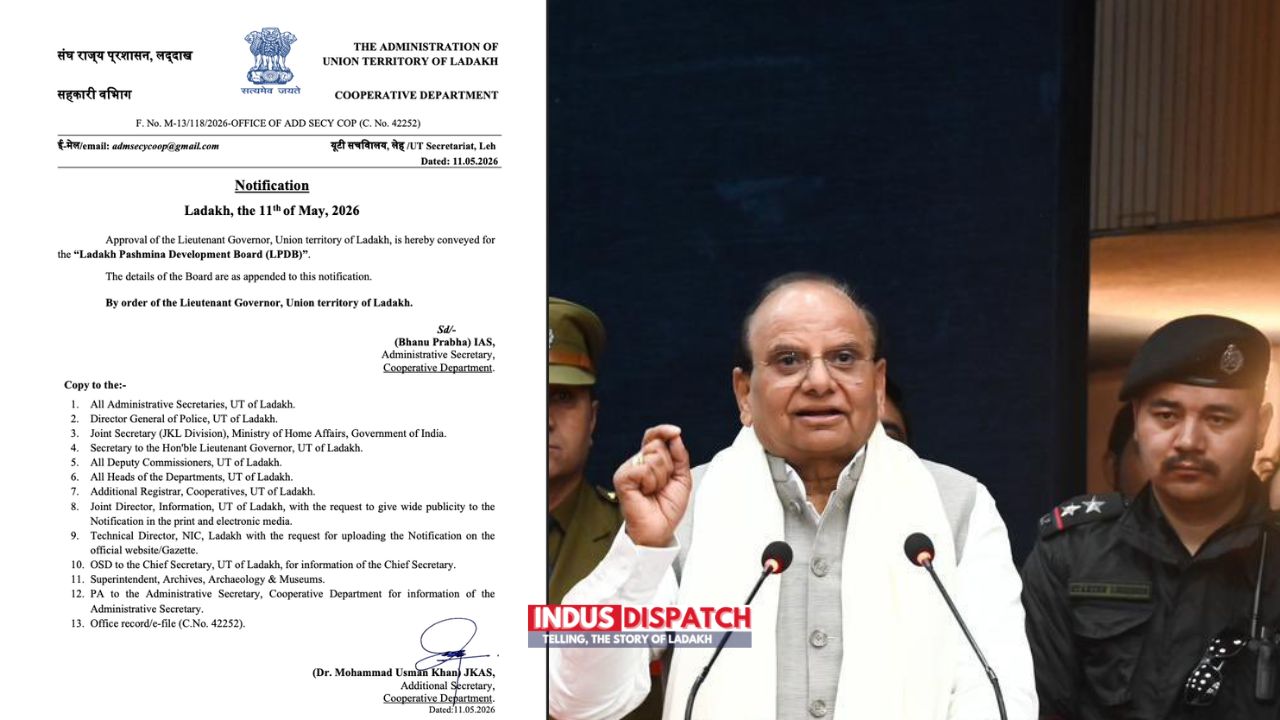
Leh, May 12: In a landmark move aimed at transforming Ladakh into a global centre for premium Pashmina production and luxury textile products, the Administration of the Union Territory of Ladakh has approved the formation of the Ladakh Pashmina Development Board (LPDB), a specialised institutional body dedicated to the holistic development of the region’s iconic Pashmina sector.
The approval was conveyed through an official notification issued by the Cooperative Department with the sanction of Lieutenant Governor Vinai Kumar Saxena. The notification was issued by IAS officer Bhanu Prabha, Administrative Secretary, Cooperative Department.
The newly-created Board will function as an autonomous body under the UT Administration and is expected to serve as the apex institution for the development, protection, branding and promotion of Ladakh Pashmina — one of the world’s finest natural fibres produced from the Changthangi goat reared by the nomadic Changpa community in eastern Ladakh’s Changthang region.
The administration has described the move as a major step towards securing the future of pastoral communities whose livelihoods depend on Pashmina production under extreme climatic conditions at altitudes above 4,000 metres.
The notification highlights that the Pashmina economy is deeply connected with Ladakh’s cultural, social and economic identity. Thousands of Changpa pastoralists depend on Changthangi goats for survival, while the fibre supports a larger textile ecosystem involving traders, artisans and exporters across the country.
Officials said the Board has been established to address long-standing structural challenges affecting the sector, including fragmented supply chains, lack of local processing facilities, weak branding systems, price fluctuations and ecological stress in the fragile Changthang rangelands due to climate change.
One of the key objectives of the Board will be to ensure that greater economic value from Pashmina remains within Ladakh itself.
At present, a large quantity of raw Pashmina fibre is transported outside Ladakh for dehairing, spinning and weaving, resulting in most profits being generated elsewhere. The Board plans to strengthen local infrastructure through dehairing plants, spinning facilities, weaving clusters and artisan support systems.
The administration believes this will create employment opportunities, strengthen local entrepreneurship and increase incomes for pastoral households and artisans.
The Board will also focus on developing a globally recognised brand for authentic Ladakh Pashmina.
Officials noted that despite Ladakh Pashmina’s international reputation, counterfeit and fake products have damaged market credibility. The LPDB will work on certification mechanisms, traceability systems and branding initiatives aimed at protecting genuine Ladakh Pashmina in international markets.
The administration also plans to promote Ladakh Pashmina as a premium luxury fibre through participation in international trade fairs and digital marketing initiatives.
The LPDB will be registered under the Societies Registration Act, 1860, giving it legal authority to implement programmes, receive grants and enter into partnerships.
The Board will have a multi-tier institutional structure consisting of a Governing Body, Executive Committee and Technical Advisory Committee.
The Governing Body will be chaired by LG Vinai Kumar Saxena, while the Chief Secretary of Ladakh will serve as Vice-Chairperson. The body will include senior administrative secretaries from Finance, Sheep Husbandry, Industries & Commerce, Cooperative and Skill Development departments along with experts in fibre technology, pastoral ecology, branding and representatives from the Pashmina industry and pastoral communities.
The Executive Committee, headed by the Chief Secretary, will oversee implementation of schemes and operational management of the Board.
According to the notification, the Administrative Secretary of the Cooperative Department will serve as Chief Executive Officer until a full-time CEO is appointed.
To accelerate sectoral development, the Board will implement a mission-mode programme titled the “Ladakh Pashmina Mission.”
The mission will focus on improving the genetic quality and productivity of Changthangi goats through veterinary support, breeding programmes and livestock development initiatives.
Special emphasis will also be placed on sustainable rangeland management and climate adaptation measures to protect the fragile ecosystems of Changthang.
The mission will additionally support local weaving and handicraft clusters, aiming to boost employment generation and entrepreneurship in the textile sector.
The notification also underlines the strategic importance of strengthening livelihoods in Changthang, a sensitive frontier region bordering China.
Officials stated that enhancing the economic resilience of pastoral communities in border areas carries broader national and strategic significance, apart from preserving Ladakh’s centuries-old nomadic traditions.
The UT Administration expects the Board to significantly improve incomes of Changpa pastoralists, strengthen cooperatives, reduce dependence on intermediaries and increase local employment opportunities.
Authorities also believe the initiative will help preserve fragile high-altitude ecosystems through sustainable grazing and pasture management while positioning Ladakh as the global hub for authentic Pashmina products.
Calling Pashmina one of Ladakh’s most valuable cultural and economic assets, the administration said the creation of LPDB would provide the institutional framework necessary to unlock the sector’s full potential and ensure long-term sustainability and prosperity for pastoral communities across the region.
