

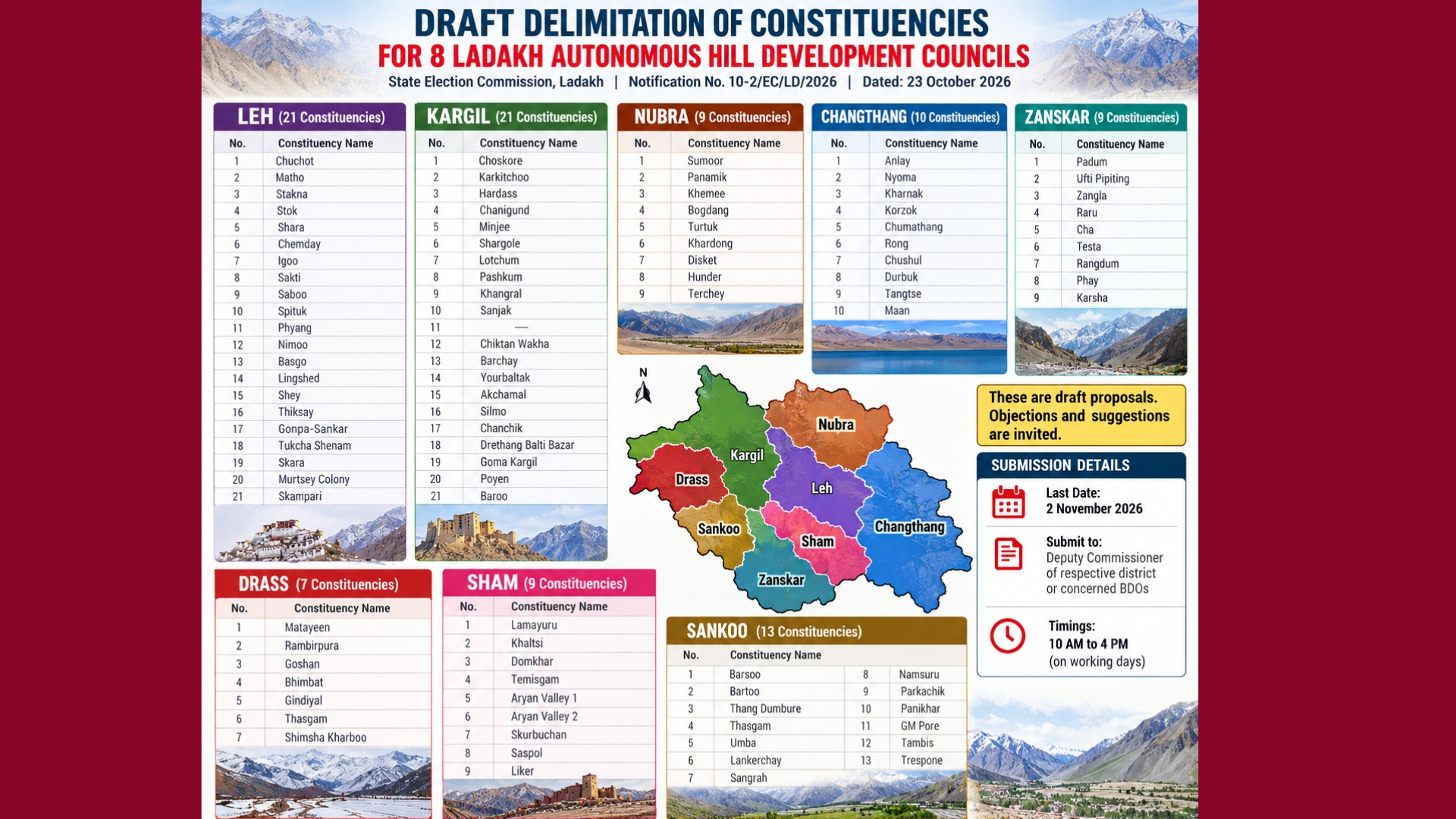
Leh: In a major step towards establishing elected local governance structures across Ladakh’s eight districts, the State Election Commission (SEC) on Friday issued draft delimitation proposals for constituencies of the newly created Ladakh Autonomous Hill Development Councils (LAHDCs), inviting objections and suggestions from the public before the boundaries are finalised.
The exercise follows the Ladakh administration’s notifications establishing autonomous hill development councils for each district and determining the number of seats in the respective councils.
According to the notifications dated October 23, the proposed delimitation covers 99 territorial constituencies across eight districts, with Leh and Kargil accounting for 21 each, Sankoo 13, Changthang 10, and Sham, Nubra and Zanskar nine each, while Drass has seven constituencies.
The proposals identify the territorial constituencies, their constituent Panchayat Halqas or municipal wards, and the villages falling within their boundaries.
The Commission has invited objections and suggestions on the draft proposals until November 2, 2026. These can be submitted to the respective Deputy Commissioners or concerned Block Development Officers on working days between 10 am and 4 pm.
The delimitation process is being carried out under the Ladakh Autonomous Hill Development Councils (Election) Rules, 2026, which provide for dividing each council area into single-member territorial constituencies corresponding to the number of seats determined for that council.
Under the rules, Panchayat Halqas and municipal wards form the basic units of delimitation. No Panchayat Halqa or municipal ward can be divided between two or more constituencies.
The Commission is also required to consider geographical continuity, compactness, existing Panchayat boundaries, population distribution, the area of constituencies and seasonal inaccessibility, an important consideration in Ladakh’s mountainous terrain.
Leh and Kargil to have 21 constituencies each
Leh

Kargil

The proposed LAHDC Leh comprises 21 constituencies, including Chuchot, Matho, Stakna, Stok, Shara, Chemday, Igoo, Sakti, Saboo, Spituk, Phyang, Nimoo, Basgo, Lingshed, Shey, Thiksay, Gonpa-Sankar, Tukcha Shenam, Skara, Murtsey Colony and Skampari.
The delimitation includes both rural Panchayat areas and urban municipal wards. In Leh town, constituencies such as Gonpa-Sankar, Tukcha Shenam, Skara, Murtsey Colony and Skampari have been proposed using groups of municipal wards.
Similarly, LAHDC Kargil has been divided into 21 proposed constituencies, including Choskore, Karkitchoo, Hardass, Chanigund, Minjee, Shargole, Lotchum, Pashkum, Khangral, Sanjak, Chiktan Wakha, Barchay, Yourbaltak, Akchamal, Silmo, Chanchik, Drethang Balti Bazar, Goma Kargil, Poyen and Baroo.
The Kargil annexure also includes a constituency numbered 11 for which the name and territorial details are not visible in the supplied text. This entry will require clarification against the official notification.
The urban constituencies of Kargil, including Chanchik, Drethang Balti Bazar, Goma Kargil, Poyen and Baroo, have been proposed on the basis of municipal ward groupings.
Sankoo allocated 13 constituencies

For the newly created Sankoo district, the Commission has proposed 13 constituencies: Barsoo, Bartoo, Thang Dumbure, Thasgam, Umba, Lankerchay, Sangrah, Namsuru, Parkachik, Panikhar, GM Pore, Tambis and Trespone.
The proposed boundaries bring together several Panchayat Halqas and villages spread across the Sankoo and Suru areas.
The Parkachik constituency, for instance, comprises Kochik, Parkachik and Tangole Panchayat Halqas, while the Panikhar constituency includes Panikhar and Taisuru.
The proposed GM Pore constituency covers Saliskote A, Saliskote B, GM Pore A and GM Pore B, according to the annexure.
Changthang to have 10 constituencies

The draft delimitation for Changthang proposes 10 constituencies: Anlay, Nyoma, Kharnak, Korzok, Chumathang, Rong, Chushul, Durbuk, Tangtse and Maan.
These constituencies cover widely dispersed settlements in eastern Ladakh, including remote and strategically significant border areas.
The Anlay constituency includes Anlay and Koyul Panchayat Halqas, while Nyoma comprises Tsaga and Nyoma.
Chushul has been proposed as a separate constituency, while Durbuk includes Durbuk and Shachukul. Tangtse comprises Kargiam and Tangtse Panchayat Halqas.
The region’s vast distances, scattered population and seasonal accessibility are particularly relevant to the delimitation criteria specified in the election rules.
Nine constituencies each for Sham, Nubra and Zanskar
Sham

Zanskar

Nubra

In Sham district, nine constituencies have been proposed: Lamayuru, Khaltsi, Domkhar, Temisgam, Aryan Valley 1, Aryan Valley 2, Skurbuchan, Saspol and Liker.
The proposals cover settlements including Kanji, Lamayuru, Bodhkharbu, Wanla, Fotoksar, Domkhar, Temisgam, Dha, Hanu, Garkon, Darchik, Saspol, Alchi and Liker.
The Aryan Valley area has been divided into two proposed constituencies. Aryan Valley 1 includes Dha, Hanu and Kokshow Panchayat Halqas, while Aryan Valley 2 comprises Garkon-Darchik.
In Nubra, the nine proposed constituencies are Sumoor, Panamik, Khemee, Bogdang, Turtuk, Khardong, Disket, Hunder and Terchey.
The proposed Turtuk constituency includes Tyakshi, Turtuk-I, Turtuk-II and Bogdang-B Panchayat Halqas, while Khardong comprises Diger and Khardong.
For Zanskar, the Commission has proposed nine constituencies: Padum, Ufti Pipiting, Zangla, Raru, Cha, Testa, Rangdum, Phay and Karsha.
The constituencies cover settlements across the Zanskar region, including Padum, Zangla, Raru, Testa, Rangdum, Phay and Karsha, along with their associated Panchayat areas.
Drass divided into seven constituencies

The draft for Drass proposes seven constituencies: Matayeen, Rambirpura, Goshan, Bhimbat, Gindiyal, Thasgam and Shimsha Kharboo.
Matayeen comprises Matayeen, Pandrass and Mushkoo Panchayat Halqas, while Rambirpura includes Holiyal and Rambirpura.
Other constituencies cover settlements such as Goshan, Bhimbat, Gindiyal, Chowkiyal, Thasgam, Shimsha and Kharboo.
The Commission’s delimitation criteria take account of seasonal inaccessibility, a significant factor in the Drass region, which experiences severe winters.
Public objections to be considered before finalisation
The notification makes clear that the constituency boundaries are still at the draft stage and are not final.
Under Rule 3(4) of the LAHDC Election Rules, 2026, the State Election Commission must publish its draft delimitation proposals and provide the public with at least ten days to submit objections and suggestions.
The Commission is required to consider the representations received before finalising its recommendations.
The proposals are also to be displayed at the offices of the respective Deputy Commissioners and concerned Block Development Officers to enable residents to examine the constituency boundaries and raise concerns.
The current exercise follows notifications issued by the Ladakh administration on September 3 and October 16, 2026, concerning the creation of LAHDCs for the districts, and another notification dated October 21 determining the number of seats for each council.
The publication of draft constituencies marks an important administrative step in preparing the framework for elected hill councils across Ladakh’s expanded district structure.
However, the October 23 notifications deal specifically with constituency delimitation. They do not, by themselves, announce the dates for Hill Council elections.
With the public consultation period now underway, residents, local representatives and other stakeholders have an opportunity to examine the proposed boundaries and seek changes before the Commission proceeds towards finalisation.
The outcome will determine the territorial constituencies through which the eight districts are represented in their respective autonomous hill development councils.
