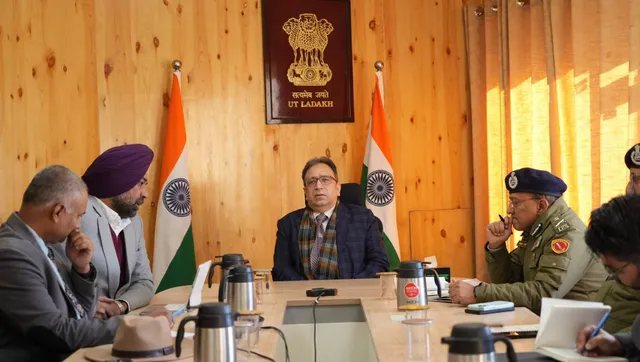
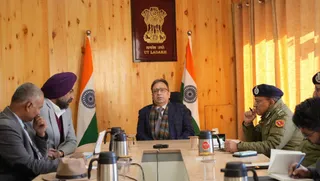



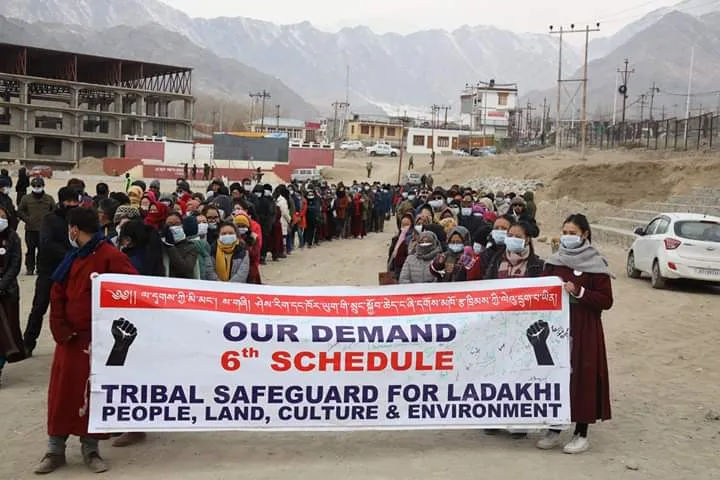
At a special session of the general council of the Leh chapter of the Ladakh Autonomous Hill Development Council (LAHDC), a resolution demanding constitutional safeguards to the Union Territory of Ladakh for the protection of land, employment, culture, environment and trade was passed on Wednesday.
The session witnessed another resolution being moved by Councillor Lower Leh and Leader of the Opposition, Tsering Namgyal, that sought constitutional safeguard on the lines of 6th Schedule of the Indian Constitution. While this resolution was not passed by the hill council, the development has put the focus back on the 6th Schedule of the Constitution.
The 6th Schedule
The sixth schedule is a special provision provided under Article 244(2) and Article 275(1) of the Constitution, that provides for the administration of tribal areas in Assam, Meghalaya, Tripura and Mizoram to safeguard the rights of the tribal population in these states. This provision seeks to do so through the formation of Autonomous District Councils and Regional Councils, armed with certain legislative, judicial, executive and financial powers.
These councils can make laws on certain specified matters like land, forests, canal water, shifting cultivation, village administration, inheritance of property, marriage and divorce, social customs and so on, but having no effect until assented by the Governor of the State. These councils can establish, construct or manage primary schools, dispensaries, markets, cattle ponds, fisheries, roads, road transport and waterways in the respective districts; to form courts to hear cases pertaining to members of Scheduled Tribes with maximum sentence less than 5 years; to levy taxes, fees and tolls on buildings, land, animals, vehicles, boats, entry of goods into the area, roads, ferries, bridges, employment and income and general taxes for the maintenance of schools and roads, and to grant licences or leases for the extraction of minerals within their jurisdiction.
Not ‘One Size Fit All’
The Sixth schedule is a special provision, introduced and amended from time to time, only to include certain areas–not the entire region or state– of only four states. In all, there are only 10 areas in the Northeast that are registered as autonomous districts – three in Assam, Meghalaya and Mizoram and one in Tripura.
Experts are of the opinion that tribes in these states have not assimilated much the life and ways of the other people in these states, still having roots in their own culture, customs and civilization. The majority of tribal communities in these areas have been living in isolation in the hills and forest areas. Thus, the need to treat these areas differently, by granting the people there a sizeable amount of autonomy for self-governance.
The simple reason that the tribal people in other parts of India have more or less adopted the culture of the majority of the people in whose midst they live, justifies that the only 10 areas in these 4 states have been included into the 6th schedule.
Ladakh’s case for inclusion into the 6th schedule looks weak on a number of counts. First, the Centre has been very careful in its assurances to people of Ladakh, at best using the phrase ‘Sixth Schedule-like’ protections. Second, the Constitution of India is very clear in mentioning that the Sixth Schedule is an exclusive provision for the Northeast. No region outside the Northeast has been included in the Sixth Schedule in the 75 years after independence. But there is more to it than what meets the eye.
A Mirage, At Best
The 6th schedule was incorporated to protect the rights of the minority tribals living within a larger state dominated by the majority. Ladakh is predominantly tribal; the people from other parts of the country had been restricted from purchasing or acquiring land there till 2019, thanks to Article 370. Even without the article 370, Ladakh’s unique geographical conditions makes it a very difficult place to relocate to, for outsiders. No wonder, the UT is yet to confront the ‘outsider’ ghosts, and in all probability, never will.
Against the intended objective, the 6th schedule provisions have resulted into undermining the social harmony, stability and economic development of the states and the regions included under it. If put in more liberal terms, the 6th schedule undermines the fundamental rights and principles mentioned in the constitution. Critics find the provisions discriminating against the non-tribal residents living in the mentioned states in several ways, including the violation of the right to equality before the law, as mentioned in article 14, right against discrimination, as mentioned in article 15, and right to settle anywhere in India, as per article 19.
As a part of the erstwhile state of Jammu and Kashmir, Ladakh faced severe neglect, leading to a number of movements in its history, demanding UT status, so as to integrate Ladakh completely with India. The ‘incomplete integration’ as Ladakhis maintained over the past decades, was attributed to Article 370, which restricted the acts of Parliament to apply to Jammu and Kashmir due to the now-abrogated special status.
On August 5, 2019, Ladakh’s happiness knew no bounds. Three years later, as Ladakhis demand for inclusion into the 6th schedule, they must remember that the Acts of Parliament (or where there are State Legislature) do not apply to autonomous districts and autonomous regions.
The 6th schedule among other things has created multiple power centres instead of bringing in a genuine process of autonomy in the region. There are multiple examples of clash of opinion and powers between the autonomous district councils and the state legislatures in the four states.
Take the case of Meghalaya. Despite the formation of the state, the whole of the state continues to be under the sixth schedule causing frequent conflict with the state government. As people in both Leh and Kargil demand for statehood along with legislature, Ladakh can also go the same, if and when it is granted legislature or statehood.
It has been seen that in case of conflict between the District Councils and the State Legislature (if and when Ladakh gets one), it is the state that enjoys the superiority.
Ever since becoming a Union Territory, Ladakh has witnessed a number of reforms. One of the significant reforms was doing away with the Inner Line Permit (ILP) for fellow countrymen and local residents visiting all notified protected areas. The move had come last year as Ladakhi felt the ILP had ‘lost its relevance’, and also because tourism is the bedrock of Ladakh’s economy.
Ladakh’s inclusion into 6th schedule would mean return of ILPs, and would definitely spell trouble for the tourism sector of the UT and the associated stakeholders, besides pushing the region, which is fast becoming a truly global tourist destination, at the very least a few decades back.
In the present day, Ladakh has the Ladakh Autonomous Hill Development Councils (LAHDC), both at Leh and Kargil districts. The LAHDC has the authority to make administrative decisions on matters such as land, development projects, budget, health, education, the environment, employment, roads, language, and culture, among others. The Centre has strengthened the grassroots democracy in the cold desert, with Panchayats and BDCs and DDCs empowering the Ladakhis, like never before.
With its local aspirations largely being met in the past three years, Ladakh is past the alleged ‘negligence’ in erstwhile J&K state. With its jobs and land protected, courtesy the requirement of Ladakh Resident Certificates, and difficult geographical conditions, respectively, it is time for Ladakh to focus on development and governance, rather than chasing the mirage that is the 6th schedule.