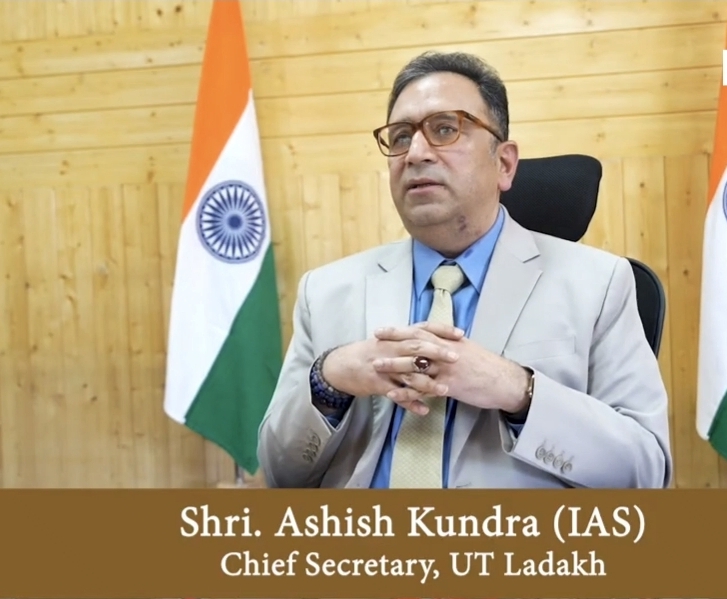
Leh: Chief Secretary, Union Territory of Ladakh, Shri Ashish Kundra, IAS, today held a detailed interaction with the media and provided an overview of the major administrative, governance and policy initiatives currently underway across the Union Territory. The interaction covered the ongoing political dialogue on constitutional safeguards, strengthening of the institutional architecture of Ladakh, recruitment and promotions, the proposed Ladakh Administrative Service and Ladakh Police Service, Nautor land reforms, land-use regulations, healthcare recruitment, creation of new districts and several other matters of public interest.
Opening the interaction with “Julley and Salam,” the Chief Secretary said that the purpose of the briefing was to provide the public with an accurate and transparent account of the developments taking place in Ladakh. Referring to his personal participation in the recent sub-committee meeting, he said it was important that the details of the ongoing dialogue and administrative initiatives be placed in the public domain so that people have a clear understanding of the processes involved, their present status and the institutional responsibilities attached to them.
Political Dialogue and Constitutional Safeguards
Speaking about the ongoing political dialogue following the decisions taken on July 3, the Chief Secretary said that the recent sub-committee meeting focused, among other matters, on the proposed establishment of a Union Territory-level body under the constitutional framework being discussed under Article 371. Representatives of the Apex Body and the Kargil Democratic Alliance (KDA) participated in the discussions, during which consensus emerged that elections to the proposed UT-level body should be conducted through direct constituency-based elections, rather than through an indirect mechanism involving the LAHDCs.
The Chief Secretary said that the fundamental objective of the ongoing dialogue is to secure effective protection for Ladakh’s land, culture, heritage, mineral resources, environment and employment opportunities. He pointed out that a unique job reservation policy specific to Ladakh is already in place, while the Union Government has also committed to providing constitutional protection for the remaining demands under discussion.
He explained that the proposed governance architecture would broadly comprise Panchayats at the grassroots level, the LAHDCs at the intermediate level and a UT-level body at the apex. In order to facilitate further internal consultation among political representatives, a set of approximately eight to ten questions concerning the jurisdiction, powers and relationship between the LAHDCs and the proposed UT-level body has been handed over to the visiting leaders. These issues are expected to form part of the discussions at the next meeting scheduled for October.
The Chief Secretary also explained that the creation of a constitutional framework is a substantive parliamentary process. A Constitutional Amendment requires a two-thirds majority in Parliament along with broad cross-party consensus, after which detailed laws and regulations would have to be framed. He stressed that such an important process requires adequate consultation, legal scrutiny and patience, and that the objective should be to arrive at a robust legal framework based on agreed principles rather than rush through a draft that may not adequately address the concerns involved.
Recruitment and Strengthening of Administrative Cadres
On recruitment, the Chief Secretary highlighted a major development concerning the State Service feeder cadres. Following representations made by the Lieutenant Governor to the Ministry of Home Affairs, an enabling notification has been issued covering 15 departments and approximately 79 Group-B Gazetted posts. Recruitment to these posts will be undertaken in accordance with the applicable local reservation provisions.
The administration is presently preparing the requisite Recruitment Rules, which will subsequently be submitted to the Lieutenant Governor and the Union Public Service Commission (UPSC) to initiate the recruitment process. The posts covered include Assistant Director and Under Secretary-level positions, Deputy Registrar in Cooperative Societies, Assistant Director Employment, Excise and Taxation Officer, Assistant Director Consumer Affairs, Assistant Director Handicrafts and Handloom, Functional Manager Industry, Assistant Labour Commissioner, Block Development Officer, Tehsildar, District Social Welfare Officer and Assistant Director Tourism, among other positions.
The Chief Secretary said that the enabling notification represents an important procedural step towards filling senior local administrative positions and establishing a regular recruitment pathway for these services under the applicable local reservation framework.
Ladakh Administrative Service and Ladakh Police Service
Another significant development is the proposed creation of dedicated administrative and police cadres for Ladakh. The Chief Secretary informed the media that the Ministry of Home Affairs has granted in-principle approval for the creation of the Ladakh Administrative Service (LAS) and Ladakh Police Service (LPS).
The modalities for establishing the two services and the associated recruitment rules are currently being finalised. The recruitment process will involve the UPSC and will incorporate the applicable local reservation provisions. The proposed dedicated services are intended to strengthen the institutional capacity of the Union Territory and provide cadres specifically aligned with Ladakh’s administrative and policing requirements.
Recruitment and Promotions Accelerated in 2026
Providing details of recruitment undertaken during 2026, the Chief Secretary said that 1,340 candidates have been recommended for appointment. These include 24 candidates for Group-B Gazetted posts, 418 for Group-B Non-Gazetted posts and 874 for Group-C posts.
He further informed that 716 long-pending promotions have been executed across various departments, helping address accumulated promotional cases and strengthen the functioning of the administration.
The current recruitment cycle covers 1,504 posts, with 633 posts advertised and a further set of posts undergoing the advertisement process. Among the posts being taken up are 331 Constable positions and 40 Police Sub-Inspector positions, reflecting the continued focus on strengthening the police establishment as well as filling vacancies across the wider administration.
The Chief Secretary said that the scale of recruitment and disposal of pending promotion cases reflects a significant acceleration in the administration’s efforts to address human-resource requirements and ensure that sanctioned positions are progressively filled.
Major Push for Doctor Recruitment
Healthcare recruitment has also received particular attention. The Chief Secretary informed the media that 125 doctor posts are currently being filled. In a significant step towards facilitating local participation in the recruitment process, two UPSC interview boards will sit directly in Leh from September 21 to 25 for conducting the interviews.
The decision to hold the interview boards in Leh is expected to make the process more accessible to candidates and facilitate the recruitment of doctors for the Union Territory’s healthcare institutions, including facilities serving remote and interior areas.
Nautor Land Rules: Proposed Transition from Tenancy to Ownership
Addressing the issue of Nautor land, the Chief Secretary explained the objective of the draft Nautor framework, which seeks to provide a mechanism for converting eligible historic leasehold or tenancy rights into full ownership rights.
He made it clear, however, that there is an important distinction between the regulatory framework being prepared by the administration and the actual exercise of regularisation powers. According to the Chief Secretary, the administration is responsible for preparing the regulatory framework, while the actual power of regularisation rests with the elected LAHDCs. The administration itself does not exercise that regularisation authority.
The draft rules have been published specifically to invite public feedback and suggestions before the framework is finalised. The Chief Secretary emphasised that public consultation is an important component of the process and that representations received from stakeholders will be taken into consideration.
Special Provisions for Monasteries, Cultural Institutions and Small Landholders
The proposed Nautor framework also contains special provisions for certain categories of landholders. Land held by religious, cultural and monastic institutions is proposed to receive title rights free of cost, taking into account the cultural and historical significance of such institutions in the region.
For small landholders, the proposed framework provides for zero fees for holdings up to one acre. For larger holdings, a graded fee structure has been proposed, including slabs covering holdings of one to ten acres and ten to twenty acres, with higher charges applicable to larger holdings under the proposed formula.
The Chief Secretary reiterated that these are provisions contained in the draft framework, which has been placed before the public precisely to obtain feedback and suggestions before finalisation.
New Framework for Change of Land Use
Alongside the Nautor reforms, the administration has also notified a framework governing change of land use. The framework is intended to provide eligible landholders with greater scope to make productive economic use of their land, including, where permitted under the applicable rules, changing agricultural land to approved commercial uses.
Such permitted uses may include activities such as commercial establishments, resorts, shops and other authorised activities. The administration has also pointed to the potential for landholders to monetise eligible land assets and improve their ability to use such assets for securing bank finance and loans.
The Chief Secretary, however, clarified that the framework should not be interpreted as providing for unrestricted conversion of agricultural land. Any change of land use would remain subject to the prescribed regulatory requirements, permissions and conditions.
Cases and Compensation Related to September 24 Incident
The Chief Secretary also informed the media that recommendations concerning the withdrawal of cases and financial compensation related to the September 24 incident are being submitted to the Lieutenant Governor for final consideration and approval.
Five New Districts and Expansion of Administrative Capacity
On the creation of five new districts, the Chief Secretary said that the expansion is expected to substantially increase administrative capacity and is estimated to result in approximately 2,000 additional posts.
He informed that important officers, including District Magistrates, Senior Superintendents of Police, Executive Engineers and Doctors, have already been deployed in interior and remote areas, including Dras, with the objective of strengthening government presence and improving delivery of public services closer to the people.
High Court Bench at Leh
Responding to questions regarding judicial infrastructure, the Chief Secretary clarified that the formal notification for a sitting bench of the High Court of Jammu & Kashmir and Ladakh at Leh has already been issued. The development is expected to improve access to judicial services for residents of Ladakh and reduce the need for travel outside the Union Territory for matters that can be heard locally.
Kargil Council Resignations and Seven Newly Notified LAHDCs
On reports concerning resignations of councillors in the Kargil Hill Council, the Chief Secretary stated that the matter is presently under legal examination, following reports received from the Deputy Commissioner.
With regard to the seven newly notified LAHDCs, he explained that elections would follow the established statutory process, including constituency delimitation and preparation of electoral rolls, before the electoral exercise is conducted in accordance with the applicable rules.
Zanskar and Sankoo District Demands
Responding to demands for the creation of additional districts, including Zanskar and Sankoo, the Chief Secretary said that such demands would be considered objectively on the basis of available evidence, committee recommendations and feedback from the ground.
In particular, the demand relating to 40 villages in Sankoo will be examined through an objective assessment, taking into account the recommendations of the relevant committee as well as ground-level inputs.
A Unique Governance Model for Ladakh
On questions regarding whether the proposed UT-level body should be viewed in the context of statehood or the Sixth Schedule, the Chief Secretary explained that Ladakh’s circumstances are distinct and that the proposed arrangement is being discussed as a unique, sui generis constitutional and governance model.
He noted that Ladakh historically formed part of the erstwhile Jammu and Kashmir State and was not constituted as a separate State. Against this background, the proposed framework seeks to establish an elected legislative, executive and financial body under the constitutional framework being discussed, rather than simply replicate the conventional State model.
The Chief Secretary reiterated that the broader constitutional dialogue is centred on providing the highest possible degree of constitutional protection for Ladakh’s land, jobs, culture, environment and other distinctive interests, while creating an institutional structure that enables effective and accountable governance.
Administration Focused on Delivery, Opportunity and Institutional Strengthening
Concluding the interaction, Shri Ashish Kundra said that Ladakh is presently witnessing a broad-based process of administrative and institutional strengthening. From the acceleration of recruitment and clearance of long-pending promotions to the proposed creation of LAS and LPS, expansion of healthcare recruitment, establishment of new districts, strengthening of judicial access and development of a regulatory framework for Nautor and land use, several initiatives are moving forward simultaneously.
The administration’s focus, he said, is to ensure that institutional reforms are translated into better public services, increased employment opportunities, stronger local administration and greater economic opportunities for the people of Ladakh, while the ongoing political dialogue addresses the region’s longer-term constitutional and institutional aspirations.
The Chief Secretary emphasised that the different initiatives currently underway should be viewed as part of a broader effort to build a stronger, more responsive and locally relevant governance framework for Ladakh—one that combines constitutional protection of the region’s distinctive interests with effective administration, transparent processes and tangible opportunities for its people.
Ladakh Advances on Governance Reforms, Recruitment, Constitutional Dialogue and Land Reforms: CS Ashish Kundra