




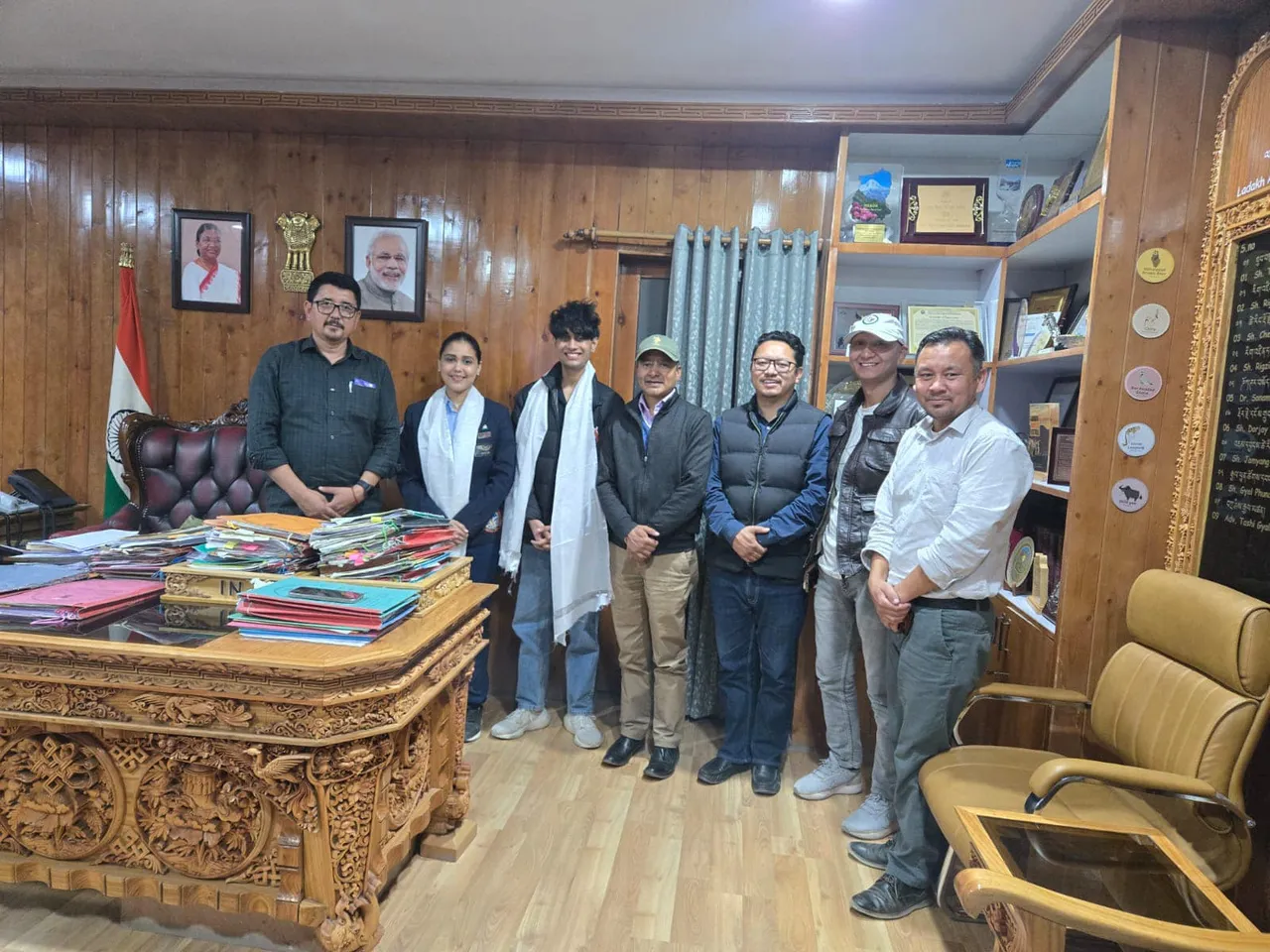
Leh: Ladakh Autonomous Hill Development Council (LAHDC) Leh has identified and approved the land for AAKA SPACE STUDIO, to Establish India’s First Space Analogue Research Facility to carry out month long activity.
AAKA SPACE STUDIO was founded by renowned space architect Aastha Kacha for month long project to carry out space analogue research.
This initiative will establish India’s first space analogue research facility, dedicated to advanced research into human factors, life support systems, hydroponics, and extra vehicular activities, all essential for long duration space missions.
This groundbreaking project will be developed in collaboration with the LAHDC Leh and ISRO by recreating the environments of Mars and the Moon, the facility aims to provide critical insights for future human spaceflight missions, including ISRO’s Gaganyaan and the proposed Bharatiya Antariksh Station.
The facility will focus on essential aspects of human habitation in space, ensuring sustainability for extended missions through innovative research. The collaboration with ISRO will enhance India’s capabilities in space exploration and help prepare for ambitious missions beyond Earth.
Ladakh’s unique terrain and high altitude environment make it an ideal location for simulating extraterrestrial conditions, providing a realistic setting for research and training. The findings from this project will directly inform the design and execution of ISRO’s human spaceflight missions, ensuring that India is well prepared for the challenges of space exploration.
It is pertinent to mention her that in August current year, Scientists from the Birbal Sahni Institute of Palaeosciences (BSIP) and the Indian Institute of Science (IISc) have identified Ladakh as the perfect site for India’s inaugural Mars and Moon analogue research station.
The team, comprising Binita Phartiyal from BSIP, IISc’s Aloke Kumar, and Shubhanshu Shukla, one of India’s Gaganyaan astronauts, made the proposal based on previous research and their own field experience.
The research comes as India steps up its space programme, which includes plans for a space station by 2035 and a landing on the moon by 2040.
An analogue research station is a place where activities meant for the Moon and Mars are planned and practised. For example, if you’re planning an astronaut habitat, you can build a habitat there as there are some similarities (geological, for example) with extra-terrestrial conditions. You can also use it to see how microbes and other organisms respond to such extreme environments.
The lead authors of the proposal, Phartiyal and Kumar, emphasised the unique geographical features of Ladakh that resemble both Martian and Lunar environments.
The region is an exceptional candidate for simulating extra-terrestrial conditions because of its rocky terrain, cold, arid desert landscape, and geomorphological similarities to early Mars and the Moon.
Phartiyal had stated that the region offers a natural laboratory for testing equipment, training personnel, and conducting scientific studies. Its environment provides geochemical, geomorphological, and astrobiological fidelity to Mars and the Moon.