

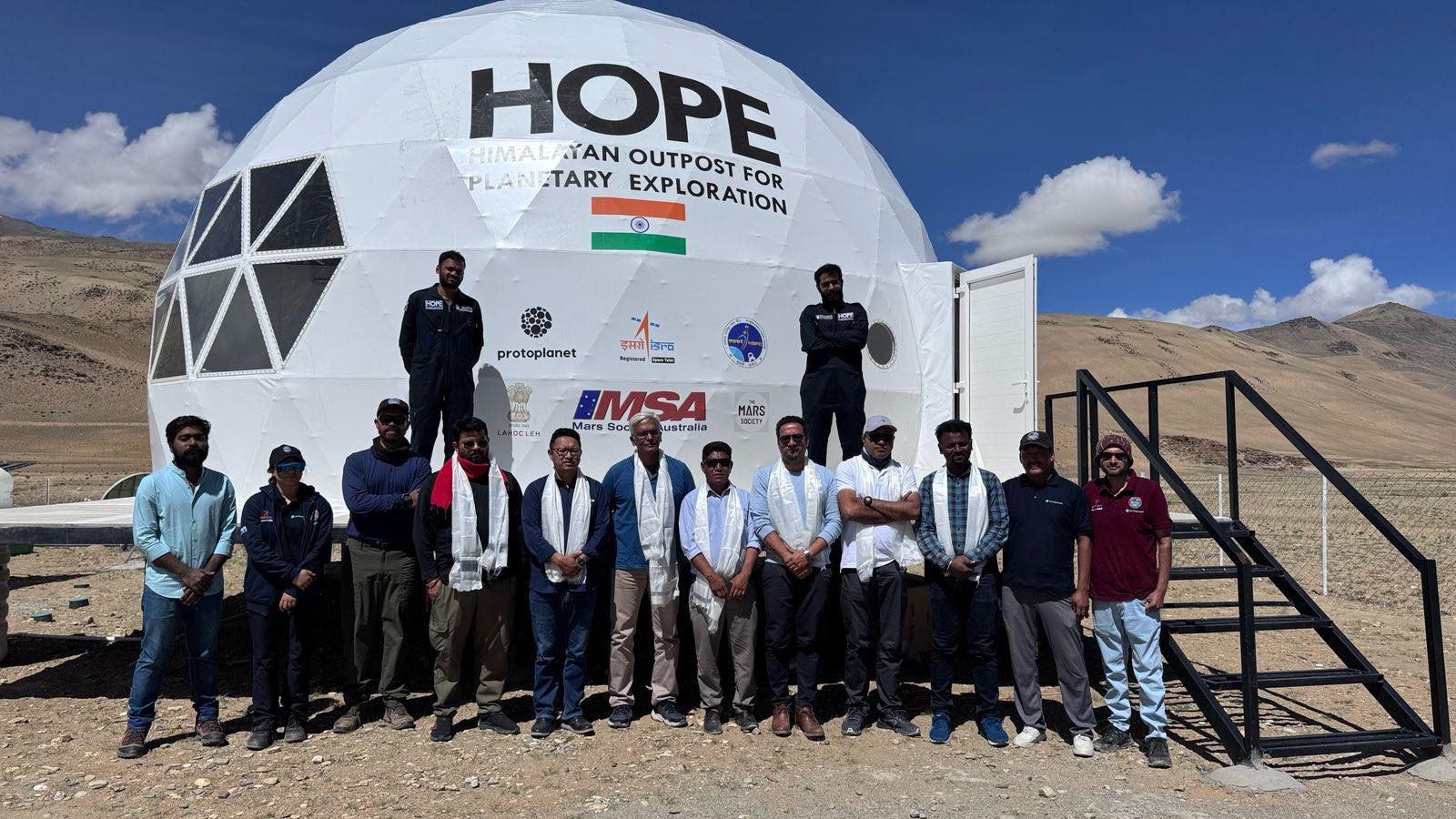
Leh: India marked a milestone in space research as the HOPE mission concluded yesterday, with the nation’s first analogue astronauts — Rahul Mogallapally and Yaman Akot — emerging from a 10-day isolation study at the HOPE analogue station in Leh.
Operated by Protoplanet in collaboration with Mars Society Australia, The Mars Society, and ISRO, the mission simulated conditions of a long-duration spaceflight, focusing on human factors, psychological resilience, and operational procedures in a confined, resource-limited environment.
The conclusion ceremony was attended by Executive Councillor Stanzin Chosphel and Councillor Korzok Karma Namdak, who congratulated the crew on their achievement. Scientists from ISRO’s Human Spaceflight Centre, who had been monitoring the mission, were also present.
During the study, the crew experienced isolation similar to deep space missions, generating valuable data to support India’s upcoming human spaceflight projects, including the Gaganyaan programme.
The HOPE mission’s findings will aid research on crew dynamics, mental well-being, and technological readiness, strengthening global understanding of the challenges of planetary exploration.
