

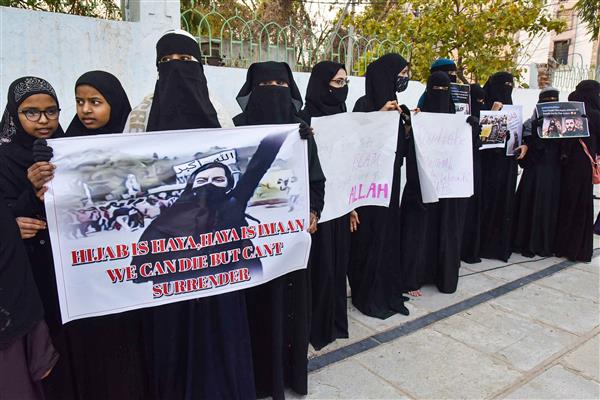
What’s in a dress? Nothing, it’s a form of clothing, but the maelstrom over the innocuous Muslim hijab (headscarf) banned in pre-university colleges in Karnataka by the State Government February and upheld by the High Court March politically spells a lot. Complicated by the split verdict of the Supreme Court Thursday. Leading to nationwide churning.
While Justice Gupta upheld the High Court order terming religion a private affair and “religious belief cannot be carried to a secular school maintained out of State funds… freedom of religion is subject to restrictions(including) equality before law under Article 14. Adding “ban was only to promote uniformity, oneness and encourage a secular environment in classrooms. The State did not deny anyone the right to education but it could not help if a student chooses not to attend classes.”
Obversely Justice Dhulia found it to be violation of the right to privacy, dignity and religion. Underlining the Constitutional right to choose asserting, “It is ultimately a matter of choice and Article 19(1)(a) and 25(1) nothing more, nothing less. Girls already face many hurdles in accessing education and would find it tougher if the ban order was allowed as all that matters is education of the girl child. Therefore we have to see whether we are making the life of a girl child any better by denying her education, merely because she wears a hijab.”
Pertinently, both judges steered clear of examining whether hijab is an essential religious practice yet it points to the complexity of the issue and its facets: Constitutional rights, religion, right to choose, powers of State to impose reasonable restrictions on freedom of religion and conscience, individual choice, community identity and State’s duty to facilitate access to education. Underscoring, the obdurate social problems arising from knotty interplay of religious, social, cultural and political impulses.
Critics describe hijab wearing as an anachronistic one that reduces faith to a set of rituals and anoints judges as arbiters of religion. How can legal eagles be religious arbiters? Hijab is an issue of value conflicts and clash of civilizations. It could perpetuate stereotypical, biased perceptions about Muslim faith and role of women.
The existing patriarchal system might lead women and girls to conform to societal expectations, even when they limit their freedom. Also, legal bans or restrictions are akin to punishing the woman herself which would further marginalize and perpetuate discrimination or perpetuate harmful stereotypes. Besides, stigmatizing Muslim women and prevent them from seeking redress.
Citing Ambedkar’s statement in the Constituent Assembly, “let us keep religious instructions outside educational institutions”. Only essential religious practice gets protection under Article 25 which guarantees citizens right to practice faith of their choice.
Counters a Muslim woman “How can someone ask us to keep away our modesty…. Both hijab is our right while studies are equally important for us. We can give our lives but we cannot leave hijab. Dictating by law what women should or should not wear is policing women’s bodies,” added another.
The Supreme Court in Shirur Mutt case 1954 held that “religion” would cover all rituals and practices “integral” to religion, but in 2004 it held Anand Marg sect had no fundamental right to perform tandav dance in public. In 2016 it upheld the discharge of a Muslim airman from the IAF for keeping a beard.
The Kerala High Court in 2016 dismissed a plea by a Muslim girl student seeking permission to wear hijab stating collective rights of an educational institution would be given primacy over individual rights. However another Bench upheld the right to wear it even as the State Government said it would significantly affect secularism.
Questionably, is hijab an essential religious practice to seek protection of Article 25? Can the right to wear it be claimed as part of freedom of expression under Article 19(1)(a) and part of right to privacy and dignity under Article 21? Is prescription of a uniform in an educational institution an unreasonable restriction?
Is hijab an essential religious practice in Islam? Is there any fundamental right to wear a religious dress in a classroom where a uniform has been prescribed for all students? Will imposing restriction lead to deprivation of education for Muslim girls, who are already facing social backwardness?
Primarily the Islamic dress is seen as being incompatible with Western values, as symbols of religious obscurantism and oppression of women. Instead, they advocate values of Enlightenment liberalism, secularism and equality of women. A more extreme view is that which is freely chosen.
Further, is placing individual ideologies before national good wrong? Yes, if it on grounds of security as an anti-terrorism measure. Globally, UK, France, Austria, Belgium, Denmark, Bulgaria, Netherlands, Germany, Italy, Spain, Switzerland, Sweden, Norway, Russia etc have banned hijab, burqa and niqab from public schools, hospitals, public transport and public places. In France and Turkey the emphasis is on the secular nature of the State hence the ban.
Ironically even Muslim-majority nations like Kosovo, Azerbaijan, Tunisia, Morocco, Lebanon have outlawed the hijab and burqa in varying degrees. Egypt and Syria have banned the face veil in universities. They argue the Quran does not clearly stipulate the use of hijab or niqab.
Over the past few years there has been an increasing sense that space for liberty is becoming narrower shown by repeated incidents of bans by State Governments and self-appointed censors thereby promoting religious intolerance. While Western countries maintain a wall of separation between the State and religion, in India the State maintains a “principled distance” from religion.
Towards that end the Government should have a balanced conversation and underscore equality for all where diversity is not just tolerated but fully respected and celebrated. This requires joint efforts by States, religious authorities, faith-based and civil society organizations with a view to ensuring non-discrimination and gender equality, denouncing any advocacy of hatred that incites to violence, discrimination or hostility as well as standing up for the rights of all persons belonging to minorities to participate equally and effectively in cultural, religious, social, economic and public life.
Clearly, in a milieu of competitive democracy whereby politics based on religion has better chance of polarising people, time has come to stoking seeds of rabid communalism. It stands to reason Muslim girls should abide by schools uniform rules as hijab can transform them into UCOs (unidentified covered objects), which are likely to turn them from an ‘us’ to a ‘them’. At the same time the hijab should not be used as a means of applying social pressure on people. Remember, there is no mysticism in the secular character of the State. It is neither pro God or anti God . —– INFA
