

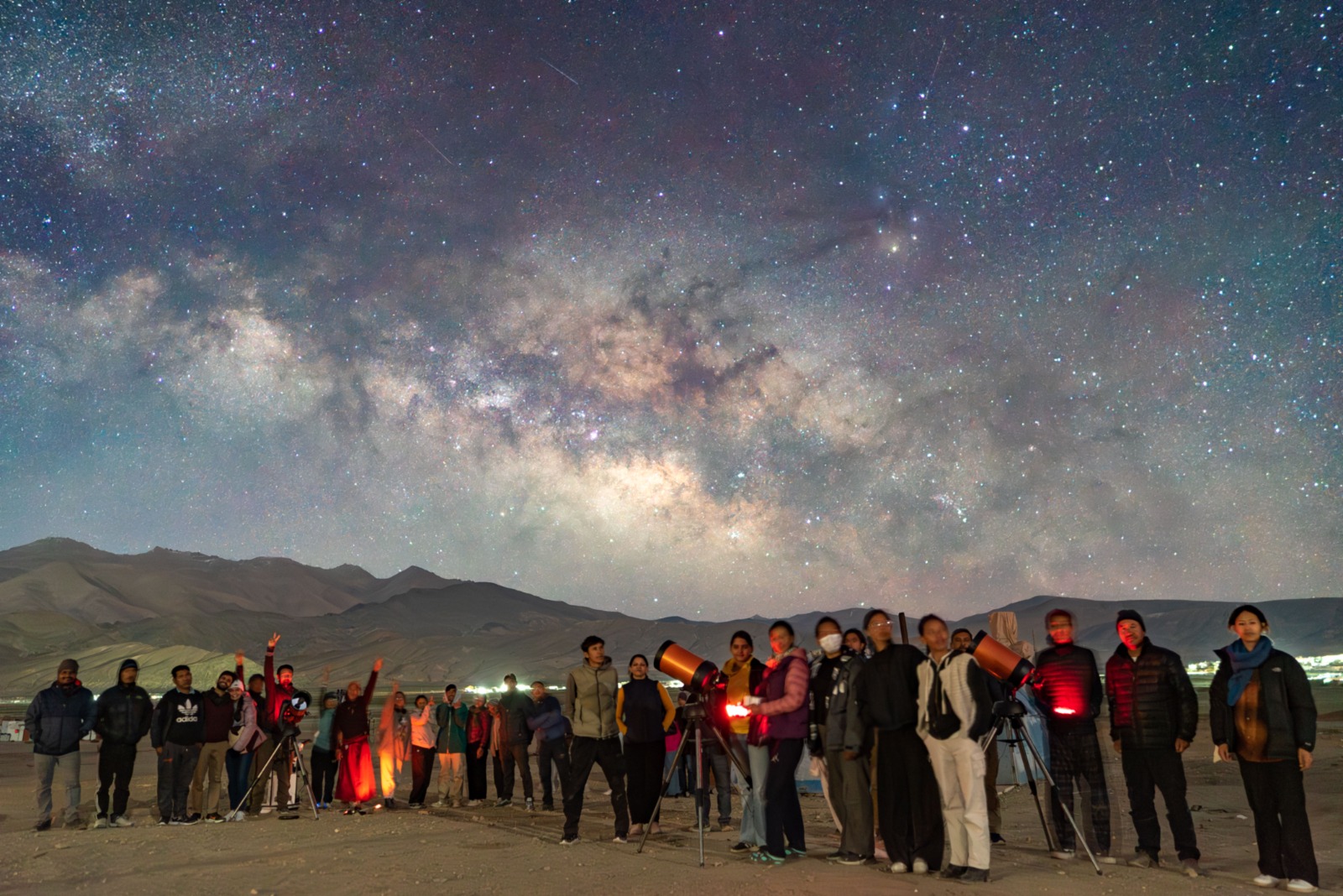
Leh: Tucked away in the cold desert of Ladakh, the Hanle Dark Sky Reserve (HDSR) is fast becoming India’s premier destination for astro-tourism, thanks to a pioneering model that blends science, sustainability, and local community participation.
Spread across 1,072 sq. km, HDSR is a unique initiative led by the Indian Institute of Astrophysics (IIA), an autonomous body under the Department of Science and Technology (DST), Government of India.
It is Asia’s first officially notified Dark Sky Reserve and a haven for both amateur and professional astronomers.
A key feature of this initiative is the training of 24 Astronomy Ambassadors—two-thirds of them women—drawn from local communities. These ambassadors now serve as guides, storytellers, and homestay hosts, offering visitors an immersive night-sky experience while promoting sustainable livelihood options in the high-altitude Changthang region.
“This model represents a unique convergence of science, tourism, and community empowerment,” officials at DST said.
To protect the region’s pristine night skies, a Light Management Plan has been implemented. It restricts artificial lighting in and around the reserve to ensure minimal light pollution—allowing a crystal-clear view of celestial wonders. From stargazing and astrophotography to public outreach and scientific education, HDSR is fast gaining global attention.
The Tso Moriri–Hanle corridor, known for its stark landscapes and high passes, is now also drawing those who come not just for the mountains but to witness the Milky Way in its full glory.
“The Hanle Dark Sky Reserve is a jewel in Ladakh’s crown—inviting travellers to experience the cosmos while staying rooted in local culture and environmental responsibility,” said officials from IIA.
As the demand for astro-tourism rises globally, Hanle offers India a shining example of how science-led tourism can preserve nature, empower communities, and open new frontiers for exploration.
