

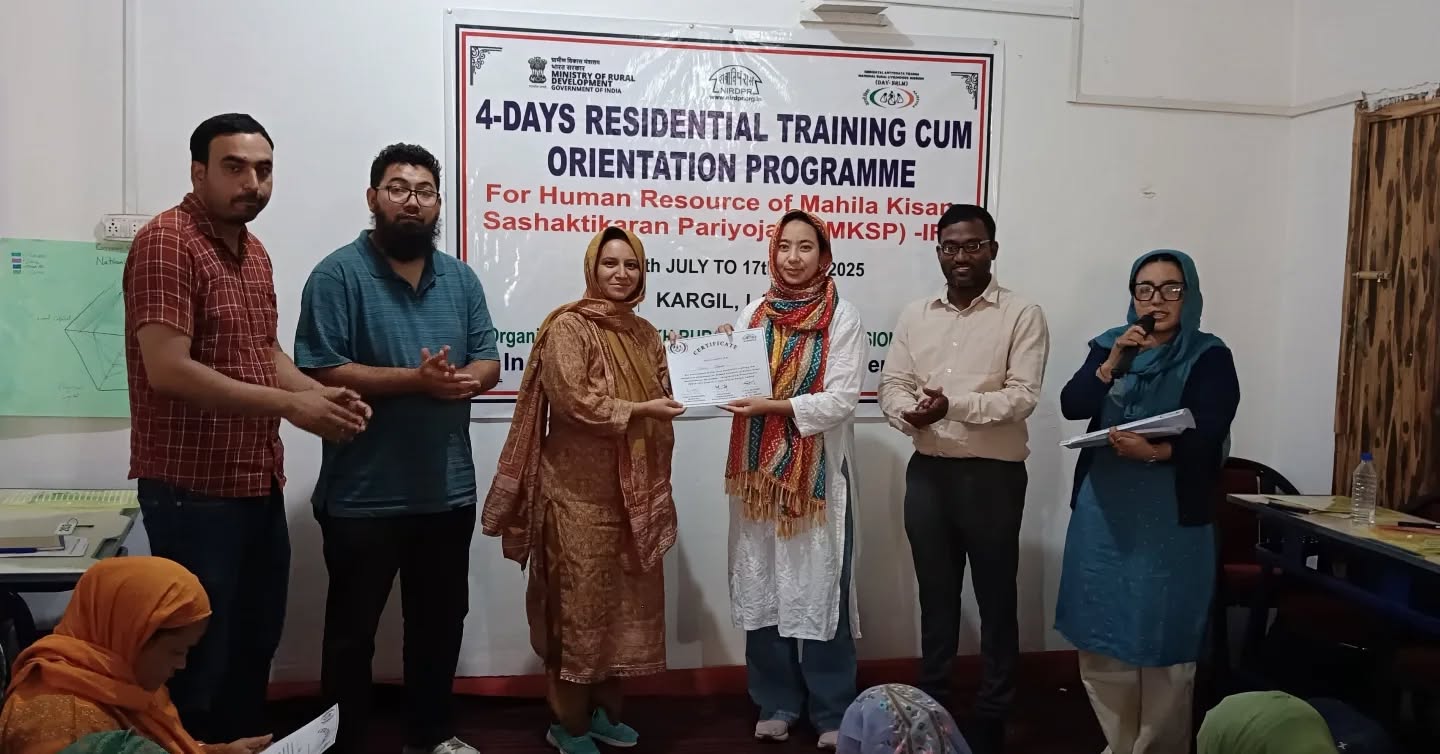
Kargil: The Union Territory of Ladakh marked a significant step in advancing women-led farm-based livelihoods with the successful completion of a four-day residential orientation-cum-training programme on the Mahila Kisan Sashaktikaran Pariyojana – Implementation Framework for Convergence (MKSP-IFC). The initiative, conducted under the Deendayal Antyodaya Yojana – National Rural Livelihoods Mission (DAY-NRLM), was held from July 14 to 17 in Kargil district.
The training brought together Human Resource teams working under MKSP, active Self Help Group (SHG) members, and key functionaries from the District, Block, and State-level Mission Management Units (DMMU, BMMU, and SMMU) from both Leh and Kargil districts. Organized with technical support from the National Mission Management Unit (NMMU), the orientation was facilitated by Baburao, a National Resource Person specializing in farm livelihoods, who brought with him a wealth of experience in rural development and sustainable agriculture.
Focused on building a foundational understanding of MKSP-IFC’s convergence strategies, the programme introduced participants to key themes such as rural livelihoods and vulnerabilities, climate-resilient adaptation strategies, and the planning frameworks for supporting smallholder women farmers. A major component of the training included exercises on commodity prioritization through the Livelihood Enterprise Ranking Matrix (LERM), as well as participatory value chain mapping of regionally significant commodities.
Participants also engaged in group work to identify potential sectoral interventions tailored to their respective villages and clusters. These included agro-ecological farming methods, livestock-based livelihood models, and the promotion of agri-nutri gardens and backyard nutrition practices aimed at improving household food security and nutrition.
The orientation emphasized interactive and participatory learning, equipping HR teams and SHG members with the skills to contextualize and implement MKSP-IFC strategies effectively in their local settings. It marked the first such training of its kind in Ladakh, reflecting the administration’s growing commitment to empowering women in agriculture and promoting sustainable, community-led development.
At its core, the MKSP-IFC framework promotes convergence — fostering better coordination between line departments, technical bodies, and grassroots institutions to ensure that women farmers are not only recognized as producers but also as entrepreneurs and decision-makers in the agricultural value chain.
The programme concluded with a reaffirmation of roles and responsibilities among the participants. A roadmap was laid out for rolling out sector-specific interventions that align with Ladakh’s unique agro-climatic conditions, with the collective goal of building resilient, women-driven farm economies in the region.
